
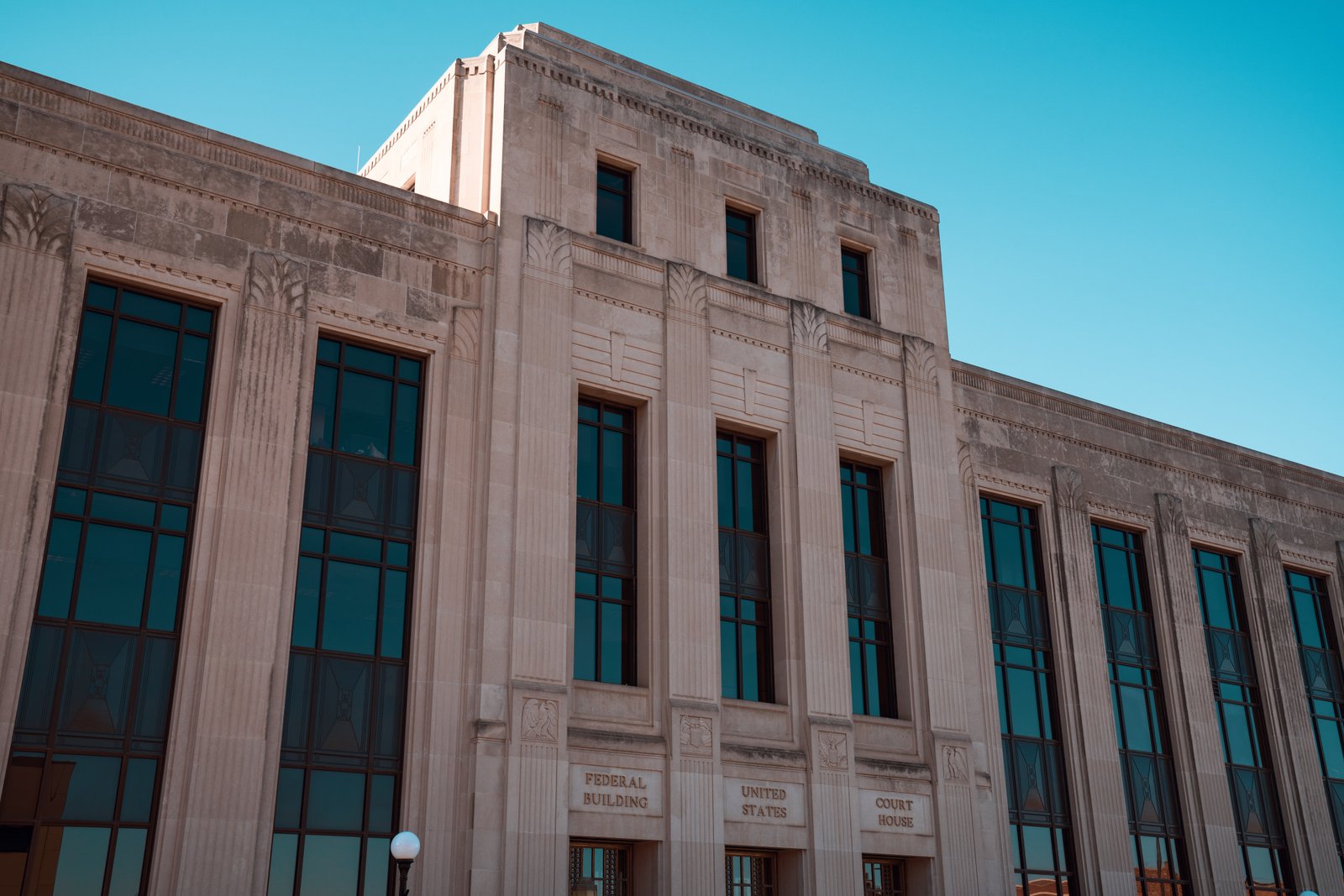
Beuttler & Arnold’s 1933 federal courthouse in Sioux City brings Art Deco and Stripped Classicism together in an E-shaped plan whose central stepped tower rises over the Missouri River valley—with a cast-bronze ziggurat newel post and sunrise-motif lobby entablature that make it one of Iowa’s most accomplished works of the New Deal building program.
At a glance
The Federal Building and United States Courthouse at 316–320 6th Street in Sioux City, Iowa was designed by the local firm of Beuttler & Arnold with oversight by Proudfoot, Rawson, Souers & Thomas, and dedicated on December 29, 1933. Listed on the National Register of Historic Places on July 17, 2013, the building combines Stripped Classicism and Art Deco in an E-shaped footprint whose central section rises as a stepped tower over the street. The exterior is clad in light gray Indiana limestone ashlar over a base of Pine Mountain granite from Iowa, and the interior deploys polished light gray marble, a cast-bronze ziggurat newel post on the main staircase, and a coffered plaster ceiling with leaf and dolphin motifs in the main courtroom. The lobby entablature carries sunrise and chevron motifs in the full vocabulary of the Art Deco style.
Key facts
- Built: 1932–1933, dedicated December 29, 1933
- Architects: Beuttler & Arnold (Sioux City); Proudfoot, Rawson, Souers & Thomas (oversight)
- Style: Art Deco / Stripped Classicism / Moderne
- Address: 316–320 6th Street, Sioux City, Iowa 51101
- NRHP: ref. 13000485, listed 17 July 2013
- Plan: E-shaped footprint; central stepped tower
- Exterior: Light gray Indiana limestone over Pine Mountain (Iowa) granite base
- Current use: United States District Court for the Northern District of Iowa
History
Sioux City’s position at the junction of the Missouri and Big Sioux rivers made it one of the most important cities in Iowa’s northwestern corner, serving as a regional commercial and transportation center for the agricultural lands of northwestern Iowa, eastern South Dakota, and southeastern Nebraska. By the early 1930s the city’s federal courts and post office operations were housed in older facilities inadequate for the region’s needs, and the construction of a new federal building became part of the New Deal era’s ambitious program of public works construction.
The Treasury Department’s Office of the Supervising Architect coordinated federal building programs across the country in the 1930s, and the Sioux City commission went to the local firm of Beuttler & Arnold, whose design blended the stripped classical vocabulary that the federal government favored for its gravitas with the Art Deco ornamental program that the era demanded of modern civic buildings. The result is a building that presents institutional authority through its limestone mass and E-shaped plan while acknowledging the decade’s visual culture through its interior ornamental program.
The building has served the Northern District of Iowa continuously since its dedication in 1933, and the NRHP listing in 2013 recognized it as a significant example of Depression-era federal architecture in Iowa.
What you see
The Federal Building’s E-shaped plan creates a facade composition with a strong central mass flanked by two projecting wings, with the central section rising as a stepped tower that gives the building its profile on the Sioux City skyline. The light gray Indiana limestone cladding and the Pine Mountain granite base are the building’s primary exterior materials, with the classical proportions of the facade overlaid by the Art Deco detailing at the entrance and window surrounds.
The interior is where the building’s Art Deco character is most fully realized. The main staircase features a cast-bronze ziggurat newel post—the ziggurat form being one of the most distinctive ornamental motifs of the Art Deco period, derived from Mesopotamian architecture via the 1925 Paris exhibition. The lobby entablature carries sunrise and chevron motifs; the main courtroom has a coffered plaster ceiling with leaf and dolphin decorations; and the lobby floor is polished light gray marble. Together these elements constitute a complete Art Deco interior environment of the highest quality within the stripped classical exterior shell.
Practical information
- Status: Active federal courthouse; exterior freely viewable from 6th Street
- Interior access: Public areas of the federal building are accessible during court business hours; visitors should check security procedures
- Photography: Exterior from public sidewalk freely permitted
- Time needed: 20–30 minutes; the 6th Street commercial area and Missouri River riverfront are both walkable
Getting there
Sioux City, Iowa is at the junction of I-29 and I-129, 90 miles north of Council Bluffs/Omaha, Nebraska. Sioux Gateway Airport (SUX) provides regional flights. The Federal Building is at 316–320 6th Street in downtown Sioux City, three blocks east of the Missouri River and adjacent to the Sioux City Convention Center. The Woodbury County Courthouse (1918, Purcell and Elmslie Prairie Style), one of America’s most significant Prairie School buildings, is 0.4 miles south at 7th and Douglas Streets.
Nearby
- Woodbury County Courthouse (1918) — 0.4 miles south at 7th and Douglas Streets; National Historic Landmark; Purcell & Elmslie Prairie School masterpiece with extensive Louis Sullivan-style ornament
- Sioux City Art Center — 0.3 miles north; regional art museum in a 1986 building by William Lescaze
- Lewis and Clark State Park — 21 miles south at Onawa; site of a documented Lewis and Clark Expedition campsite on the Missouri River
- Sergeant Floyd Monument — 2 miles south; obelisk marking the grave of Sergeant Charles Floyd, the only member of the Lewis and Clark Expedition to die during the journey; National Historic Landmark
Sources
- Wikipedia, “Federal Building and United States Courthouse (Sioux City, Iowa)” — primary narrative source
- National Register of Historic Places, ref. 13000485 (17 July 2013)
- Wikimedia Commons, Sioux City Iowa Federal Courthouse Northern District of Iowa (Public Domain)
Find it on the map
See this place and what’s around it →Record researched and written by Luigi De Marchi for Cultural Heritage Online, 2026.
📷 Become a Cultural Heritage Online photographer
Share your photos of places: they stay published under your name as the author. The more they're seen, the more you get noticed — and soon a contest will reward the most appreciated photos.
Log in or sign up free to add a photoIs this page about you?
This page is read by travellers and heritage enthusiasts who find it on Google. Tell us how you are connected to this place and we will take it from there.