
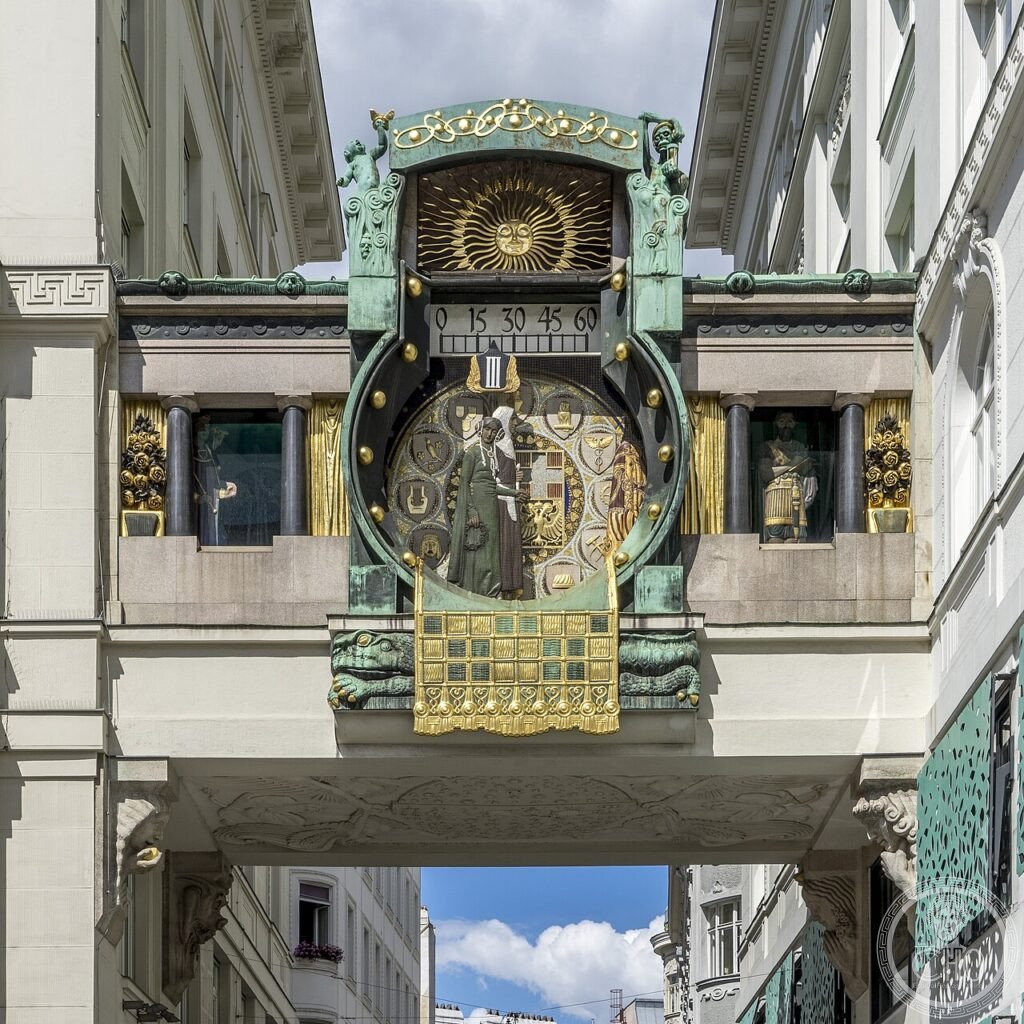

Once an hour, a figure from Vienna’s past drifts across a golden bridge above Hoher Markt; at noon all twelve parade in procession to the music of their own centuries. Insurance advertising has never aged so well.
At a glance
The Anker Clock spans the gap between two buildings of the Anker insurance company on the north side of Hoher Markt, Vienna’s oldest square. Created between 1911 and 1914 by Franz Matsch — the painter who had begun his career sharing a studio partnership with Gustav and Ernst Klimt — it is a bridge, a mosaic-encrusted work of late Jugendstil, and a slow theatre: over twelve hours, twelve figures or pairs from the city’s history cross the dial, from Roman emperor to composer, and at twelve o’clock the whole procession passes in review, each figure accompanied by music of its era.
Key facts
- Created: 1911–1914
- Designer: Franz Matsch, painter and sculptor
- Commissioned by: The Anker insurance company, bridging its two office buildings
- Mechanism: Twelve historical figures or pairs cross the clock face, one per hour; full parade daily at noon with period music
- Figures: Span Vienna’s history from Marcus Aurelius to Joseph Haydn
- Style: Late Viennese Jugendstil; mosaic and gilded copper
- Location: Hoher Markt 10–11, Vienna 1
- GPS: 48.2108, 16.3737 — View on Google Maps
History
The Anker insurance company wanted its twin buildings on Hoher Markt linked — and wanted the link to advertise permanence, protection and the passage of time, the raw materials of the insurance trade. Franz Matsch, by then a fashionable portraitist and decorator of the Ringstraße generation, answered with a clock conceived as a procession of the insured city itself: emperor, duke, empress, soldier, mayor, composer, crossing the bridge in eternal rotation. Completed as the First World War began, the clock survived the century better than the world that built it; the noon parade — twelve figures, twelve musics — remains one of Vienna’s fixed daily rituals, drawing a small crowd to Hoher Markt at five to twelve in every season.
What you see
The clock is a bridge of gilded copper and mosaic thrown between two office buildings, its parapet carved with allegorical figures and its underside coffered like a triumphal arch. The dial is the stage: each hour, one figure — silhouetted in patinated metal, picked out with gold — slides slowly across, its name displayed as it goes. The span of characters runs from Marcus Aurelius — whose death tradition places in Roman Vindobona — to Joseph Haydn, closing the parade at noon. Come at midday for the full procession with its changing music; come at any other hour for the quieter pleasure of one figure alone, mid-bridge, with the Jugendstil sunburst behind.
Practical information
- Free to view at any time from Hoher Markt; the noon parade lasts about ten minutes — arrive by 11:55
- The square can be crowded at noon in high season; the parade repeats identically every day
- Evening illumination makes the gilding glow — worth a second pass after dark
Getting there
Hoher Markt is three minutes from Stephansplatz (U1/U3): walk down Rotenturmstraße and turn left. The clock bridges the narrow Bauernmarkt exit on the square’s north side, above the passage between the two Anker buildings.
Nearby
- Zacherlhaus — Plečnik’s granite-clad office building on Brandstätte, two minutes away
- Engel-Apotheke — Laske’s golden angels on Bognergasse, five minutes west
- Roman Museum Hoher Markt — remains of Vindobona’s officers’ quarters beneath the square
- Österreichische Postsparkasse — Wagner’s banking hall, eight minutes east
Sources
- Vienna Tourist Board (wien.info), “Anker Clock” — dates, mechanism, noon parade, figure span
- visitingvienna.com — description and practical detail
- Wikidata Q557226 — coordinates and 1911 date
Find it on the map
See this place and what’s around it →Record researched and written by Luigi De Marchi for Cultural Heritage Online, 2026.
📷 Become a Cultural Heritage Online photographer
Share your photos of places: they stay published under your name as the author. The more they're seen, the more you get noticed — and soon a contest will reward the most appreciated photos.
Log in or sign up free to add a photoIs this page about you?
This page is read by travellers and heritage enthusiasts who find it on Google. Tell us how you are connected to this place and we will take it from there.