
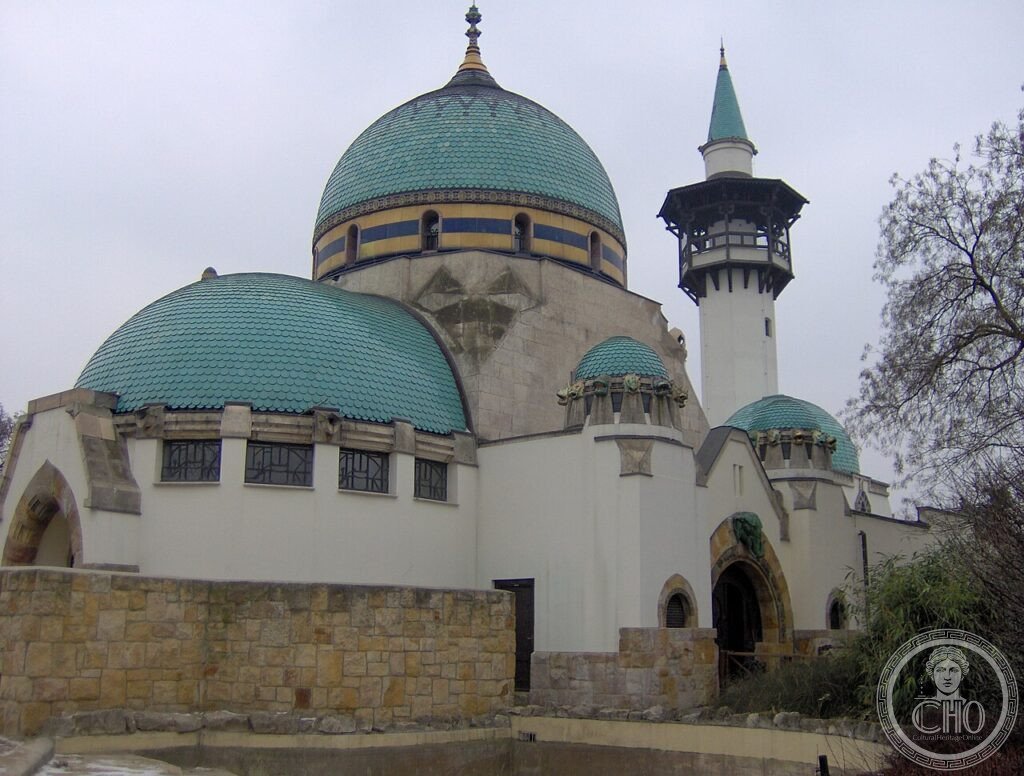

A zoo pavilion with a diplomatic incident in its past: the Elephant House’s minaret so resembled a real one that Ottoman Turkey — Hungary’s wartime ally — had it taken down in 1915. It took until the 1990s for the elephants to get their tower back.
At a glance
When Budapest Zoo was completely rebuilt between 1909 and 1912, its animal houses were entrusted to some of Hungary’s most inventive architects. The pavilion for the thick-skinned animals — originally called the Vastagbőrűek Háza, House of Pachyderms — fell to Kornél Neuschloss, who wrapped an Art Nouveau structure in motifs quoting African and Indian architecture, the homelands of its residents. Zsolnay pyrogranite ornament, eosin-glazed animal figures and stained glass made it less a stable than a small oriental palace, crowned by a 31-metre minaret-like tower.
Key facts
- Built: 1909–1912, during the zoo’s total reconstruction
- Architect: Kornél Neuschloss
- Original name: Vastagbőrűek Háza (House of Pachyderms)
- Materials: Zsolnay pyrogranite ornaments, enamel tiles, eosin-glazed animal figures, stained glass
- Tower: 31-metre minaret, demolished 1915, rebuilt in the restoration begun 1997
- Recognition: Europa Nostra European Heritage Award for the restoration
- Location: Budapest Zoo (Fővárosi Állat- és Növénykert), Városliget
- GPS: 47.5191, 19.08021 — View on Google Maps
History
The Elephant House opened with the reborn zoo in 1912 and immediately became its emblem — and, within three years, its diplomatic problem. In the middle of the First World War, the Ottoman Empire, allied to Austria-Hungary, let it be known through diplomatic channels that a tower evoking an Islamic minaret on a house for animals was undesirable. In 1915 the offending tower came down; the pavilion spent eight decades truncated, surviving war damage and decades of make-do maintenance.
Restoration began in 1997 and returned the building to its original state, tower included. The work was recognised with a Europa Nostra European Heritage Award for the sensitive and precise restoration of what the citation called a remarkable example of Hungarian Art Nouveau. Elephants still live in Neuschloss’s palace today — one of the few Art Nouveau buildings in Europe whose original residents’ descendants, so to speak, never moved out.
What you see
The building gathers domes and vaulted halls under a skin of glazed ceramics from the Zsolnay factory in Pécs: pyrogranite frames, enamel tiles in greens and blues, and — the detail visitors remember — eosin-glazed animal heads whose iridescent surfaces shift colour as you move. The rebuilt minaret-tower rises beside the main dome, giving the silhouette its oriental profile. Inside, the central hall preserves the logic of a 1912 menagerie building translated into Art Nouveau: top-lit, tiled, and surprisingly ceremonial for a house of elephants. Around it, the zoo holds further listed pavilions of the same campaign, including Károly Kós’s Transylvanian-styled bird house.
Practical information
- Inside Budapest Zoo — zoo admission required; the building is seen as part of the normal visit
- The Zsolnay ceramics photograph best in low afternoon light; the eosin glazes need an angle to show their iridescence
- Allow 2–3 hours for the zoo’s full ensemble of listed Art Nouveau pavilions
- Check current opening hours on the zoo’s official site before visiting
Getting there
The zoo sits on the edge of Városliget (City Park), between the Széchenyi Baths and Heroes’ Square. Metro line M1 — itself a piece of 1896 heritage — stops at Széchenyi fürdő, three minutes from the zoo entrance on Állatkerti körút.
Nearby
- Széchenyi Thermal Bath — across the boulevard; the great neo-baroque bathing palace of 1913
- Hungarian Geological Institute — Ödön Lechner’s blue-roofed masterpiece, 15 minutes away on Stefánia út
- Heroes’ Square and Vajdahunyad Castle — the 1896 millennium ensemble at the park’s heart
- Budapest — Ödön Lechner and the Hungarian Szecesszió — the CHO city guide
Sources
- European Heritage Awards / Europa Nostra archive — restoration and award citation
- budapestlegenda.hu — reconstruction history of the Elephant House and enclosure
- Hungarian Wikipedia: “A Fővárosi Állat- és Növénykert Elefántháza” — architect, date, original name
- Wikidata Q110086646 — coordinates
Find it on the map
See this place and what’s around it →Record researched and written by Luigi De Marchi for Cultural Heritage Online, 2026.
📷 Become a Cultural Heritage Online photographer
Share your photos of places: they stay published under your name as the author. The more they're seen, the more you get noticed — and soon a contest will reward the most appreciated photos.
Log in or sign up free to add a photoIs this page about you?
This page is read by travellers and heritage enthusiasts who find it on Google. Tell us how you are connected to this place and we will take it from there.