

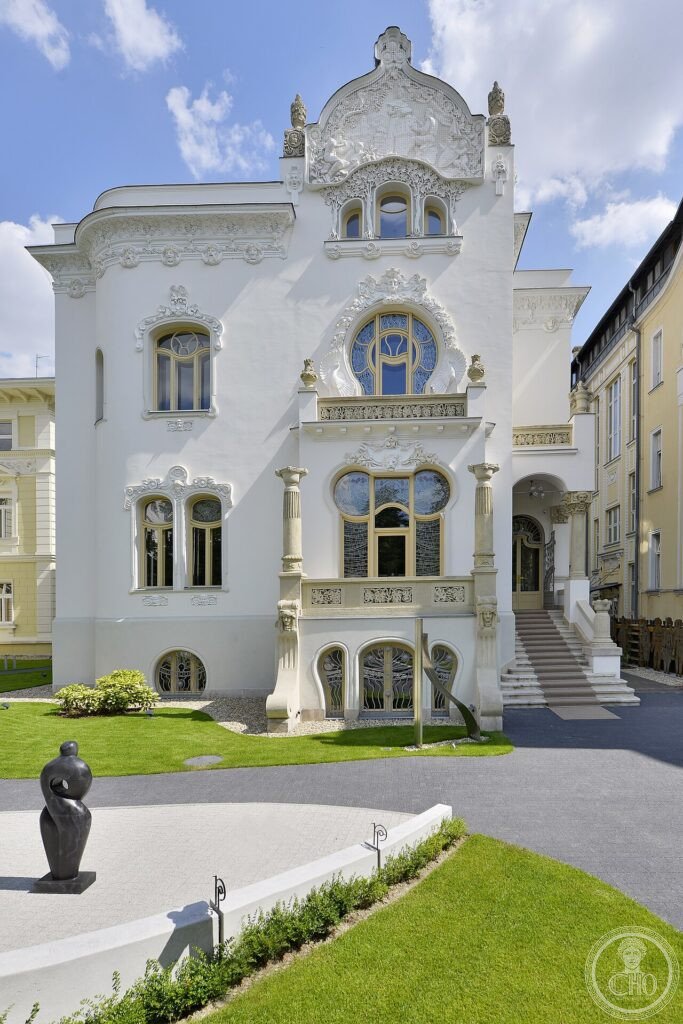

In the gable allegory of this villa, the figure of Architecture measures a scale model — and is widely read as a self-portrait. Albert Kálmán Kőrössy built the house for himself in 1899, and signed it in stucco.
At a glance
In 1899 the young architect Albert Kálmán Kőrössy bought a plot on Városligeti fasor, the chestnut-lined avenue leading to the City Park, between the properties of the photographer György Klösz and the painter Viktor Madarász. The villa he designed for his own family — he moved in with his wife in 1900 — became one of Budapest’s purest statements of French-Belgian Art Nouveau, its facade dressed in plant-form stucco closer to Brussels and Nancy than to the Hungarian national manner of Lechner. After decades of neglect it has been restored, and today it houses the ResoArt Villa, a private gallery built around the largest private Zsolnay ceramics collection in the city.
Key facts
- Designed: 1899; the architect’s family moved in by 1900
- Architect and first owner: Albert Kálmán Kőrössy
- Style: Art Nouveau of French-Belgian and early German Jugendstil inspiration
- Signature feature: Gable allegory of Painting, Sculpture and Architecture — the last read as Kőrössy’s self-portrait
- Address: Városligeti fasor 47, Budapest
- GPS: 47.51047, 19.080238 — View on Google Maps
- Today: ResoArt Villa — gallery with Budapest’s largest private Zsolnay collection; guided tours
History
Kőrössy belonged to the generation of Hungarian architects who looked west as much as inward: trained in Budapest and abroad, he absorbed the Art Nouveau of Brussels and Paris and the first Jugendstil experiments of Munich, and his own villa became his manifesto. The avenue was then the city’s most artistic address — Klösz photographed Budapest from next door, Madarász painted Hungarian history two doors down. Kőrössy went on to design apartment houses and bank headquarters across the city, but the small villa remained his most personal work. The twentieth century was unkind — decades of institutional use and neglect stripped interiors and let the stucco decay — until a restoration returned the facade’s ornament and opened the house to visitors as the ResoArt Villa, pairing the architecture with a major private collection of Zsolnay ceramics.
What you see
The villa reads as a single sustained piece of ornament: window surrounds that swell into plant forms, curved balconies, and stucco tendrils spreading across the facade with a botanical exuberance rare in Budapest, where the Secession usually spoke Lechner’s folk-inflected dialect. The gable carries the sculptural allegory of the three arts — Painting, Sculpture, Architecture — with the figure of Architecture bent over a scale model from which the villa’s own lines seem to grow; guides and historians alike read the figure as Kőrössy himself. Inside, restored rooms display the Zsolnay collection: eosin-glazed vases and architectural ceramics from the same Pécs factory that clad half the great Secession buildings of Hungary.
Practical information
- Visits are by guided tour through ResoArt Villa — check resoart.hu for current schedules and booking
- The facade and gable allegory are visible from the avenue at any time
- Combine with a walk along Városligeti fasor’s villa row toward the City Park
Getting there
Városligeti fasor 47 stands near the City Park end of the avenue. Trolleybuses along the fasor and the M1 metro at Hősök tere are both within a few minutes on foot; from the inner city, the avenue begins at Lövölde tér, a short ride up Király utca.
Nearby
- Hungarian Geological Institute — Lechner’s blue-tiled masterpiece, ten minutes away
- Elephant House, Budapest Zoo — Neuschloss’s Zsolnay-clad pavilion in the City Park
- Liszt Academy of Music — the 1907 Secession concert palace, 15 minutes toward the centre
- Budapest — Ödön Lechner and the Hungarian Szecesszió — the CHO city guide
Sources
- Museum of Applied Arts collection database (gyujtemeny.imm.hu), “Kőrössy-villa, Városligeti fasor 47” — architect, date, style classification
- resoart.hu — villa history, restoration, current use and collection
- We Love Budapest — neighbouring plots (Klösz, Madarász), gable allegory reading
- Wikidata Q117842652 — coordinates
Find it on the map
See this place and what’s around it →Record researched and written by Luigi De Marchi for Cultural Heritage Online, 2026.
📷 Become a Cultural Heritage Online photographer
Share your photos of places: they stay published under your name as the author. The more they're seen, the more you get noticed — and soon a contest will reward the most appreciated photos.
Log in or sign up free to add a photoIs this page about you?
This page is read by travellers and heritage enthusiasts who find it on Google. Tell us how you are connected to this place and we will take it from there.