
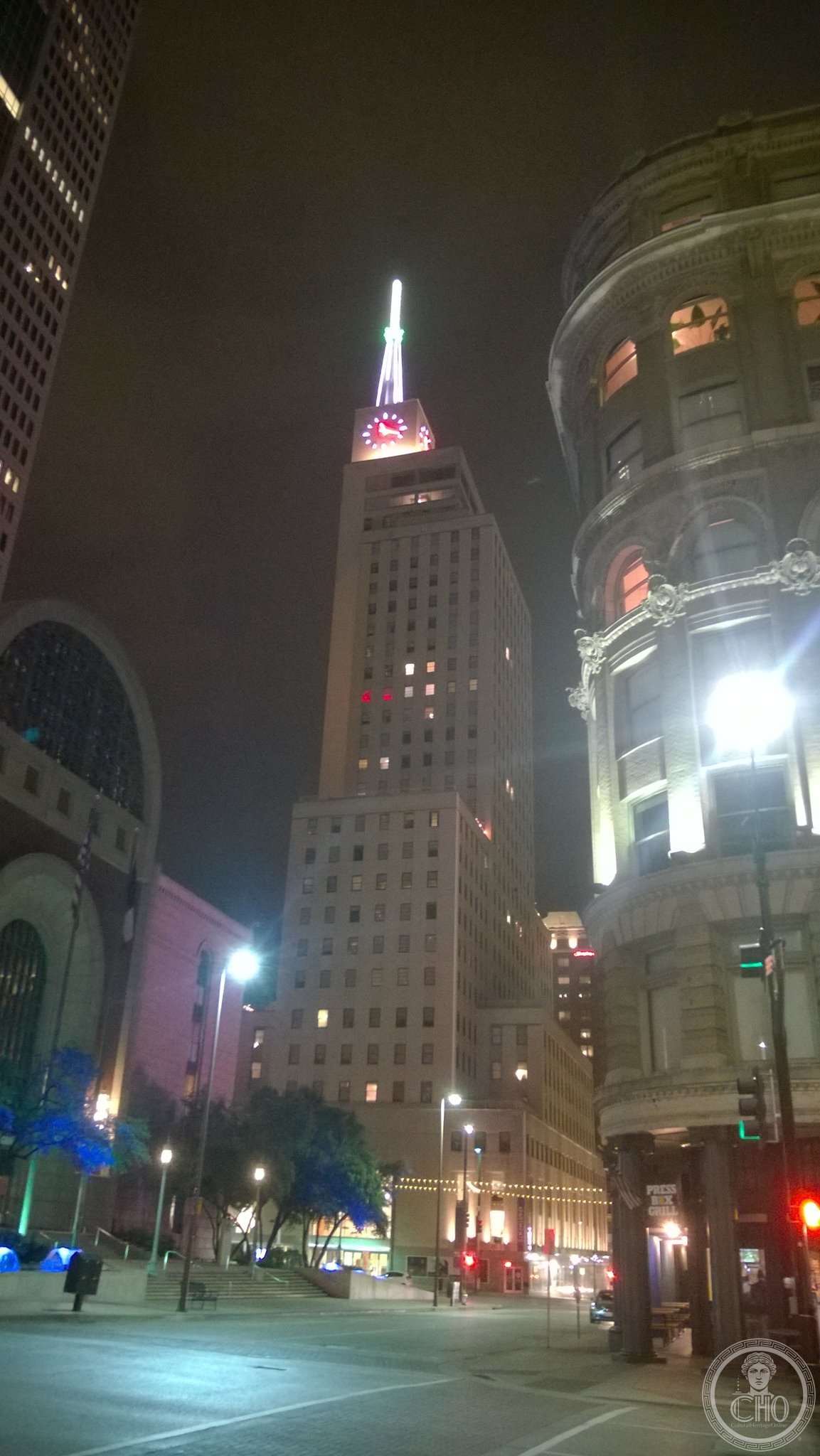
The only major American skyscraper built during World War II — the tallest west of the Mississippi when it opened, with the world’s largest Art Deco wood murals in its lobby.
At a glance
When the Mercantile National Bank Building opened in 1943, it was the only major skyscraper completed in the United States during World War II — built through a federal waiver because most of its steel had been prefabricated before the wartime construction freeze. Architect Walter W. Ahlschlager’s Moderne Art Deco tower soared to 545 feet with its ornamental clock tower, making it the tallest building west of the Mississippi River on completion. The bank lobby held the world’s largest Art Deco wood murals. Vacant since 1993 and converted to 225 luxury apartments in 2009, the Merc remains one of Dallas’s most recognizable Art Deco landmarks and a Dallas designated historic landmark.
Key facts
- Built: 1943 (only major US skyscraper built during WWII)
- Architect: Walter W. Ahlschlager; Donald Nelson
- Style: Moderne Art Deco
- Height: 545 ft (166 m) with clock tower, 31 floors
- Address: 1800 Main Street, Dallas, Texas
- NRHP: August 11, 2006 (Dallas Downtown Historic District)
- Dallas Landmark: December 13, 2006 (H/129)
- Currently: Mercantile Place, luxury apartments
History
Robert L. Thornton, founder of Mercantile National Bank, commissioned the tower as Dallas’s commercial ambitions were accelerating in the late 1930s. When construction was underway, the United States entered World War II and the government called for a halt to private construction to redirect materials for the war effort. The Mercantile received a special waiver: most of the tower’s structural steel had been prefabricated before the freeze. Federal agencies occupied ten floors for war-related offices. Thornton built his own penthouse in the upper levels.
When it opened in 1943, the Mercantile was the tallest building west of the Mississippi River and Dallas’s dominant landmark. The bank lobby held the world’s largest Art Deco wood murals. In 1947 an illuminated tower was added for KERA radio broadcasts; this was replaced in 1958 by the four-sided ornamental clock and weather spire that still crown the building. In the 1960s, the original stone facade at the base was covered by a modernist curtain wall — a common mid-century update that obscured the original Art Deco exterior for forty years. The Merc became the centerpiece of a four-building complex that eventually spanned a full city block, constructed between 1943 and 1972.
MCorp Bank (successor to Mercantile National) was dissolved by Bank One in 1989; the entire complex went vacant on February 5, 1993. Forest City Enterprises reached a $60.5 million deal with the City of Dallas in 2005 for residential conversion. The three post-war additions were demolished; the main tower was converted to 225 apartments (Mercantile Place, opening April 2009). The 1960s curtain wall was removed during renovation, revealing the original Art Deco exterior and restoring the building’s historic appearance.
What you see
From Main Street, the Mercantile’s setback profile climbs in the Moderne vocabulary of the early 1940s: horizontal banding, restrained geometric ornament, and a series of stepbacks that culminate in the four-sided ornamental clock and weather spire. The clock dates from 1958 but fits the tower’s idiom closely. The building carries balconies added to the east facade during the residential conversion — a visible modification — but the overall silhouette, now with the curtain wall removed, reads clearly as a 1943 Art Deco tower set against the Dallas skyline.
The bank lobby’s Art Deco wood murals were, at the time of opening, the largest in the world — carved panels that transformed the commercial ground floor into a total Art Deco interior environment. The extent of their survival through decades of renovation is not fully documented for public visitors, as the ground floor has been adapted for residential use. The building’s exterior, however, is now fully restored and open to view from Main Street and the adjacent Main Street Garden Park.
Practical information
- Residential apartments; lobby and ground-floor retail accessible during business hours
- No public access to upper floors
- Exterior best viewed from Main Street and Main Street Garden Park (across St. Paul Street)
- The ornamental clock tower is illuminated at night, visible from multiple blocks
- Allow 20–30 minutes to walk the exterior and adjacent park
Getting there
1800 Main Street is in the Main Street District of downtown Dallas, one block east of Dallas City Hall Plaza and adjacent to Main Street Garden Park. DART light rail at St. Paul Station (Green and Orange lines) is one block away. By car, downtown Dallas exits from I-30 or I-35E connect to Main Street; parking garages on Commerce and adjacent streets. Dallas/Fort Worth International Airport is 17 miles northwest. GPS: 32.78084°N, 96.79681°W.
Nearby
- Wilson Building (1904) — neighboring Main Street landmark, now also residential lofts, immediately adjacent to the Mercantile block
- Main Street Garden Park — outdoor public park across St. Paul Street, the best vantage point for viewing the Merc’s facade
- Old Red Museum — 1892 Romanesque county courthouse turned cultural museum, five minutes on foot west on Main Street
Sources
- Wikipedia: Mercantile National Bank Building
- Dallas Public Library, Texas/Photo Gallery: Downtown Living, Mercantile documentation
- National Register of Historic Places: Dallas Downtown Historic District, ref. 04000894
- City of Dallas Landmark Ordinance No. 26522 (December 13, 2006)
Find it on the map
See this place and what’s around it →📷 Become a Cultural Heritage Online photographer
Share your photos of places: they stay published under your name as the author. The more they're seen, the more you get noticed — and soon a contest will reward the most appreciated photos.
Log in or sign up free to add a photoDo you manage this place?
This page is read by travellers and heritage enthusiasts who find it on Google. Keep it accurate — and make it work for you. Free for non-profit heritage institutions.