
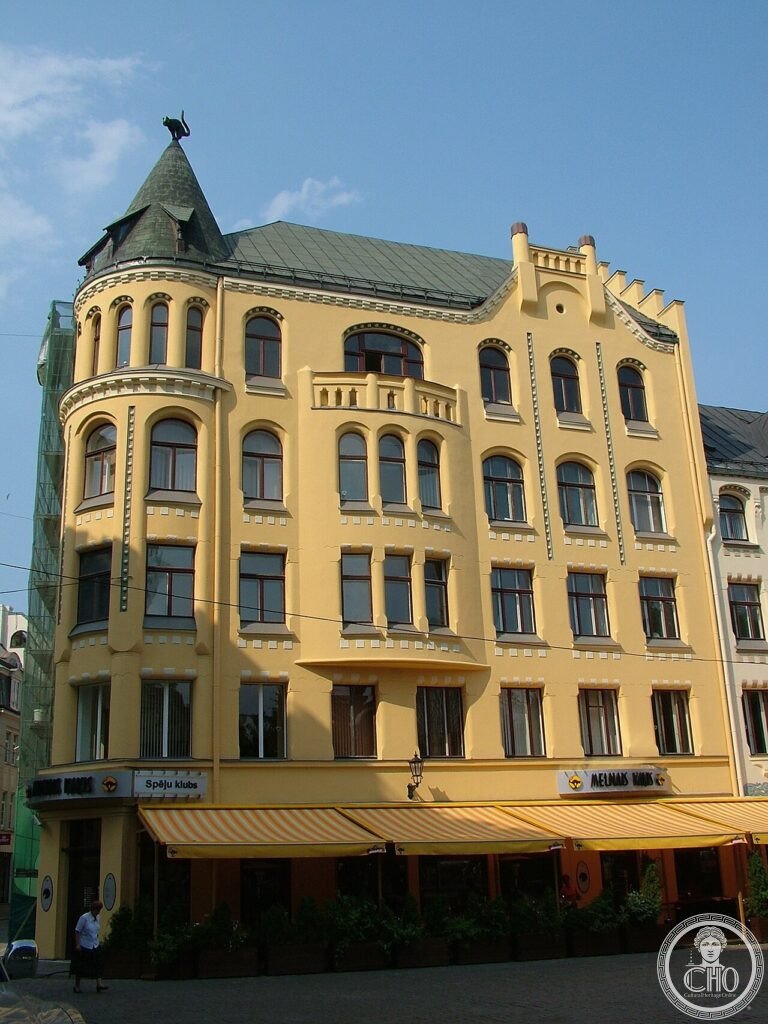

A yellow corner building in Riga’s Old Town would be easy to walk past — if it weren’t for the two copper cats arching their backs on its rooftop turrets, protagonists of the city’s most-told architectural legend.
At a glance
The Cat House stands at Meistaru iela 10, in the heart of Vecrīga, Riga’s medieval Old Town. It was built in 1909 to a design by architect Friedrich Scheffel, at the tail end of the city’s extraordinary building boom. Stylistically it looks both ways: the stepped silhouette, corner turrets and robust massing quote medieval architecture, while the detailing carries elements of the Art Nouveau that was reshaping the rest of the city. What made it famous, though, is smaller than any of that — two black copper cats, backs arched and tails raised, perched on the conical turret roofs.
Key facts
- Built: 1909
- Architect: Friedrich Scheffel
- Style: Medieval-inspired forms with Art Nouveau elements
- Signature feature: Two copper cat sculptures with arched backs on the corner turrets
- Address: Meistaru iela 10, Riga Old Town
- GPS: 56.95019, 24.10843 — View on Google Maps
- Setting: Within the UNESCO-listed Historic Centre of Riga, facing the Great Guild
History and the legend of the cats
The building was commissioned by a wealthy tradesman during the last years of Riga’s pre-war construction fever, when the city was among the fastest-growing in the Russian Empire. The legend that every Rigan knows — and every guide retells — exists in at least two versions. In the better-known one, the owner was refused membership of the Great Guild, the powerful merchants’ association whose hall stands just across the street. Seeking revenge, he had the two angry copper cats mounted on his turrets with their raised tails pointed squarely at the Guild hall. In the older version, the dispute was with the Riga City Council, and the tails aimed at the Town Hall — which stood in the same direction until it burned in the Second World War.
Either way, the story ends the same: the offended institution took the matter seriously enough that the owner was eventually ordered to turn the cats around to face the Guild politely. The tale is impossible to document in full — which has never stopped it from becoming the building’s identity. The cats themselves are genuine period work, and the house has carried the name Kaķu nams for over a century.
What you see
The Cat House is a corner building whose two street facades meet at a rounded angle crowned by the taller of its turrets. The composition — steep roofs, turrets with conical caps, and a gabled attic — deliberately echoes the medieval merchant houses of the surrounding Old Town, a historicist gesture unusual for its date. Look closer, however, and the window surrounds, the curving ornament and the ironwork betray the hand of an architect working in the Art Nouveau years. The facade’s warm yellow render makes the black silhouettes of the two cats stand out sharply against the sky; bring binoculars or a zoom lens to catch their arched backs and bared expressions.
Practical information
- The building is privately occupied; it is viewed from the street
- The cats are best seen from Livu Square (Līvu laukums) side, with the light behind you in the morning
- Viewing takes 10–15 minutes; combine with the Great Guild and Small Guild across the street
- Free to view at any time
Getting there
Meistaru iela 10 is in the pedestrian heart of the Old Town, two minutes on foot from Livu Square and about five minutes from Town Hall Square. From the Freedom Monument, walk into the Old Town along Kaļķu iela and turn right on Meistaru iela; the cats appear above you almost immediately. All Old Town sights are within easy walking distance.
Nearby
- Great Guild — directly across the street; the merchants’ guild hall at the centre of the cat legend, rebuilt in 1854–59 and today the concert hall of the Latvian National Symphony Orchestra (closed for renovation until late 2026)
- Historic Centre of Riga — the UNESCO World Heritage property that encompasses the Old Town and the Art Nouveau district
- Alberta iela — 20 minutes on foot north; the most concentrated Art Nouveau street in Europe
- House of the Blackheads — 6 minutes south on Town Hall Square; the reconstructed guild house of the Brotherhood of Blackheads
Sources
- Wikipedia: “Cat House, Riga” — construction date, architect, and the two versions of the cat legend
- Wikidata Q2533242 — coordinates and architect attribution (Friedrich Scheffel)
- Riga tourism materials on Old Town landmarks (Live Rīga)
Find it on the map
See this place and what’s around it →Record researched and written by Luigi De Marchi for Cultural Heritage Online, 2026.
📷 Become a Cultural Heritage Online photographer
Share your photos of places: they stay published under your name as the author. The more they're seen, the more you get noticed — and soon a contest will reward the most appreciated photos.
Log in or sign up free to add a photoIs this page about you?
This page is read by travellers and heritage enthusiasts who find it on Google. Tell us how you are connected to this place and we will take it from there.