

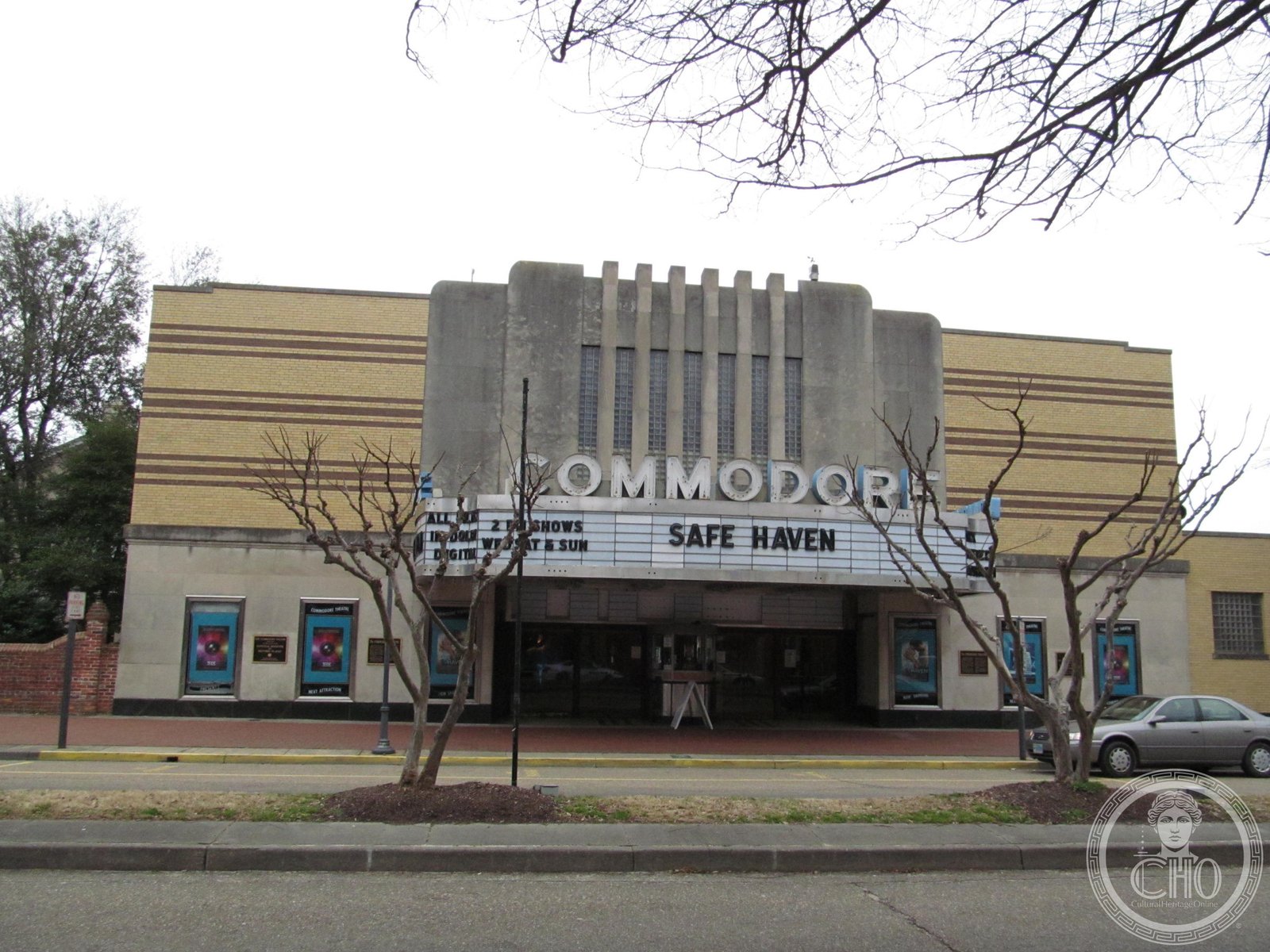
A late Streamline Moderne jewel named for a naval hero, the Commodore Theatre opened in 1945 as Portsmouth’s grandest picture house and reinvented itself as a dinner theater without losing a square inch of its original shell.
At a glance
Completed in 1945 when most American construction was still frozen by wartime rationing, the Commodore Theatre at 421 High Street in downtown Portsmouth stands as a near-perfect specimen of Streamline Moderne Art Deco. Its architect, John J. Zink, delivered a two-story composition of yellow pressed brick, Indiana limestone, and decorative glass block that is both restrained and unmistakably modern. The theatre was added to the National Register of Historic Places in 1997 and remains in continuous operation as a first-run cinema with full table service, a distinction that makes it one of the rarest active movie theaters in the American South.
Key facts
- Completed: 1945; built by William Stanley Wilder
- Architect: John J. Zink
- Style: Streamline Moderne / Art Deco
- Original capacity: 1,000 seats; converted to dinner theater 1989
- Address: 421 High St., Portsmouth, VA 23704
- NRHP: February 27, 1997 (ref. 97000203); Virginia Landmarks Register: December 4, 1996
- GPS: 36.83472°N, 76.30222°W
History
The Commodore was conceived and built by William Stanley Wilder, a Portsmouth native who had operated theaters in Virginia’s Tidewater region since the 1920s. He named it in honor of Commodore James Barron, the officer aboard the frigate USS Chesapeake during the 1807 Chesapeake–Leopard affair with Britain. Barron is buried in a churchyard immediately adjacent to the theater, his memory sealed into the building’s identity from the first brick.
The construction of the Commodore in 1945 was itself a minor wartime achievement. With standard building materials strictly rationed under federal controls, local rumor held that the supplies were allocated because of the morale value the theater would provide to the large military population stationed in Portsmouth during and immediately after the war. Whether or not that story is wholly accurate, the building was completed and opened to audiences who might otherwise have had no access to first-run films.
The theatre operated as a conventional cinema for three decades before declining attendance led to its closure in 1975. After sitting empty for over a decade, it was purchased and renovated beginning in 1987. When it reopened two years later, it had been transformed into a dinner theater: the main floor seating was removed in favor of table-service dining, while the original balcony retained traditional auditorium rows. The marquee, ticket booth, and most interior fixtures were kept intact, preserving the visual language Zink had established in 1945.
What you see
The Commodore’s facade is a study in Streamline restraint. The upper facade is a plain field of yellow pressed brick interrupted only by horizontal stripes of brown brick and a central pavilion of curved-top vertical pylons in Indiana limestone, with narrow bands of decorative glass block between them. The lower level shifts to Indiana limestone ashlar veneer above a base of polished black marble—a material shift that anchors the composition at street level and catches the afternoon light in a deep, almost liquid way. There is no historical ornament: no pilasters, no cornices, no cartouches. Everything decorative is geometric or tonal.
Inside the auditorium, two large restored murals occupy the side walls: one representing the progress of America, the other the commerce and industry of the Hampton Roads region. The murals are the most figurative element in an otherwise abstract interior, and their subjects—transportation, trade, shipbuilding—ground the theater in the industrial and naval economy of the Portsmouth waterfront.
Practical information
- Current use: First-run cinema with full dinner service; Dolby Digital and THX sound
- Seating: Main floor: dinner-theater style; balcony: traditional auditorium seating
- Reservations: Advised for weekend performances; booking available via the theater’s website
- Dress: Smart casual; the dinner service is a genuine sit-down experience
- Duration: Allow 2–3 hours including dining
Getting there
The Commodore Theatre is located at 421 High Street in the heart of downtown Portsmouth, Virginia, part of the Downtown Portsmouth Historic District. Portsmouth is directly across the Elizabeth River from Norfolk; the two cities are connected by the free Passenger Ferry or by road via the Downtown Tunnel (I-264). Norfolk International Airport is approximately 10 miles east. Street parking is available along High Street and in nearby municipal lots.
Nearby
- Portsmouth Naval Shipyard Museum — one block north; the nation’s oldest naval shipyard history told through artifacts and models
- Olde Towne Portsmouth Historic District — blocks of 18th- and 19th-century residential architecture walking distance from the theater
- Norfolk waterfront — a short ferry ride across the Elizabeth River
Sources
- Viles, Mary Ruffin / Calder Loth, National Register of Historic Places Inventory–Nomination: Commodore Theatre, Virginia Department of Historic Resources, October 1996
- National Register of Historic Places listing #97000203, February 27, 1997
- Virginia Landmarks Register listing #124-0101, December 4, 1996
- Downtown Portsmouth Historic District, NRHP nomination, Virginia DHR, June 2002
Find it on the map
See this place and what’s around it →Record researched and written by Luigi De Marchi for Cultural Heritage Online, 2026.
📷 Become a Cultural Heritage Online photographer
Share your photos of places: they stay published under your name as the author. The more they're seen, the more you get noticed — and soon a contest will reward the most appreciated photos.
Log in or sign up free to add a photoIs this page about you?
This page is read by travellers and heritage enthusiasts who find it on Google. Tell us how you are connected to this place and we will take it from there.