

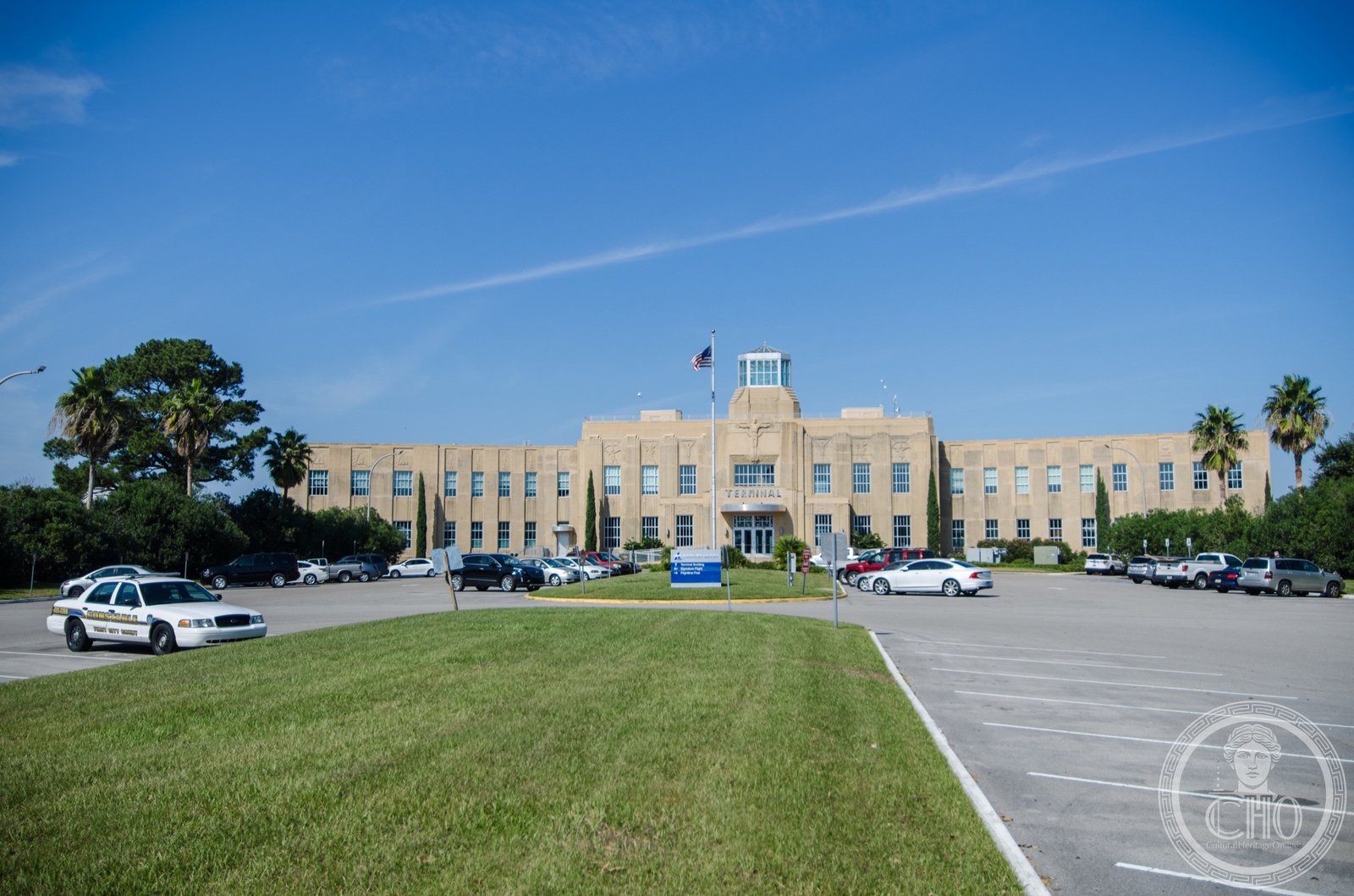
Originally “Shushan Airport,” this jewel of 1930s Art Deco opened in February 1934 on a man-made peninsula dredged into Lake Pontchartrain—its restored terminal, extravagant for its era, has since stood in for a fictional aircraft company in the Green Lantern film and survived two hurricanes.
At a glance
New Orleans Lakefront Airport (IATA: NEW) sits five miles northeast of downtown New Orleans on a man-made peninsula jutting into Lake Pontchartrain. Built between 1929 and 1934 by order of Governor Huey Long, its terminal was designed by the firm Weiss, Dreyfous, and Seiferth—the same architects responsible for the Louisiana State Capitol. The building opened on February 10, 1934, originally named Shushan Airport after the Levee Board president. Its Art Deco exterior—obscured for decades by a concrete “bomb-proof” casing installed during the Cold War—was fully restored after Hurricane Katrina, returning the terminal to its original appearance. The Enrique Alferez sculpture “Fountain of the Four Winds” stands at the entrance as a local landmark.
Key facts
- Opened: February 10, 1934 (construction began 1929)
- Original name: Shushan Airport; renamed New Orleans Airport 1939; renamed Lakefront Airport later
- Architect: Leon C. Weiss / Weiss, Dreyfous, and Seiferth
- Style: Art Deco
- Location: Orleans Parish, five miles NE of downtown New Orleans
- GPS: 30.04250°N, 90.02833°W
- Owner: Orleans Levee District; operated by Lakefront Management Authority
History
Airport construction began in 1929 when Governor Huey Long ordered the Orleans Levee Board to dredge a new peninsula into Lake Pontchartrain. The site was named for Abraham Shushan, the Levee Board president and Long ally whose initials and name were reportedly stamped on every doorknob, windowsill, countertop, and plumbing fixture in the building. Leon C. Weiss and his firm Weiss, Dreyfous, and Seiferth—celebrated for the Louisiana State Capitol—designed a lavish terminal that set a standard for American airport architecture in the 1930s. The airport opened to considerable fanfare on February 10, 1934, serving as the region’s primary commercial aviation gateway.
Shushan’s reputation collapsed in the Louisiana Scandals of the late 1930s, and the airport was discreetly renamed New Orleans Airport in 1939. During World War II the U.S. Army Air Forces used the airfield, housing the Tropical Weather School in 1945. With the arrival of larger aircraft, airline service shifted in summer 1946 to the new Moisant International Airport (now Louis Armstrong New Orleans International Airport) in Kenner. At the start of the 1960s, thick concrete panels were bolted over the Art Deco facade, converting the terminal into a Cold War–era bomb shelter. The name “Lakefront Airport” came later, as the facility transitioned to general aviation and charter use.
Hurricane Katrina struck in 2005, damaging the terminal and destroying several outlying hangars. Restoration proceeded slowly in the aftermath, but the project ultimately returned the exterior to its original Art Deco appearance. The restored terminal gained additional fame when it served as the headquarters of fictional Ferris Aircraft in the 2011 action film Green Lantern starring Ryan Reynolds and Blake Lively. It has since appeared in numerous other productions including Live and Let Die (1973), Reminiscence (2021), and Daisy Jones & The Six (2023).
What you see
The terminal building expresses the aerodynamic optimism that characterized American Art Deco in its airport guise. Smooth rendered surfaces, horizontal banding, and streamlined massing communicate speed and modernity—qualities that resonated with a public newly captivated by commercial flight. The original interior retains much of its 1930s decoration: terrazzo floors, decorative metalwork, and the proportions of a public hall designed to impress. The Walnut Room restaurant continues to operate inside the terminal, drawing nearby residents as much for the setting as for the food.
In front of the building, Enrique Alferez’s “Fountain of the Four Winds” remains one of New Orleans’s most distinctive pieces of public sculpture. Alferez (1901–1999), a Mexican-born artist who worked extensively in Louisiana, produced the work as part of the original terminal commission—making it among the city’s earliest examples of integrated Art Deco public art. The combination of restored architecture and surviving sculpture creates one of the most complete ensembles of 1930s civic design in the American South.
Practical information
- Active airport: The facility remains a functioning general aviation airport; vehicle access requires awareness of airport operations
- Walnut Room restaurant: Open to the public inside the terminal; check current hours before visiting
- WWII Air, Sea & Land Festival: Annual three-day airshow hosted each year since 2014 (National WWII Museum partnership)
- Best approach: Drive along the lakefront from downtown via Robert E. Lee Boulevard; the building’s restored facade is visible from the approach road
Getting there
The airport is located at 6001 Stars and Stripes Blvd., New Orleans, approximately five miles northeast of the French Quarter. From downtown, take Elysian Fields Avenue northeast toward the lakefront, then follow Lakeshore Drive east; the terminal is clearly visible from the waterfront road. Louis Armstrong New Orleans International Airport (MSY), the commercial hub, is about 18 miles west in Kenner. Public transit is limited in this area; a car or rideshare is the most practical option for visitors.
Nearby
- Lake Pontchartrain Causeway — the world’s longest bridge over water begins at the lakefront, about two miles west of the airport
- New Orleans Museum of Art — located in City Park, 10–15 minutes southwest; significant collection of Louisiana art and decorative objects
- National WWII Museum — downtown New Orleans, 20-minute drive; one of the country’s most visited history museums
Sources
- Wikipedia: “Lakefront Airport” — https://en.wikipedia.org/wiki/Lakefront_Airport
- Lakefront Airport official site: lakefrontairport.com
- Federal Aviation Administration airport data: FAA ID NEW, site 07676.*A
- National Register of Historic Places — Art Deco architecture in Louisiana category
Find it on the map
See this place and what’s around it →Record researched and written by Luigi De Marchi for Cultural Heritage Online, 2026.
📷 Become a Cultural Heritage Online photographer
Share your photos of places: they stay published under your name as the author. The more they're seen, the more you get noticed — and soon a contest will reward the most appreciated photos.
Log in or sign up free to add a photoIs this page about you?
This page is read by travellers and heritage enthusiasts who find it on Google. Tell us how you are connected to this place and we will take it from there.