
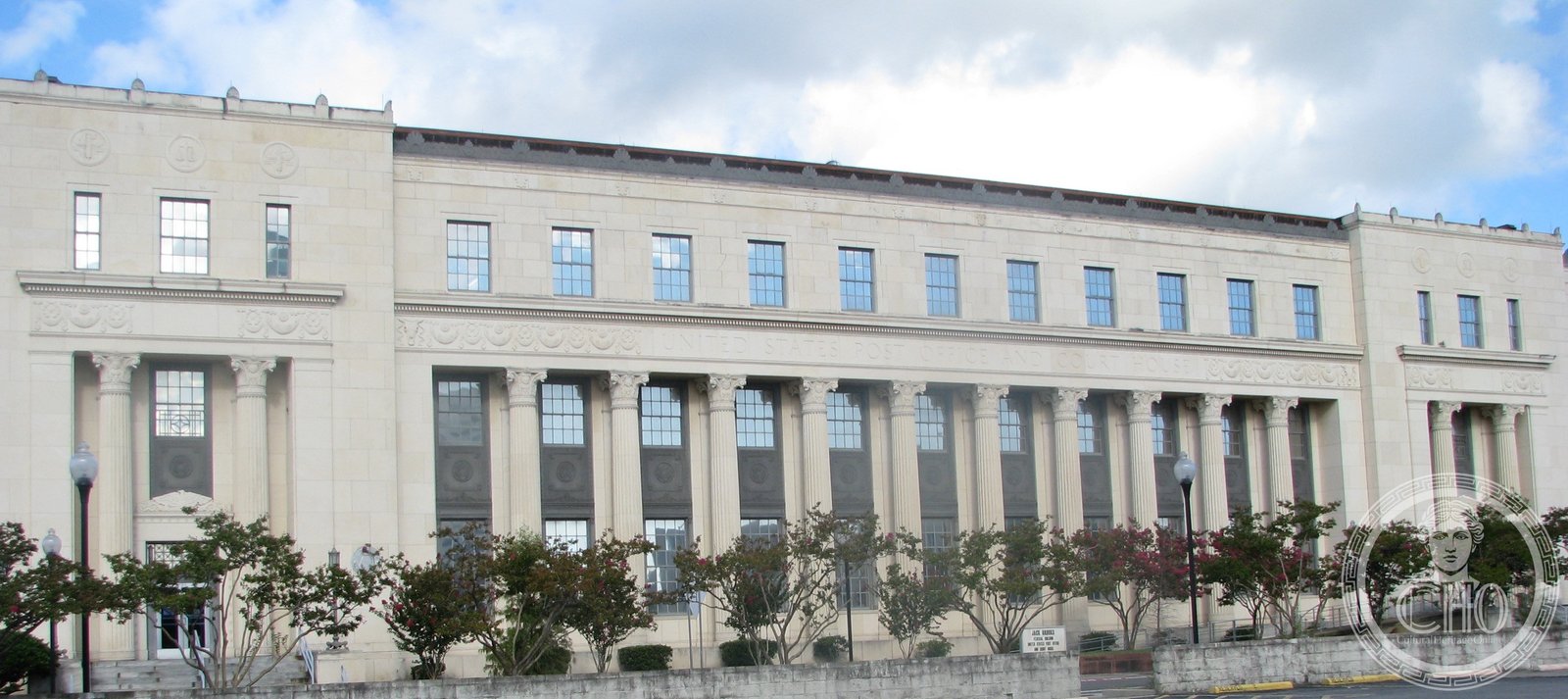
Jack Brooks Federal Building
A federal courthouse and post office built during the Great Depression, where Classical Revival columns meet Art Deco restraint along the streets of downtown Beaumont.
At a glance
Completed in 1933, the Jack Brooks Federal Building stands at 300 Willow Street in downtown Beaumont, Texas. Designed by architects Fred Stone and F.W. & Douglas E. Steinman, the building served the region simultaneously as the United States Post Office and the federal courthouse for the Eastern District of Texas. Listed on the National Register of Historic Places in 1978, it is recognized as a contributing property to the Beaumont Commercial District — a concentrated block of significant early twentieth-century civic and commercial architecture in southeast Texas.
Key facts
- Completed: 1933
- Architects: Fred Stone; F.W. & Douglas E. Steinman
- Style: Art Deco with Classical Revival (Neoclassical) elements
- Address: 300 Willow St., Beaumont, Jefferson County, Texas
- NRHP designation: April 14, 1978 (ref. 78002959), contributing to Beaumont Commercial District
- Current tenants: U.S. District Court for the Eastern District of Texas; U.S. Postal Service
- Named for: U.S. Representative Jack Brooks, Texas (served the Beaumont area for decades)
History
The building was completed in 1933, at the height of the Great Depression, under federal public works programs that channeled investment into civic infrastructure across the country. Beaumont was then an active regional center in southeast Texas, shaped by the Spindletop oil boom of the early twentieth century and a growing industrial base along the Neches River.
The structure served for decades as both the principal post office and the federal courthouse for the Eastern District of Texas. In 1978, President Jimmy Carter traveled to Beaumont to preside over the renaming ceremony: the building was dedicated to Jack Brooks, longtime U.S. Representative who had served the Beaumont area and worked to bring federal resources to southeast Texas throughout his congressional career.
What you see
The façade integrates Corinthian columns — the most elaborate of the classical orders — with the streamlined ornamental vocabulary typical of early 1930s American federal architecture. This blend of Classical Revival solidity and Art Deco restraint was deliberately chosen by the federal government: post offices and courthouses of this period were designed to project permanence and institutional authority while acknowledging contemporary modernist currents. The result is a building that reads monumental from the street, its columns framing an entrance scaled to civic ceremony.
The building occupies a two-acre site within the Beaumont Commercial District. Its horizontal massing, symmetrical entrance bay, and carved stone details place it firmly within the tradition of PWA-era federal buildings that reshaped American downtowns during the New Deal years.
Practical information
- Access: Active federal facility; public post office lobby open during business hours
- Courthouse areas: Restricted to court business; security screening at entry points
- Photography: Exterior photography freely permitted from public sidewalks
- Best time to visit: Weekday mornings for exterior views in good light
Getting there
Located at 300 Willow Street in downtown Beaumont, the building is accessible from Interstate 10. Beaumont is approximately 85 miles east of Houston. Beaumont Municipal Airport (BPT) serves regional connections. From most downtown hotels the building is within easy walking distance.
Nearby
- Jefferson County Courthouse (1931) — Art Deco landmark on Pearl Street, a few blocks away
- Beaumont Commercial District — the broader NRHP district of which this building is a contributing property
- Texas Energy Museum — documents the Spindletop oil discovery that shaped early twentieth-century Beaumont
Sources
- Wikipedia: Jack Brooks Federal Building
- National Register of Historic Places, ref. 78002959, designated April 14, 1978
- Federal Judicial Center: Historic Federal Courthouses database
- U.S. District Court for the Eastern District of Texas
Find it on the map
See this place and what’s around it →📷 Diventa un fotografo di Cultural Heritage Online
Condividi le tue foto dei luoghi: restano pubblicate con la tua firma come autore. Più vengono viste, più ti fai conoscere — e presto un concorso premierà le foto più apprezzate.
Accedi o registrati gratis per aggiungere una foto