
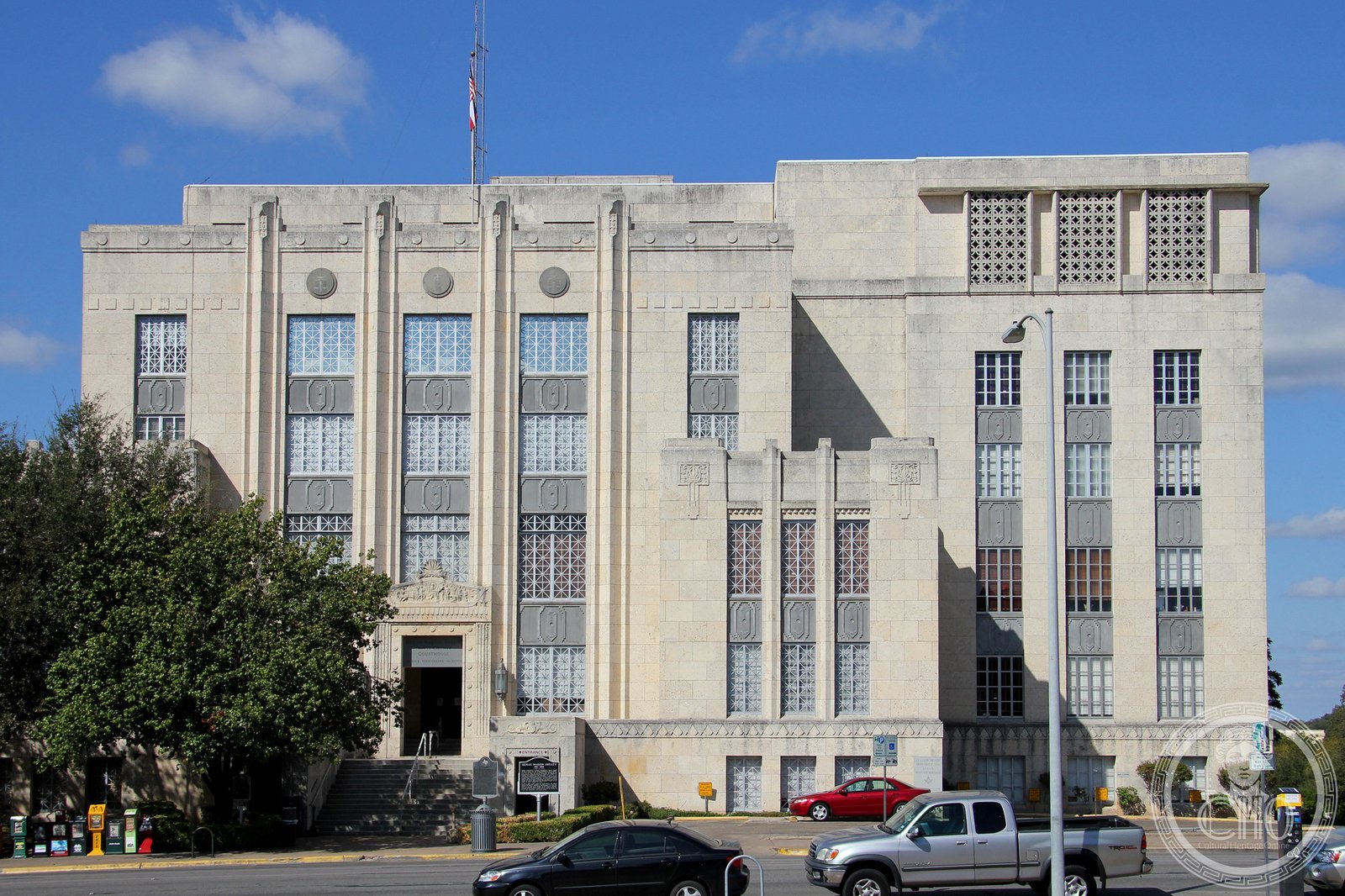
Built in 1931 in the austere PWA Moderne style and renamed in honor of the civil rights plaintiff who challenged racial segregation at the University of Texas, this six-floor courthouse carries two distinct chapters of Texas history.
At a glance
The Heman Marion Sweatt Travis County Courthouse stands at 1000 Guadalupe Street in downtown Austin, one block from Wooldridge Park. Built between 1930 and 1931, it replaced a Second Empire courthouse from 1876 and was designed in the PWA Moderne style by Page Brothers (Charles Henry Page) — the same idiom deployed in hundreds of federal and civic buildings built during the Depression era with Public Works Administration funding. At 104 feet and 125,000 square feet, the courthouse has served Travis County’s civil and criminal courts continuously since its grand opening on June 27, 1931.
Key facts
- Built: 1930–1931; opened June 27, 1931
- Style: PWA Moderne (Art Deco)
- Height: 104 feet; 6 floors; 125,000 sq ft
- Architect: Page Brothers (Charles Henry Page)
- Contractor: H.E. Wattinger
- Expanded: 1958, 1962
- Namesake: Heman Marion Sweatt — plaintiff in Sweatt v. Painter (1950) civil rights case
- Address: 1000 Guadalupe St., Austin, Texas
History
Travis County’s first purpose-built courthouse was a modest two-story stone structure built in 1855 near Republic Square in downtown Austin. It was replaced by a Second Empire limestone building in 1876 — a three-story monumental structure built along the south side of the Texas State Capitol — which itself became inadequate as Austin grew through the early twentieth century. In 1930, the county selected a site on the north side of Wooldridge Park for a larger building. The cornerstone was laid in 1930, and on June 27, 1931, the courthouse opened its doors; the county’s courts and offices moved in from the old building, which continued as state office space before its demolition in 1964.
The building was designed in PWA Moderne — a stripped, geometric variant of Art Deco that emerged from the Depression-era Public Works Administration’s preference for severe, unornamented civic architecture. Page Brothers applied this vocabulary to a building that needed to project permanence and authority on a tight civic budget. Substantial additions in 1958 and 1962 expanded the facility as Travis County’s population grew.
The courthouse carries a second history in its name. Heman Marion Sweatt was an African American mail carrier who applied to the University of Texas School of Law in 1946 and was refused admission solely on the basis of race. The legal battle — Sweatt v. Painter — reached the United States Supreme Court, which ruled in Sweatt’s favor in 1950, ordering the University of Texas to admit him and delivering a precedent that helped dismantle separate-but-equal in graduate education. The courthouse was renamed in his honor to mark his place in Texas and American civil rights history.
What you see
The courthouse’s PWA Moderne exterior presents clean horizontal banding and minimal ornament — a deliberate departure from the Beaux-Arts elaboration of the preceding generation of civic buildings. The material palette is severe and institutional, but the proportions of the massing are carefully resolved. The east facade on Guadalupe Street is the principal elevation. The 1958 and 1962 additions are clearly distinguishable from the 1931 core but do not overwhelm it; the original building’s geometry remains legible from Wooldridge Park to the south.
The building once included a jail on its top floor — a common arrangement in Texas county courthouses of the era, the Jefferson County Courthouse in Beaumont being one parallel example — though the Travis County jail was eventually relocated after a 1974 federal court order found the facility inadequate, and a new jail opened in 1986.
Practical information
- Access: Active courthouse; public access during court business hours
- Exterior: PWA Moderne facade visible from Guadalupe Street and Wooldridge Park
- Interior: Public hallways and lobby accessible; courtrooms by access only
- Best time: Weekday mornings for interior; the east facade is best lit in late afternoon
- Time needed: 20–30 minutes exterior and lobby
Getting there
The courthouse stands at 1000 Guadalupe Street in downtown Austin, one block from the south end of Wooldridge Park and roughly a ten-minute walk from the Texas State Capitol. Austin-Bergstrom International Airport is approximately 10 miles southeast. The CapMetro transit network serves downtown Austin; several bus lines stop on Guadalupe Street.
Nearby
- Texas State Capitol (1888) — one of the most architecturally significant capitol buildings in the United States, ten minutes on foot
- Wooldridge Park — the 1878 public square immediately south of the courthouse
- University of Texas at Austin campus — including the Texas Science & Natural History Museum (1939, Art Deco) and the UT Tower
- Sixth Street entertainment district — Austin’s live music corridor, ten minutes south
Sources
- Wikipedia: Travis County Courthouse
- Travis County Archives — The Courthouse historical summary
- List of Art Deco architecture in Texas — Wikipedia
- Sweatt v. Painter, 339 U.S. 629 (1950) — Supreme Court decision
Find it on the map
See this place and what’s around it →Record researched and written by Luigi De Marchi for Cultural Heritage Online, 2026.
📷 Become a Cultural Heritage Online photographer
Share your photos of places: they stay published under your name as the author. The more they're seen, the more you get noticed — and soon a contest will reward the most appreciated photos.
Log in or sign up free to add a photoIs this page about you?
This page is read by travellers and heritage enthusiasts who find it on Google. Tell us how you are connected to this place and we will take it from there.