
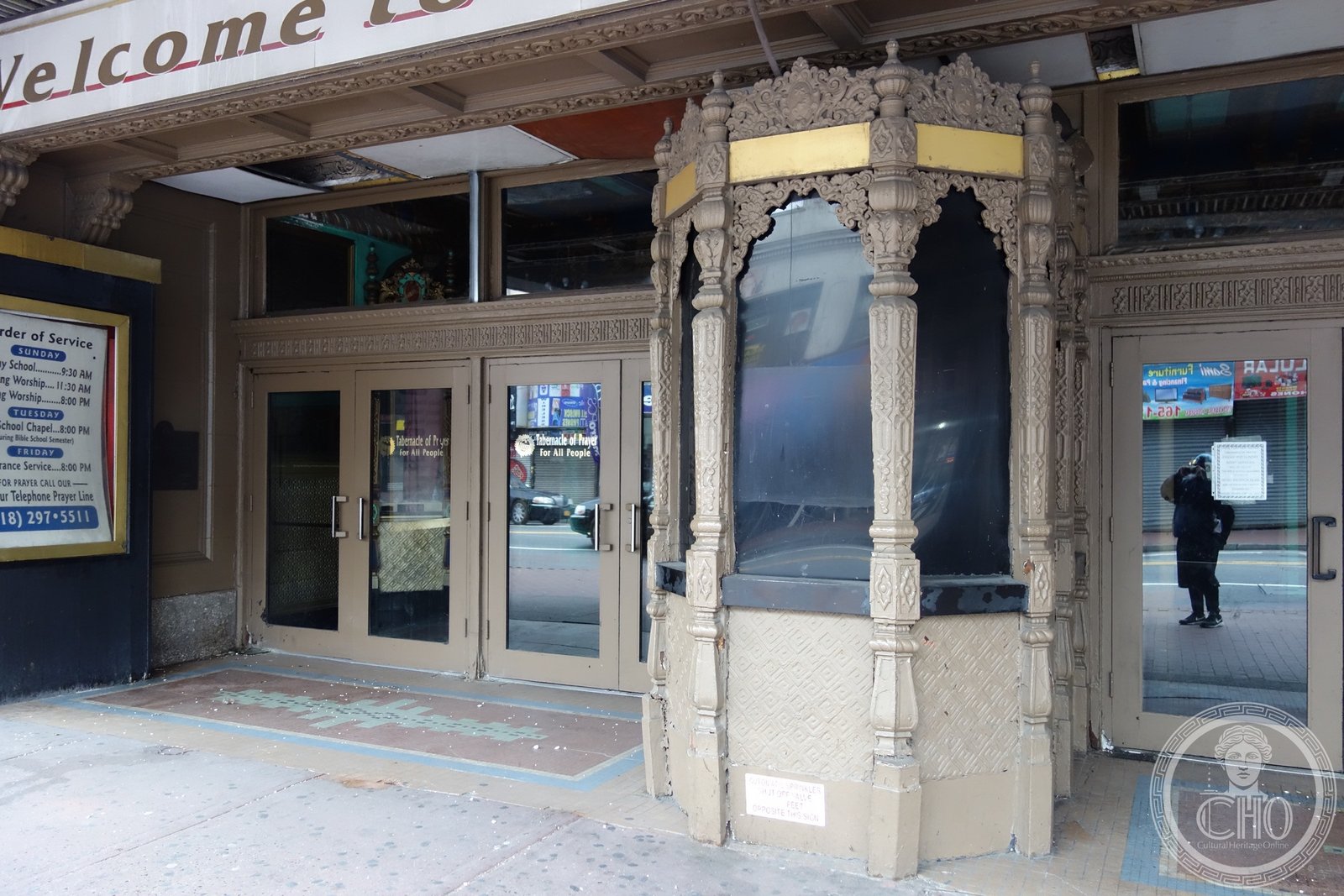
One of the five Loew’s Wonder Theatres built in the New York metropolitan area, the Valencia opened in 1929 as an atmospheric movie palace by John Eberson — 3,500 seats of Spanish-Moorish ornament on Jamaica Avenue in Queens, now preserved as a church and New York City Landmark.
At a glance
Loew’s Valencia Theatre stands on Jamaica Avenue in the Jamaica neighborhood of Queens, New York, where it has occupied the same facade since 1929. John Eberson — the originator of the atmospheric theater concept — designed it for Loew’s as one of five entries in the Wonder Theatre program, a coordinated campaign of five super-palaces built across the New York region between 1929 and 1931. The Valencia’s atmospheric interior conjures a Spanish-Moorish courtyard in the Eberson manner: painted sky overhead, side walls carrying arched loggias and decorative towers, and the full vocabulary of the atmospheric style executed at the scale of a 3,500-seat palace. The New York City Landmarks Preservation Commission designated the theater in 1999. It has been used since the 1970s as a church — the Tabernacle of Prayer, later the King of Kings Cathedral — which has preserved the building through decades when many comparable theaters were demolished or subdivided.
Key facts
- Address: 165-11 Jamaica Avenue, Jamaica, Queens, New York
- Opened: 1929
- Architect: John Eberson
- Style: Atmospheric / Spanish-Moorish Revival
- Original capacity: 3,500 seats
- NYC Landmark: Yes (designated 1999)
- Current use: Tabernacle of Prayer for All People (church)
- Wonder Theatre series: One of five (Kings, Paradise, Valencia, Jersey, 175th St)
History
John Eberson had invented the atmospheric theater in Chicago in 1923 — a format in which the auditorium simulates an outdoor space rather than a decorated interior room — and by 1929 had built atmospheric palaces across the United States. The commission from Loew’s for the Wonder Theatre series placed him alongside Thomas W. Lamb on one of the most ambitious theater-building programs in New York’s history, with five theaters being designed and constructed within two years. While Lamb designed four of the five Wonder Theatres, the Valencia was assigned to Eberson, the originator of the type, in an act of architectural justice that gave the atmospheric master the chance to demonstrate the style at Wonder Theatre scale.
The Valencia served the Jamaica neighborhood of Queens — a busy commercial corridor on the Long Island Rail Road main line — as a first-run Loew’s house through the Hollywood studio era. Jamaica’s role as a transportation hub in outer Queens brought a steady audience from across southeastern Queens and western Long Island. The postwar decline of the movie palace format affected the Valencia as it did the other Wonder Theatres; Loew’s closed it for cinema use in the early 1970s. The Tabernacle of Prayer for All People acquired the building and adapted it for church use, a conversion that preserved the atmospheric interior rather than subdividing or demolishing it.
New York City’s Landmarks Preservation Commission designated the theater in 1999, recognizing its architectural significance and its place in the Wonder Theatre legacy. The building remains in church use, with the atmospheric interior largely intact, making it one of the best-preserved Wonder Theatres in the group and a significant survivor of New York’s movie palace era.
What you see
The Jamaica Avenue facade presents a broad terra-cotta composition in warm colors with Moorish and Spanish ornamental motifs — pointed arches, tilework, and decorative panels — that distinguish the building from the commercial neighbors on either side. The main entrance, centered on the facade, leads through a lobby decorated in the Moorish manner into the atmospheric auditorium, where Eberson’s trademark vocabulary of arched loggias, decorative towers, and the painted-sky ceiling transforms the room into a simulated Spanish courtyard.
The auditorium’s three levels — orchestra, mezzanine, and upper balcony — distribute the seating under the atmospheric ceiling. The side walls carry the complete atmospheric program: arched niches, towers, and wall surfaces designed to read as parts of a building seen from outside, reinforcing the illusion that the audience sits in an open-air plaza. The pipe organ and proscenium arch frame the stage in the Moorish manner. The current church use has altered some interior elements but preserved the atmospheric character of the space well enough for the building to read as what it was.
Practical information
- Address: 165-11 Jamaica Avenue, Jamaica, Queens, NY
- Transit: E, J, Z trains to Jamaica–Van Wyck or Jamaica Center–Parsons/Archer; Long Island Rail Road to Jamaica Station
- Exterior: Viewable from Jamaica Avenue at any time
- Interior access: Currently restricted to church members; check current status before visiting
Getting there
The Valencia is located on Jamaica Avenue in the Jamaica neighborhood of Queens, one of the major transportation hubs in outer New York City. The E, J, and Z subway lines serve Jamaica Center–Parsons/Archer station, a short walk from the theater. The Long Island Rail Road Jamaica Station is nearby. JFK International Airport is approximately 3 miles to the south. Driving from Manhattan via the Van Wyck Expressway takes approximately 30 minutes without traffic.
Nearby
- King Manor Museum (King Park, Jamaica — historic colonial house)
- Jamaica Center commercial district
- York College CUNY campus (Jamaica)
Sources
- Wikipedia, “Loew’s Valencia Theatre” — history, architect John Eberson, Wonder Theatre program, NYC Landmark 1999, current use
- New York City Landmarks Preservation Commission, Designation Report (1999)
- Cinema Treasures, “Loew’s Valencia Theatre, Jamaica NY” — capacity, atmospheric interior, preservation history
Find it on the map
See this place and what’s around it →Record researched and written by Luigi De Marchi for Cultural Heritage Online, 2026.
📷 Become a Cultural Heritage Online photographer
Share your photos of places: they stay published under your name as the author. The more they're seen, the more you get noticed — and soon a contest will reward the most appreciated photos.
Log in or sign up free to add a photoIs this page about you?
This page is read by travellers and heritage enthusiasts who find it on Google. Tell us how you are connected to this place and we will take it from there.