
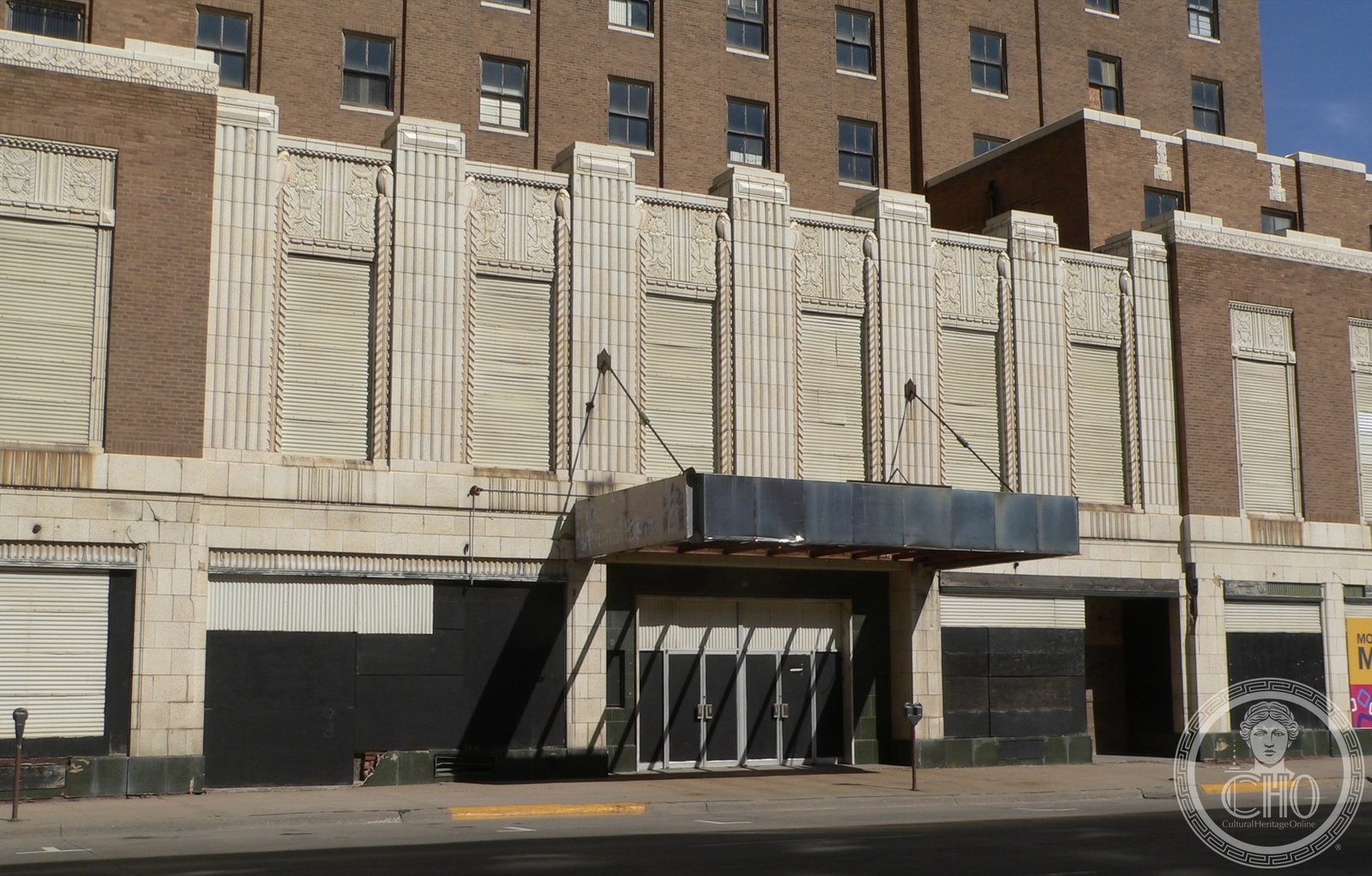
A terra-cotta Art Deco tower on Fourth Street in downtown Sioux City, the Warrior Hotel opened in 1930 as the premier hotel in a significant Midwestern river city and has been restored to its original purpose as a boutique hotel after decades of decline.
At a glance
The Warrior Hotel stands on Fourth Street in the heart of downtown Sioux City, Iowa, overlooking the Missouri River corridor that made this city one of the more prosperous commercial centers of the upper Midwest in the early twentieth century. Built in 1930, the hotel’s Art Deco terra-cotta facade rose above a downtown already dense with commerce, and its name drew on the Native American heritage of the region — the Sioux peoples after whom the city itself is named. Listed on the National Register of Historic Places, the building fell into disuse after the mid-century decline of downtown hotels and was eventually closed. A full restoration returned the building to hotel use in recent years, restoring the original Art Deco ornamental program and bringing a prominent historic landmark back to productive life.
Key facts
- Address: Fourth Street, Sioux City, Iowa
- Opened: 1930
- Style: Art Deco
- NRHP: Yes, listed on the National Register of Historic Places
- Current use: Boutique hotel (restored)
- Location: Downtown Sioux City, near the Missouri River
History
Sioux City in 1930 was still a city of considerable commercial ambition. Its position at the confluence of the Missouri, Big Sioux, and Floyd Rivers had made it a meatpacking center, a grain-trading hub, and a gateway to the upper Great Plains. The Warrior Hotel, built at the height of the city’s confidence, addressed a downtown audience that expected a hotel of metropolitan standard — a building that could take its place among the better commercial addresses in the Midwest without apology. The Art Deco design, with its terra-cotta ornamental program and verticality, placed the hotel squarely in the mainstream of American commercial hotel architecture of the period.
The name was a deliberate invocation of the Sioux peoples, whose lands the city had been built upon and whose name the city carried. This practice of naming commercial buildings after Indigenous nations and figures was common in the interwar Midwest, mixing civic pride with an unsentimental acknowledgment of the region’s founding history. The hotel served its original clientele — businessmen, traveling salespeople, government officials, visitors to the stockyards — through the Depression and the postwar decades. The shift of commercial traffic to suburban motels and the decline of downtown retail began to erode the hotel’s market in the 1960s and 1970s, as it did for comparable properties across the country.
The restoration that returned the Warrior to hotel use preserved the building’s most significant architectural features, including the terra-cotta ornamental panels and the lobby’s Art Deco character. The project was part of a broader revitalization of downtown Sioux City that has focused on adaptive reuse of historic commercial buildings as hotels, apartments, and mixed-use properties.
What you see
The hotel’s facade presents a composition typical of the mid-grade commercial hotel of the late 1920s and early 1930s: a street-level entrance bay in detailed terra-cotta, a shaft of repetitive window bays through the middle stories, and a decorated crown at the top. The Art Deco ornamental vocabulary — geometric panels, stylized motifs derived from Native American visual forms, and angular banding — distinguishes the building from the Beaux Arts hotels of the previous generation and from the more stripped-down modernism that would follow in the late 1930s and 1940s.
The corner placement and the relative height of the building made it a landmark in the downtown skyline at the time of construction and continue to give it a commanding presence in the current streetscape. The restoration has preserved the exterior’s terra-cotta program while bringing the interior back to hotel use, maintaining the design character that earned the National Register listing.
Practical information
- Location: Fourth Street, downtown Sioux City, Iowa — near the Missouri River overlook and Historic Fourth Street district
- Access: Sioux City is accessible by I-29 (north-south) and I-129 (connecting to I-80)
- Nearby: Sioux City Art Center, Sioux City Public Museum, Missouri River waterfront
Getting there
Sioux City is located in far northwestern Iowa at the junction of Iowa, Nebraska, and South Dakota. The nearest commercial airport is Sioux Gateway Airport (SUX), approximately four miles from downtown. By car, Interstate 29 provides north-south access through Sioux City, while Interstate 129 connects to Interstate 80 to the south. The downtown Fourth Street area is walkable from the hotel district.
Nearby
- Sioux City Art Center (225 Nebraska Street)
- Sergeant Floyd Monument (Missouri River, NRHP)
- Historic Fourth Street commercial district
Sources
- Wikipedia, “Warrior Hotel” — history, NRHP listing, restoration, Sioux City context
- National Register of Historic Places — Warrior Hotel, Sioux City, Iowa
- Sioux City History Society — downtown commercial architecture 1920s–1930s
Find it on the map
See this place and what’s around it →📷 Become a Cultural Heritage Online photographer
Share your photos of places: they stay published under your name as the author. The more they're seen, the more you get noticed — and soon a contest will reward the most appreciated photos.
Log in or sign up free to add a photoIs this page about you?
This page is read by travellers and heritage enthusiasts who find it on Google. Tell us how you are connected to this place and we will take it from there.