
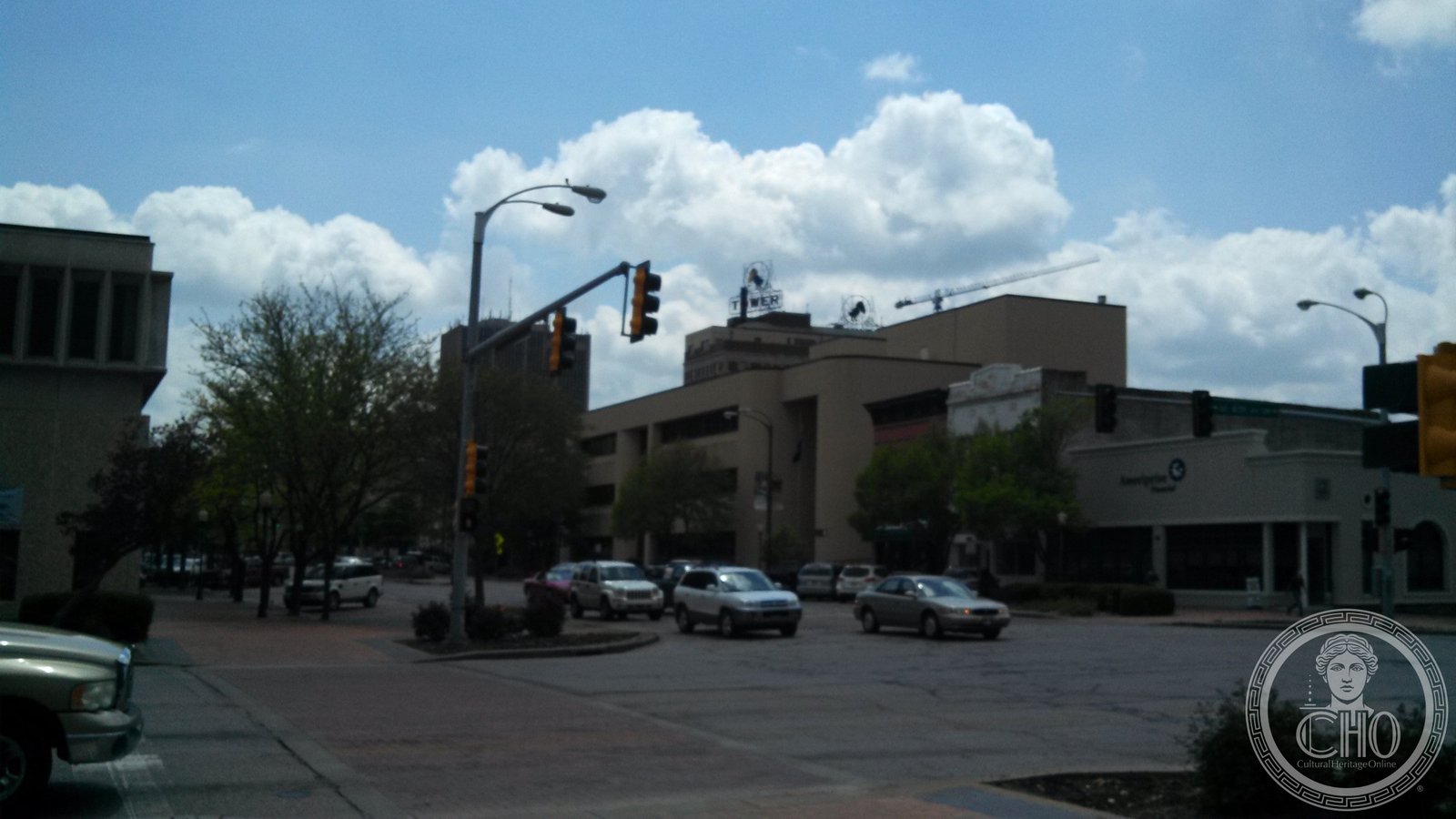
An Art Deco tower that has anchored the civic core of Topeka since 1926, the Jayhawk Hotel remains the most visible monument to the decade when prairie cities built upward in terra-cotta and geometric ornament.
At a glance
Standing at SW Quincy Avenue and SW Jackson Street in downtown Topeka, the Jayhawk Hotel was the premier address in the Kansas state capital when it opened in 1926. Its multi-story Art Deco masonry tower made it among the tallest buildings in Topeka at the time, and its terra-cotta cladding — in warm earthy tones with geometric banding and stylized ornament — announced a confidence in the language of modern commercial architecture that was redefining American downtowns during the mid-1920s. Listed on the National Register of Historic Places in 1980, the Jayhawk has been restored and continues to serve as a downtown landmark within a few blocks of the Kansas State Capitol. The building takes its name from the Jayhawk, the mythical bird and symbol of the University of Kansas and of the state itself.
Key facts
- Address: SW Quincy Avenue and SW Jackson Street, Topeka, KS 66603
- Built: 1926
- Style: Art Deco
- NRHP: Yes (listed 1980, refnum 80001953)
- Location: Downtown Topeka, near Kansas State Capitol
History
The Jayhawk Hotel opened in 1926 as Topeka’s most ambitious hotel project of the decade, capitalizing on the downtown’s proximity to the state government complex and the commercial and political traffic that followed legislators, lobbyists, and visiting officials. A multi-story tower, it was an imposing presence in a low-rise city, and its decorative program in the Art Deco manner — geometric friezes, stylized ornament at the crown, and terra-cotta panels along the base — made it the most architecturally sophisticated hotel in downtown Topeka when completed. The name Jayhawk tied the building’s identity directly to Kansas civic culture: the mythical half-hawk, half-jay, adopted as a symbol of the state during the Civil War era, carried associations of pride and tenacity that the hotel’s owners made no effort to suppress.
The hotel served state legislators, visiting businessmen, and travelers arriving by rail during the interwar decades. The nearby Atchison, Topeka and Santa Fe Railway depot channeled passengers directly into the downtown hotel district, and Topeka’s role as the state capital assured a steady flow of government-related visitors. As automobile travel displaced rail and suburban motels drew travelers away from city centers in the postwar era, the Jayhawk, like many urban hotels of its class, faced declining occupancy. The building’s listing on the National Register of Historic Places in 1980 recognized its architectural significance and opened pathways for preservation investment.
Restoration efforts have brought the Jayhawk back to productive use within the revitalizing downtown core. The building retains its original terra-cotta exterior, its Art Deco ornamental vocabulary, and its position as one of the defining structures in the Topeka skyline and a touchstone of the city’s architectural heritage.
What you see
The Jayhawk’s eleven-story facade presents the characteristic Art Deco commercial hotel composition: a richly detailed terra-cotta base at street level, a shaft of relatively restrained masonry through the middle stories, and a decorated crown with geometric ornament at the top. The terra-cotta panels carry the flat angular motifs — chevrons, zigzags, and stylized forms drawn from the Art Deco vocabulary current in the mid-1920s — that distinguished better commercial architecture of the period from the Classical Revival buildings that had preceded it. The building’s verticality, emphasized by shallow piers and projecting spandrels, draws the eye upward in the manner architects of the period borrowed from the emergent skyscraper vocabulary and applied to buildings of more modest height.
At street level the original hotel entrance introduced ornamental metalwork and carved stone in the Art Deco manner, leading to a lobby that combined geometric elegance with the warm materials — marble, brass, dark wood — standard in the better hotels of the decade. Restoration has preserved or reconstructed key elements of this public face, maintaining the continuity between the ornamental program of the exterior and the public rooms.
Practical information
- Address: SW Quincy Avenue and SW Jackson Street, Topeka, KS 66603
- Downtown location: A short walk from the Kansas State Capitol grounds
- Exterior viewing: The terra-cotta facade is best seen from the street at any time
- By car: I-70 (Kansas Turnpike) or I-470 to downtown Topeka; street parking available
Getting there
The Jayhawk Hotel stands in central Topeka within the core downtown area. Topeka is served by Interstate 70 (Kansas Turnpike) and Interstate 470. The Kansas State Capitol is within a five-minute walk to the south. Street parking and surface lots serve the immediate neighborhood, and Topeka Metro bus routes serve the downtown corridor.
Nearby
- Kansas State Capitol (1903 Beaux Arts dome, SW 8th and SW Harrison)
- Kansas Museum of History (6425 SW 6th Avenue, approximately two miles west)
- Brown v. Board of Education National Historic Site (Monroe Elementary School, 1515 SE Monroe)
Sources
- Wikipedia, “Jayhawk Hotel” — history, NRHP listing 1980, architectural description, Topeka context
- National Register of Historic Places, refnum 80001953 (Jayhawk Hotel, Topeka KS, listed 1980)
- Kansas Historical Society — Topeka downtown historic commercial architecture
Find it on the map
See this place and what’s around it →Record researched and written by Luigi De Marchi for Cultural Heritage Online, 2026.
📷 Become a Cultural Heritage Online photographer
Share your photos of places: they stay published under your name as the author. The more they're seen, the more you get noticed — and soon a contest will reward the most appreciated photos.
Log in or sign up free to add a photoIs this page about you?
This page is read by travellers and heritage enthusiasts who find it on Google. Tell us how you are connected to this place and we will take it from there.