
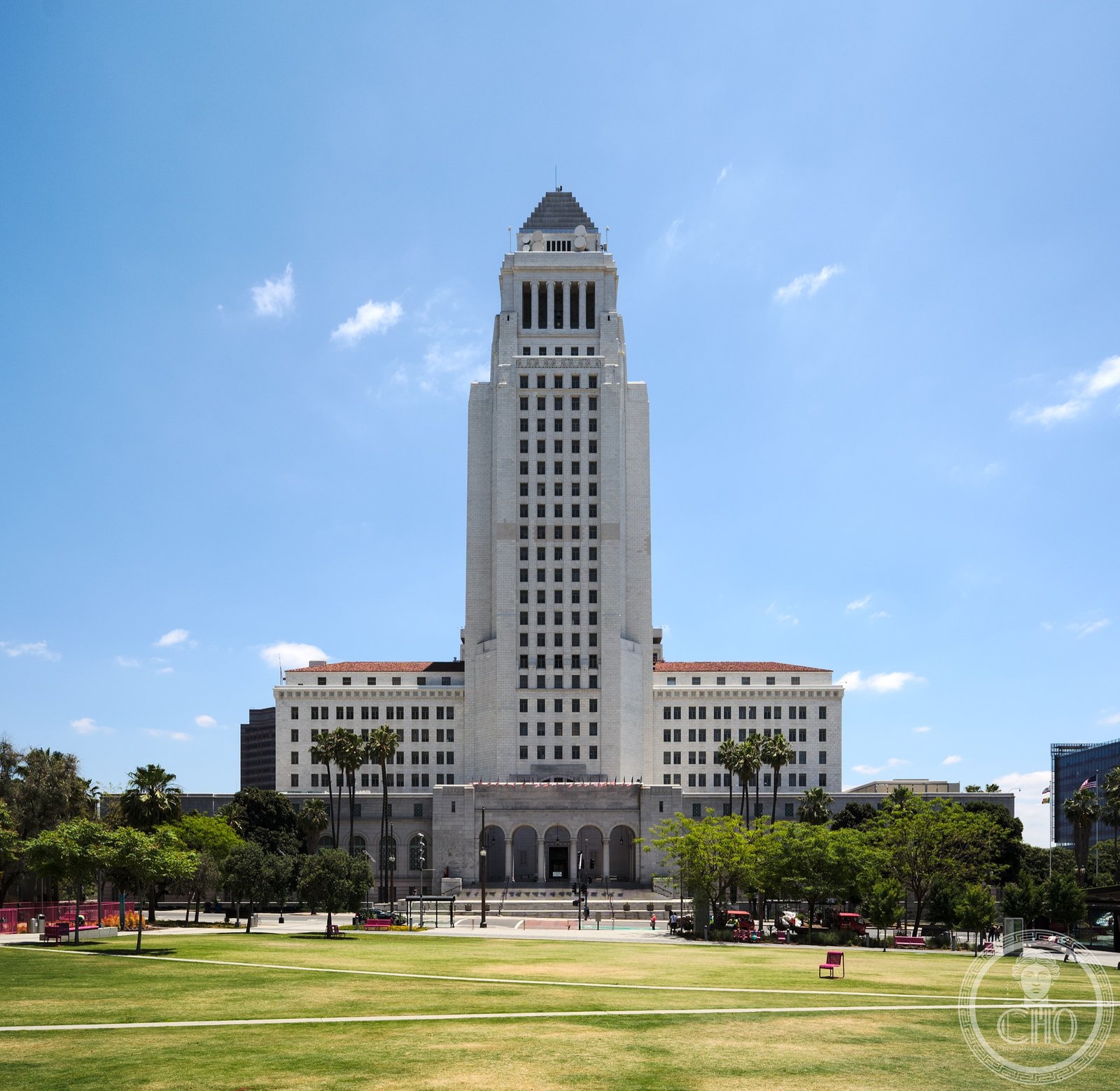
The 28-story Los Angeles City Hall, completed in 1928 to designs by John Parkinson, John C. Austin, and Albert C. Martin Sr., was for decades the only building in Los Angeles exempt from the city’s 150-foot height limit — a singular Art Deco tower whose tiered crown became the most recognized symbol of Los Angeles civic identity and one of the most frequently filmed buildings in American cinema.
At a glance
Los Angeles City Hall at 200 North Spring Street in the Civic Center district was completed in 1928 to designs by architects John Parkinson, John C. Austin, and Albert C. Martin Sr. At 28 stories and 454 feet, it was the tallest structure in Los Angeles at the time of its completion — the only building in the city formally exempt from the height limit that constrained all other construction — and it held that position of singular civic prominence for over three decades. The building combines Art Deco ornament with Classical and Italian Renaissance base elements in a composition whose tiered crown has made it one of the most recognized skyline profiles in American architectural history. It is listed on the National Register of Historic Places and designated a Los Angeles Historic-Cultural Monument.
Key facts
- Address: 200 North Spring Street, Los Angeles, CA 90012
- Height: 28 stories, 454 ft (138 m)
- Completed: 1928
- Architects: John Parkinson, John C. Austin, and Albert C. Martin Sr.
- Style: Art Deco (with Classical base)
- NRHP: Yes
- Los Angeles Historic-Cultural Monument: Yes
- Seismic retrofit: 1998–2001
- Current use: Active municipal government building
History
The three architects who designed Los Angeles City Hall each brought a substantial portfolio to the project. John Parkinson was the principal architect of Union Station Los Angeles and several other major civic buildings; John C. Austin had designed Shrine Auditorium; Albert C. Martin Sr. led a firm that would remain influential in Los Angeles architecture through his successors for decades. Together they produced a design that synthesized the Classical civic building tradition with the emerging Art Deco vocabulary — a tower whose lower floors read in the Beaux-Arts manner, whose upper shaft is Art Deco, and whose crown is a tiered composition derived from ancient mausolea (specifically the Mausoleum at Halicarnassus).
The building’s exemption from Los Angeles’s 150-foot height limit was enacted by the California state legislature at the time of its construction, making it unique in the city and giving it a visual prominence that no other building could approach until the height limit was lifted in 1957. For decades Los Angeles City Hall was the singular vertical marker on the city’s skyline — a point of orientation visible from the surrounding mountains and from the freeways that came to define the city’s geography in the postwar decades.
The building entered American popular culture through its extensive use in film and television production — most famously as the headquarters of the Daily Planet in the Superman television series of the 1950s, and in countless films and television productions that needed an image of official civic power in Los Angeles. A major seismic retrofit program completed in 2001 preserved the building for continued use as the working seat of Los Angeles municipal government.
What you see
From the surrounding streets of the Civic Center, Los Angeles City Hall presents a complex and carefully considered composition. The base is a broad classical platform — colonnaded, symmetrical, ornamented in the manner of civic Beaux-Arts buildings of the early 20th century. Above the base, the shaft rises in the manner of Art Deco commercial towers, with vertical emphasis, setbacks, and geometric ornament. The crown is the building’s most distinctive element: a stepped pyramid of receding stages that references ancient monumental architecture and gives the building its instantly recognizable silhouette.
The building occupies a site in the Civic Center that gives it room to be seen from multiple directions — from the plaza to the north, from the streets to the south along Spring Street, from the elevated sections of the freeways that pass nearby. The public observation deck on the upper floors (access varies; check in advance) offers a panoramic view of the Los Angeles basin and the surrounding mountains that contextualizes the building’s position within the geography it governs. The interior spaces — rotunda, council chambers, lobby — carry the same synthesis of Classical and Art Deco vocabularies that defines the exterior.
Practical information
- Public access: Lobby open during business hours (Monday–Friday); public observation deck access varies — check with the building in advance
- Exterior: Viewable at all times from Spring Street, Temple Street, and the surrounding Civic Center plaza
- Photography: Best full tower views from the plaza to the north or from the El Pueblo de Los Angeles Historic Monument across Alameda Street
- Civic Center: The building is adjacent to the Los Angeles Superior Court, the Hall of Justice, and the Federal Building complex
Getting there
Los Angeles City Hall is at 200 North Spring Street in the Civic Center district of downtown Los Angeles. Los Angeles International Airport (LAX) is 16 miles southwest. The Metro Gold/A Line stops at Union Station, three blocks east; the Red/Purple B/D Lines stop at Civic Center/Grand Park station directly adjacent. The building is within easy walking distance of Union Station, El Pueblo de Los Angeles, Grand Park, and the Museum of Contemporary Art.
Nearby
- Union Station (1939) — the Spanish Colonial Revival/Streamline Moderne railroad terminal, three blocks east; one of the last great American railroad stations
- El Pueblo de Los Angeles — the historic birthplace of the city, including Olvera Street, adjacent to the east
- Grand Park — the civic park connecting City Hall to the Music Center, directly to the west
Sources
- Wikipedia, “Los Angeles City Hall” — architects, date, height, NRHP listing, height-limit exemption, seismic retrofit
- Los Angeles Historic-Cultural Monument designation — architectural significance
- National Register of Historic Places nomination — significance documentation
- Los Angeles Conservancy — preservation documentation
Find it on the map
See this place and what’s around it →📷 Become a Cultural Heritage Online photographer
Share your photos of places: they stay published under your name as the author. The more they're seen, the more you get noticed — and soon a contest will reward the most appreciated photos.
Log in or sign up free to add a photoIs this page about you?
This page is read by travellers and heritage enthusiasts who find it on Google. Tell us how you are connected to this place and we will take it from there.