
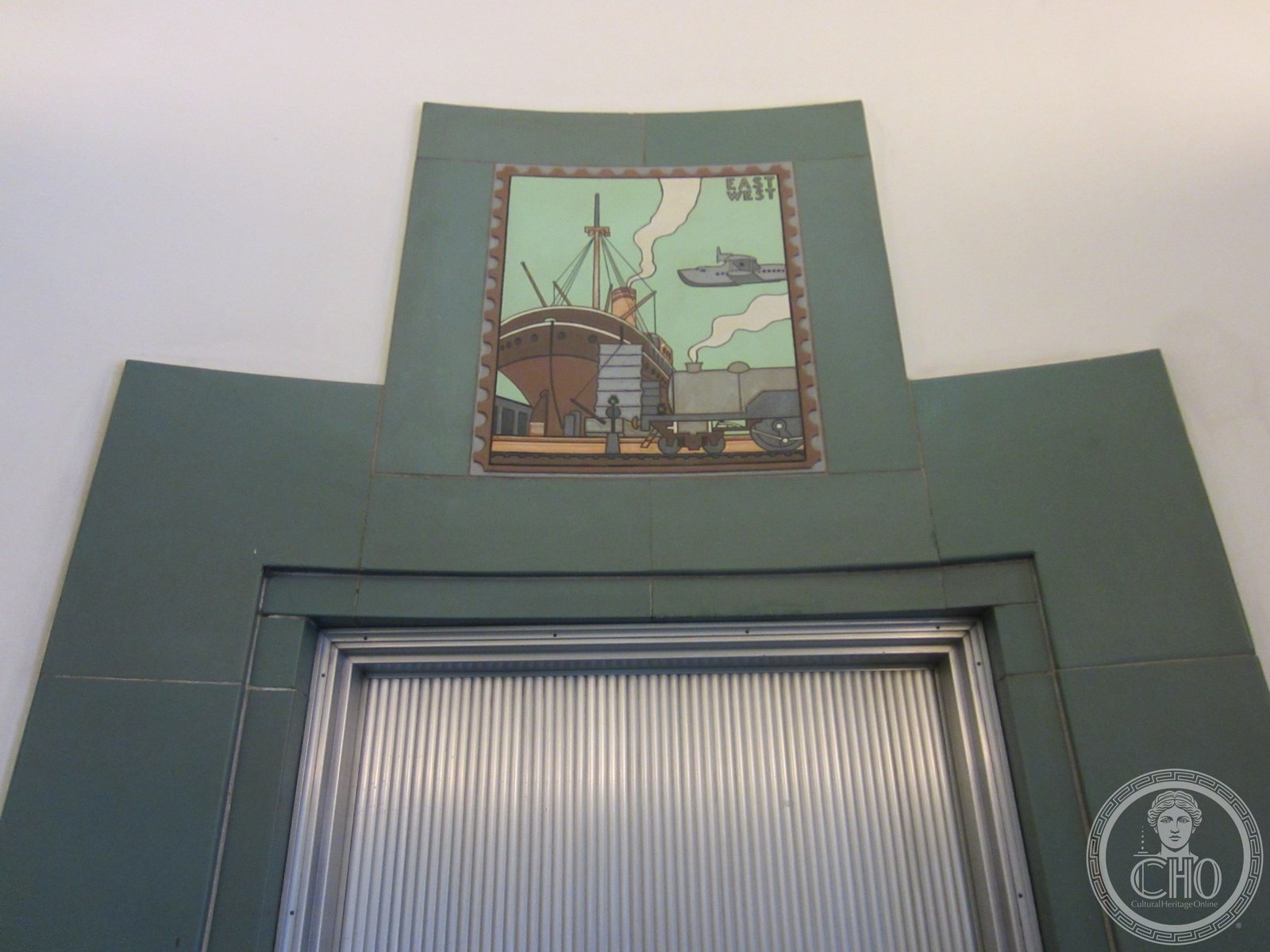
Completed in 1940 as the main postal annex for San Francisco, the Rincon Center building is a Streamline Moderne landmark at 99 Mission Street whose WPA-era exterior frames one of the largest collections of New Deal murals in the United States — 27 panels by Anton Refregier covering the history of California from the Spanish missions to the Second World War.
At a glance
Designed by Gilbert Stanley Underwood, the official architect of the United States Post Office Department, and completed in 1940, the Rincon Annex Post Office was built as a sorting and distribution facility to serve the growing commercial district south of Market Street. Its exterior expresses the Streamline Moderne vocabulary that Underwood applied to federal buildings across the country during the New Deal era: smooth concrete and masonry cladding, horizontal banding, an absence of historical ornament, and the aerodynamic curves that gave the style its name. Inside, a commission from the Works Progress Administration funded Anton Refregier’s 27 mural panels, installed between 1941 and 1948, tracing the social and labor history of California in a figurative style that was one of the most ambitious public art projects of the federal program. The building was converted to mixed-use development in 1989, with the murals preserved in situ, and was added to the National Register of Historic Places.
Key facts
- Completed: 1940
- Architect: Gilbert Stanley Underwood
- Address: 99 Mission Street, San Francisco, CA 94105
- Style: Streamline Moderne / WPA Federal
- Murals: Anton Refregier, 27 panels, 1941–1948
- Status: National Register of Historic Places; San Francisco Landmark
- GPS: 37.7944°N, 122.3939°W
History
The Rincon Annex Post Office was one of several large federal buildings constructed in San Francisco under the New Deal’s ambitious public works program. Gilbert Stanley Underwood, who had designed national park lodges for the 1920s before transitioning to federal building commissions, brought to the project the same modernist sensibility he applied to his other Post Office Department commissions during the 1930s and early 1940s. The Rincon building was conceived as a functional postal annex for the city’s industrial waterfront district, and its Streamline Moderne form — horizontal limestone surfaces, minimal ornament, ribbon windows — expressed the aesthetic language of federal modernism that distinguished New Deal architecture from the Beaux-Arts style of the previous generation.
Simultaneously with the building’s construction, the Works Progress Administration commissioned a young San Francisco artist, Anton Refregier, to create a mural cycle for the main public space. Refregier spent years developing 27 panels depicting California history from the indigenous Ohlone people and the Spanish missions through the Mexican period, the Gold Rush, the labor struggles of the late nineteenth century, and the Japanese-American internment and home-front mobilization of the Second World War. The murals were controversial from the moment of their installation — conservative critics objected to Refregier’s sympathetic treatment of labor movements and his inclusion of the internment as a historical fact — but they survived attempts at removal and became one of the most complete examples of New Deal public art in any single building in the country.
The postal operations moved out over the decades following the war. In 1989, the developer Perini Land & Development converted the annex to Rincon Center, a mixed-use complex of shops, restaurants, a hotel, and office space, with a dramatic atrium added to the interior. The murals were preserved in their original location under a preservation agreement, and the building’s Streamline Moderne exterior was maintained intact. The National Register listing protects both the architectural fabric and the mural cycle.
What you see
The Mission Street facade is Underwood’s Streamline Moderne at its most deliberate: the limestone-clad surface runs without break from the entrance block to the service bays, horizontal courses emphasizing the building’s length over its height. The windows are grouped into horizontal bands that read as speed lines from the street, a reference to the aerodynamic forms that gave Streamline Moderne its name and its connection to the machine age. At the entrance, the decorative program is concentrated in a carved panel and the bronze hardware of the doors — elements that reveal the New Deal period’s tendency to preserve a degree of craftsmanship in the public face of otherwise austerely modern federal buildings.
Inside, the 1989 conversion added a tall atrium with a rain column — a vertical cylinder of water that descends through the full height of the space — surrounded by the original main post office hall. Refregier’s mural panels begin at the entry level and continue around the walls of the upper gallery in the sequence of California history the artist intended. The panels are substantial works — several feet in height — rendered in a Social Realist figurative style that draws from both Mexican muralism and the WPA’s commitment to accessible, narrative public art. The Ohlone panels and the Gold Rush scenes occupy the earlier sections; the labor movement panels, depicting dock strikes and agricultural workers, are the most explicitly political and generated the most controversy.
Practical information
- Access: Open daily during retail and office hours; atrium accessible from Mission Street and the Embarcadero corridor
- Murals: Freely visible from the interior circulation areas; no admission charge
- Photography: Permitted in the atrium; the mural panels photograph well in natural light from the upper gallery
- Time needed: 30–60 minutes for a full circuit of the mural cycle
Getting there
Rincon Center is at 99 Mission Street in San Francisco’s South of Market district, one block from the Embarcadero. The Embarcadero BART and Muni Metro station is a three-minute walk north. The Ferry Building Marketplace is immediately adjacent to the north, and the Embarcadero waterfront promenade connects the building to the Financial District and the Bay Bridge approach. Validated parking is available in the building’s garage on Beale Street.
Nearby
- Ferry Building Marketplace (1898/2003) — waterfront food hall, one block north
- Aquatic Park Bathhouse (1939) — Streamline Moderne WPA building, 1.5 miles northwest
- Pacific Coast Stock Exchange (1930) — Art Deco, 0.4 miles northwest at 301 Pine Street
Sources
- National Register of Historic Places, Rincon Center nomination, 1979
- Park, Marlene, and Gerald E. Markowitz. Democratic Vistas: Post Offices and Public Art in the New Deal. Temple University Press, 1984.
- San Francisco Landmarks Preservation Advisory Board, designation documentation
- United States General Services Administration, Rincon Center building records
Find it on the map
See this place and what’s around it →Record researched and written by Luigi De Marchi for Cultural Heritage Online, 2026.
📷 Become a Cultural Heritage Online photographer
Share your photos of places: they stay published under your name as the author. The more they're seen, the more you get noticed — and soon a contest will reward the most appreciated photos.
Log in or sign up free to add a photoIs this page about you?
This page is read by travellers and heritage enthusiasts who find it on Google. Tell us how you are connected to this place and we will take it from there.