
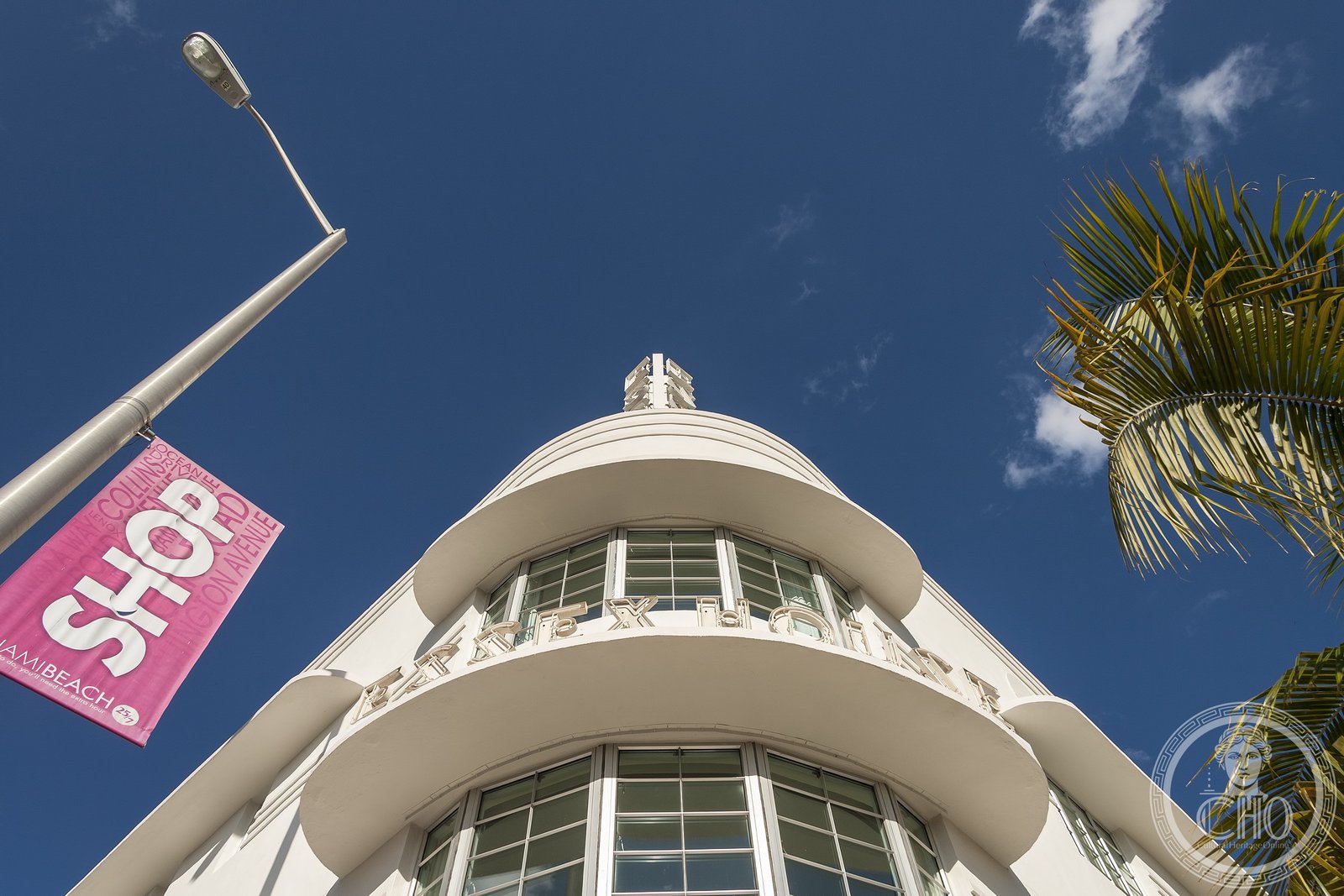
The Essex House at 1001 Collins Avenue is among L. Murray Dixon’s most studied Streamline Moderne designs — its three-fin facade, stacked eyebrow canopies, and rooftop spire representing the mature form of South Beach Art Deco as the 1930s building boom drew to a close.
At a glance
Completed in 1938 by architect L. Murray Dixon, the Essex House stands at the corner of Collins Avenue and 10th Street in the heart of South Beach’s Art Deco Historic District. Dixon, whose output during the 1930s rivaled Henry Hohauser’s in volume and exceeded it in formal ambition, gave the Essex House a more overtly vertical composition than the typical Ocean Drive hotel: a stucco facade organized around three vertical fins that rise from street level to the roofline, punctuated by eyebrow canopies at each floor and culminating in a slender rooftop spire that serves as the building’s signature element. The Essex House was included in the Miami Beach Architectural District when it was listed on the National Register of Historic Places in 1979 and has been operated as a hotel continuously since its completion.
Key facts
- Completed: 1938
- Architect: L. Murray Dixon
- Address: 1001 Collins Avenue, Miami Beach, FL 33139
- Style: Streamline Moderne / Art Deco
- Status: Miami Beach Architectural District (National Register of Historic Places, 1979)
- Original use: Resort hotel
- GPS: 25.7805°N, 80.1315°W
History
L. Murray Dixon arrived in Miami Beach in the early 1930s and quickly established himself as the most formally inventive of the South Beach modernist architects. While Hohauser favored horizontal compositions and pure Streamline idiom, Dixon’s work explored more varied relationships between horizontal and vertical elements, often introducing the spire or vertical fin as a compositional counterpoint to the eyebrow canopies. His buildings — the Tides, the Raleigh, the Delano, and the Essex House among them — are distinguished by slightly greater scale and spatial ambition than the typical Ocean Drive hotel, and by a tendency to use the roofline as a design opportunity rather than a neutral termination.
The Essex House was designed in 1937 and completed in 1938, toward the end of the first phase of South Beach’s building boom. By 1938, the speculative hotel market on Collins Avenue was maturing: the cheapest lots along Ocean Drive had been developed, and developers had moved to Collins Avenue, which offered wider lots and slightly more distance from the beach. The Essex House reflects this evolution: its Collins Avenue address and footprint gave Dixon room for the three-fin vertical composition that distinguishes it from the narrower-fronted Ocean Drive hotels. The rooftop spire — a pure vertical ornament — became one of the building’s most characteristic elements.
The Essex House declined with the rest of South Beach during the 1960s and 1970s. The Miami Beach Architectural District listing in 1979 and the subsequent neighborhood revival restored the hotel’s standing. The building has undergone restoration work that has maintained the stucco facade and the rooftop spire while updating the interior for contemporary hotel use.
What you see
The Collins Avenue facade is organized by three projecting vertical fins that rise the full height of the building and provide the primary visual rhythm of the composition. Between the fins, the eyebrow canopies at each floor — the horizontal shelves of stucco that protect the windows from direct sun — create a secondary horizontal rhythm that plays against the fins’ vertical thrust. The interplay of the two systems gives the Essex House its characteristic energy: neither purely horizontal nor purely vertical, but a composition in which the two directions are in active tension. The stucco surface is white, the standard Miami palette, with the speed-stripe ornament in relief on the fins themselves.
At the roofline, the slender spire rises from the center fin as a pure vertical element, visible from Collins Avenue for several blocks. Dixon’s proportioning of the spire — narrow enough to read as a single line at a distance but substantial enough to cast a visible shadow at close range — is a considered gesture in resort-architecture signage: the hotel identifies itself from a distance without the rooftop neon that Hohauser’s buildings required. The ground-floor arcade shelters the entrance and street-level storefronts under the first-floor eyebrow canopy, maintaining the pedestrian connection to Collins Avenue.
Practical information
- Exterior: The Collins Avenue facade is always freely viewable
- Photography: The three-fin composition photographs well in early morning from the west side of Collins Avenue; the rooftop spire reads clearly against a clear sky
- Access: Hotel lobby accessible to guests; visitors can view the common areas
- Time needed: 15 minutes for the exterior; combine with a Collins Avenue walk through the Art Deco Historic District for context
Getting there
The Essex House is at 1001 Collins Avenue at the corner of 10th Street in South Beach, Miami Beach. Ocean Drive and its beach-front hotels are one block east. The Wolfsonian-FIU Museum is one block west on Washington Avenue. Parking is available in the 10th Street garage and throughout the Collins and Washington Avenue corridors. Miami International Airport is approximately 12 miles west; ride-share from the airport takes 20-35 minutes.
Nearby
- Tides Hotel (1220 Ocean Drive) — L. Murray Dixon’s largest South Beach commission, one block east
- Cardozo Hotel (1939, Henry Hohauser) — one block east and two blocks north on Ocean Drive
- Wolfsonian-FIU Museum (1001 Washington Avenue) — Art Deco and industrial design collection, one block west
- Lincoln Road Mall — pedestrian shopping district, approximately 0.5 miles north
Sources
- National Register of Historic Places, Miami Beach Architectural District, 1979 nomination
- Capitman, Barbara Baer. Deco Delights: Preserving the Beauty and Joy of Miami Beach Architecture. E. P. Dutton, 1988.
- Miami Design Preservation League, L. Murray Dixon architectural documentation
- Florida Department of State, Division of Historical Resources, Essex House Hotel building records
Find it on the map
See this place and what’s around it →📷 Become a Cultural Heritage Online photographer
Share your photos of places: they stay published under your name as the author. The more they're seen, the more you get noticed — and soon a contest will reward the most appreciated photos.
Log in or sign up free to add a photoIs this page about you?
This page is read by travellers and heritage enthusiasts who find it on Google. Tell us how you are connected to this place and we will take it from there.