
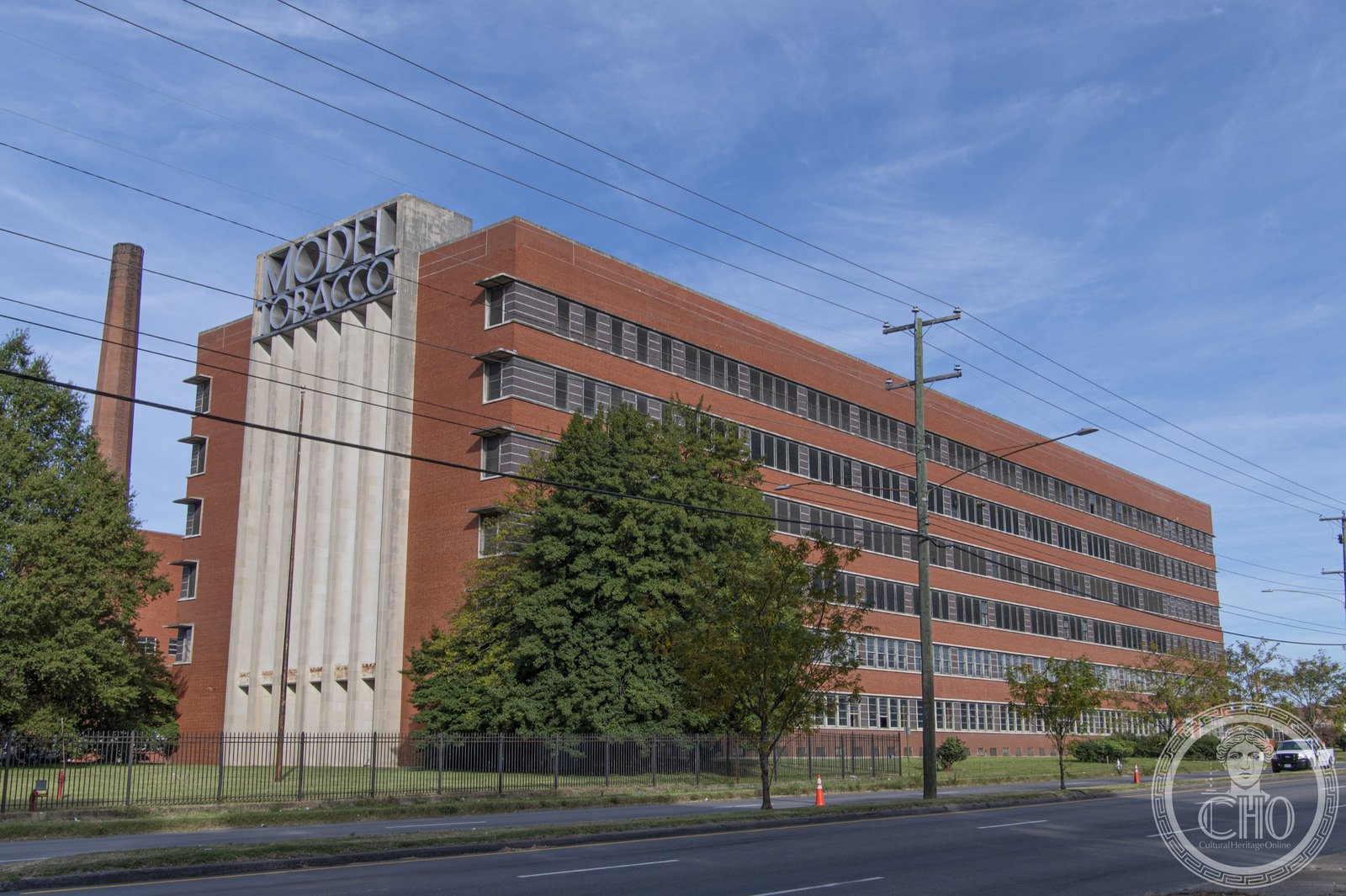
A Streamline Moderne tobacco factory on the south bank of the James River—an industrial building that turned functional mass into sculptural form, and later found new life as urban lofts.
At a glance
The Model Tobacco Building stands on Jefferson Davis Highway (US Route 1) in the Manchester neighborhood on the south bank of the James River in Richmond, Virginia. Built around 1940 for the Model Tobacco Company, the building is a significant example of Streamline Moderne industrial architecture—a style that brought the aerodynamic vocabulary of the late Art Deco era to factories, warehouses, and manufacturing facilities. Richmond’s position as a major tobacco manufacturing center gave the industry enough capital to invest in buildings that went beyond minimum functional requirements, and the Model Tobacco Building is the result: an industrial structure designed with the compositional confidence of a much more public building. Listed on the National Register of Historic Places, it has been adapted as residential lofts.
Key facts
- Built: c.1940
- Style: Streamline Moderne / Art Deco
- Original use: Tobacco manufacturing
- Current use: Residential lofts (Model Tobacco Lofts)
- Location: Jefferson Davis Highway (US Route 1), Manchester, Richmond, VA
- Designation: National Register of Historic Places
- GPS: 37.5178°N, 77.4396°W
History
Richmond’s relationship with tobacco predates the city itself: the Chesapeake region’s tobacco economy was the engine that drove colonial Virginia’s settlement, and by the nineteenth century, Richmond had become one of the leading tobacco manufacturing centers in the United States. The James River provided water power and transport; the rail connections brought tobacco from the Virginia and Carolina piedmont; and a labor force—long drawing on the city’s African American community, both enslaved before the Civil War and free afterward—processed the leaf into manufactured product. By the early twentieth century, firms including the American Tobacco Company, Liggett & Myers, and smaller manufacturers had built Richmond into a global tobacco capital.
The Model Tobacco Company occupied a niche in this ecosystem, and the building it constructed around 1940 on Jefferson Davis Highway reflects the tobacco industry’s readiness to invest in architecture even as the Depression was testing other sectors of the economy. The Streamline Moderne design—curving corners, continuous horizontal window bands, smooth rendered surfaces—was the dominant idiom for new industrial buildings in the late 1930s and early 1940s, reflecting an aesthetic consensus that even factories should aspire to visual coherence.
The building survived the decline of Richmond’s tobacco manufacturing industry in the postwar decades and the urban disinvestment that followed. Its conversion to residential lofts as part of Manchester’s broader revitalization represents the standard preservation narrative of industrial Art Deco buildings in American cities: adapted use brought renewed attention and investment, and the building’s listed status on the National Register gave the conversion project both historical legitimacy and access to tax incentives.
What you see
The building’s most striking feature is the way it deploys the Streamline Moderne vocabulary on an essentially rectangular industrial mass. The corners are rounded rather than squared—a design element borrowed from product design and automotive styling that, at architectural scale, reads as simultaneously modern and sculptural. The horizontal window bands emphasize the factory’s length and low profile, echoing the emphasis on speed and flow that characterized the Streamline aesthetic in all its applications. The smooth surfaces, unbroken by the rustication or ornamental detailing typical of earlier industrial buildings, give the facade a visual cleanness that has aged better than the ornamental excesses of some contemporaries.
The building’s setting along Jefferson Davis Highway—a major regional road corridor—means it was designed to be read at speed from passing vehicles as well as on foot: the Streamline design is accordingly legible at multiple distances and speeds. From the south bank of the James River, with the downtown Richmond skyline across the water, the building reads as a horizontal counterpoint to the vertical towers of the opposite bank.
Practical information
- Access: Private residential building; exterior freely viewable from Jefferson Davis Highway
- Best viewing: From the sidewalk on Jefferson Davis Highway; also visible from the Manchester Bridge pedestrian path
- Time needed: 10–15 minutes for exterior
- Neighborhood: Manchester, a revitalizing area with cafes, galleries, and the Virginia Capital Trail (cycling/walking)
Getting there
The Model Tobacco Building is in the Manchester neighborhood on the south bank of the James River, across from downtown Richmond. By car from I-95, take Exit 74A for US Route 60 West / Belt Boulevard and proceed north toward the James River; Jefferson Davis Highway (US Route 1/301) runs north-south through Manchester. The building is visible from the road. From downtown Richmond, the Manchester Bridge (14th Street Bridge) connects the financial district directly to Manchester. The Virginia Capital Trail passes nearby for cyclists; the nearest bus routes follow Semmes Avenue and Midlothian Turnpike into Manchester.
Nearby
- Manchester Climbing Wall — converted industrial building adjacent to the James River, Manchester’s outdoor recreation focus
- Virginia Capital Trail — 55-mile cycling and walking trail from Richmond to Williamsburg, its northern end near the Manchester waterfront
- Maymont — Victorian estate and nature center on the north bank of the James, a Richmond landmark accessible via the Boulevard Bridge
- James River Park System — urban whitewater, trails, and access points along both banks of the James through central Richmond
Sources
- National Register of Historic Places, Model Tobacco Company Building, U.S. Department of the Interior
- Virginia Department of Historic Resources, Survey Files, Richmond (dhcd.virginia.gov)
- Library of Congress, Historic American Buildings Survey / HAABS, Richmond industrial surveys
- Library of Virginia, Richmond industrial survey records and Virginia Business History Collection (lva.virginia.gov)
- Wikimedia Commons — image CC BY-SA 4.0
Find it on the map
See this place and what’s around it →📷 Become a Cultural Heritage Online photographer
Share your photos of places: they stay published under your name as the author. The more they're seen, the more you get noticed — and soon a contest will reward the most appreciated photos.
Log in or sign up free to add a photoDo you manage this place?
This page is read by travellers and heritage enthusiasts who find it on Google. Keep it accurate — and make it work for you. Free for non-profit heritage institutions.