
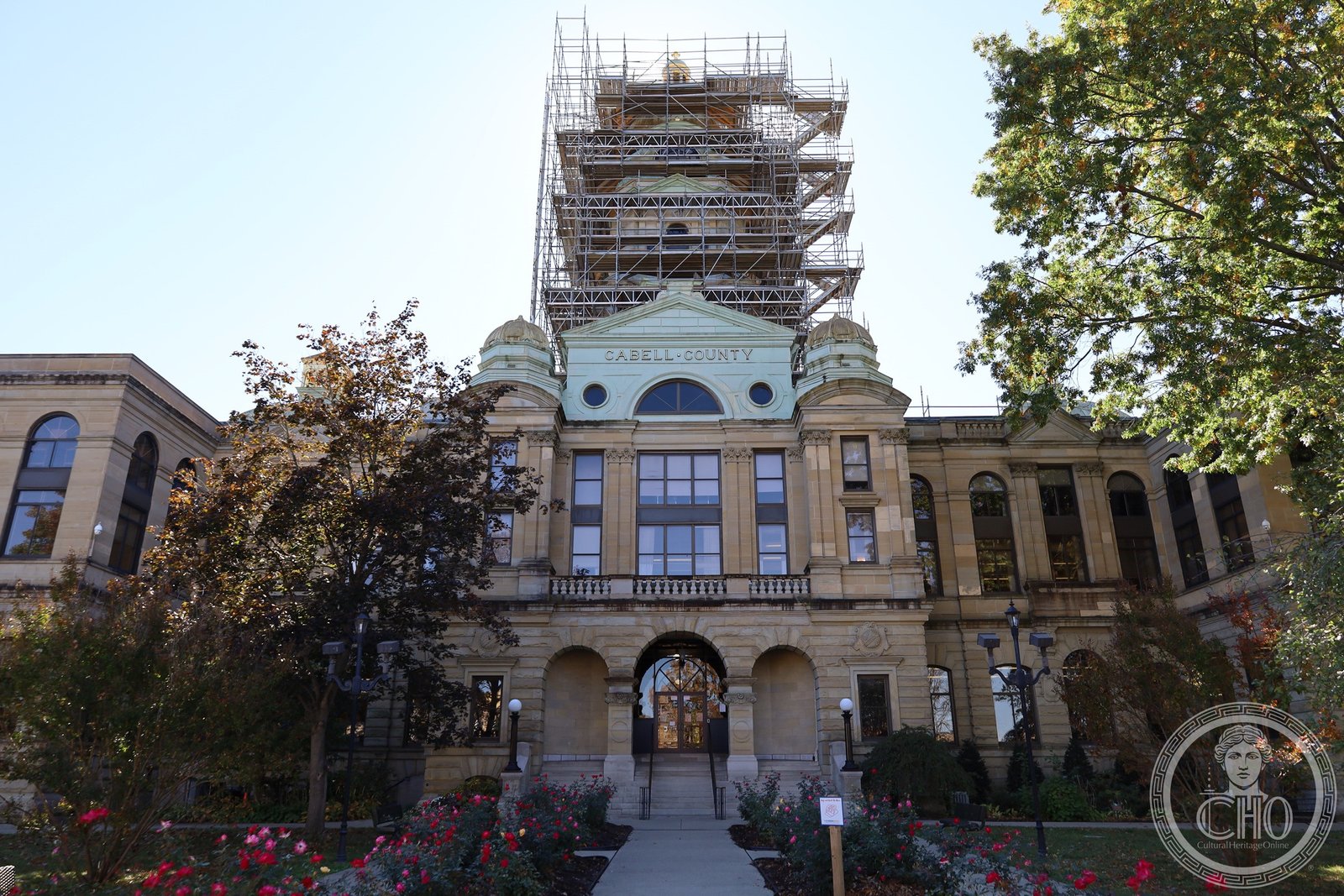
A late 1930s Art Deco courthouse rising from the heart of West Virginia’s second-largest city, where the New Deal’s investment in public architecture left a permanent mark in limestone and steel.
At a glance
The Cabell County Courthouse stands at 750 5th Avenue in downtown Huntington, West Virginia, a Streamline Moderne building completed in 1939 that represents the federal government’s investment in civic infrastructure at the close of the New Deal era. Huntington, the county seat of Cabell County, sits at the tripoint where West Virginia, Kentucky, and Ohio meet along the Ohio River—a geographic position that made it a significant rail, river, and commercial center throughout the early twentieth century. The courthouse’s clean horizontal lines, restrained Art Deco ornament, and commanding siting on a downtown block give it a presence that endures despite the architectural changes of the postwar decades around it.
Key facts
- Completed: 1939
- Style: Art Deco / Streamline Moderne
- Function: County courthouse (government offices, courts)
- Location: 750 5th Avenue, Huntington, WV 25701
- County: Cabell County, West Virginia
- GPS: 38.4197°N, 82.4452°W
History
Cabell County was formed in 1809 and named for William H. Cabell, governor of Virginia at the time—Huntington would not become part of the new state of West Virginia until 1863. The city itself was founded in 1871 by Collis P. Huntington, the railroad magnate who made it the western terminus of the Chesapeake and Ohio Railway. By the 1930s, Huntington had grown into a substantial industrial and commercial city, its economy rooted in railroads, glass manufacturing, and Ohio River trade.
The 1939 courthouse replaced an earlier structure and was built during the waning years of the New Deal, when the federal government still channeled significant resources into public buildings across the country. The Streamline Moderne design reflects the aesthetic preferences of the late Depression era: less ornate than the high Art Deco of the late 1920s, the building uses horizontal bands, smooth surfaces, and simplified geometric detailing to convey efficiency, permanence, and institutional confidence. The choice of materials—limestone and steel—underscored the ambition to build something that would last.
Throughout the postwar decades the courthouse continued to serve Cabell County’s judicial and administrative functions, adapting to changing court caseloads and bureaucratic needs without the wholesale demolition and replacement that erased many comparable buildings in larger cities. Today it remains the county’s primary government building, still recognizable as a product of the era when American civic architecture aspired to more than functional adequacy.
What you see
The courthouse presents a symmetrical facade in which horizontal elements dominate: the continuous banding of the window floors, the flat roofline, and the recessed entrance bay all push the eye laterally rather than vertically. This is characteristic of the Streamline Moderne variant of Art Deco, which favored aerodynamic horizontal flow over the vertical ziggurat stepping of the earlier skyscraper Deco. The ornamental vocabulary—restrained carved panels, simplified pilasters, geometric metalwork at the entrance—is concentrated at the points of entry and transition, not distributed uniformly across all surfaces.
The materials read as civic without being grandiose: limestone gives the building gravity and permanence, while the steel window frames and metalwork of the entrance doors signal modernity. The building’s ground-floor base anchors it firmly to its street; the upper floors recede slightly, creating a subtle monumentality that works at pedestrian scale rather than requiring distance to appreciate.
Practical information
- Access: Public building; accessible during court hours (Monday–Friday)
- Location: Downtown Huntington, 750 5th Avenue at 8th Street
- Parking: Street parking and public lots within one block
- Time needed: 15–20 minutes for exterior; interior access depends on court schedule
Getting there
Huntington is served by Tri-State Airport (Huntington, WV), approximately 10 miles west of downtown. By car from Interstate 64, take Exit 11 for US Route 60 into downtown Huntington; the courthouse is on 5th Avenue between 8th and 9th Streets in the core of the central business district. Marshall University, one of West Virginia’s major universities, occupies a campus immediately east of downtown and generates significant foot traffic through the area. Amtrak’s Cardinal line connects Huntington with Chicago and Washington DC, with the Huntington station on 8th Street a short walk from the courthouse.
Nearby
- Keith-Albee Performing Arts Center (1928), 4th Avenue — Art Deco theatre two blocks west, one of Huntington’s best-preserved Deco interiors
- Huntington Museum of Art — 11th Street W, one of the largest art museums in the mid-Atlantic Appalachian region
- Heritage Farm Museum — Huntington, interpretive history of Appalachian rural life
- Ohio River waterfront — Ritter Park and the riverfront promenade, a few blocks north of downtown
Sources
- West Virginia State Archives, county government records — archives.wvculture.org
- National Register of Historic Places, Cabell County Courthouse records, U.S. Department of the Interior
- West Virginia Encyclopedia, “Huntington,” wvencyclopedia.org
- West Virginia Historic Preservation Office, Survey Files
- Wikimedia Commons — image CC BY-SA 4.0
Find it on the map
See this place and what’s around it →📷 Become a Cultural Heritage Online photographer
Share your photos of places: they stay published under your name as the author. The more they're seen, the more you get noticed — and soon a contest will reward the most appreciated photos.
Log in or sign up free to add a photoDo you manage this place?
This page is read by travellers and heritage enthusiasts who find it on Google. Keep it accurate — and make it work for you. Free for non-profit heritage institutions.