

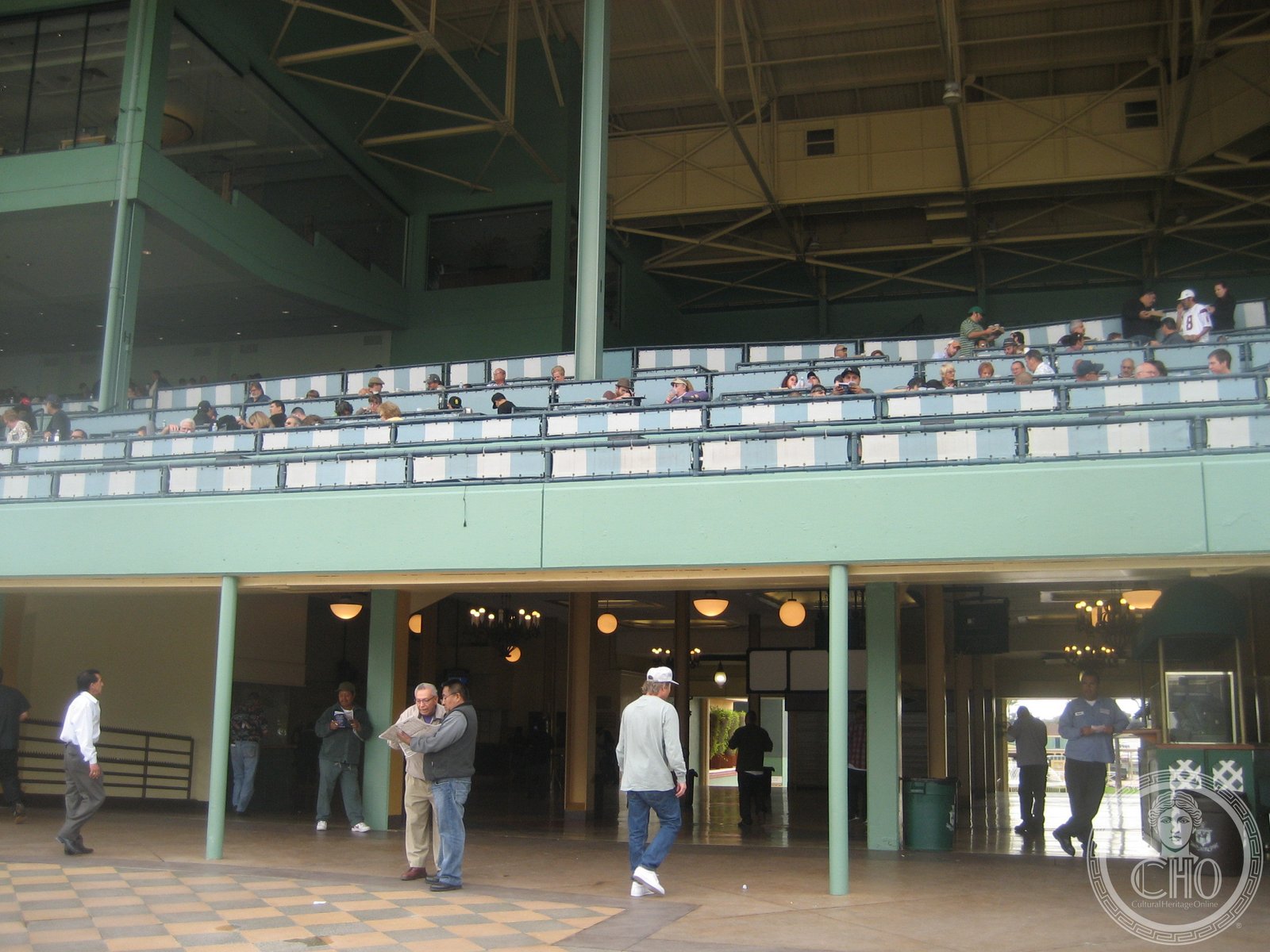
California's finest Art Deco racetrack, opened Christmas Day 1934, with a Gordon Kaufmann grandstand and the San Gabriel Mountains as backdrop — and the track where Seabiscuit made history.
At a glance
Santa Anita Park opened December 25, 1934, at the base of the San Gabriel Mountains in Arcadia, California, and became almost immediately the most celebrated racetrack in America. Designed by Gordon Kaufmann — the same architect who shaped the architectural vocabulary of Hoover Dam's powerhouse — the grandstand and Turf Club translate the horizontal speed-lines and stripped ornament of California Moderne into a building meant to evoke motion, wealth, and precision. Within four years of opening, the track hosted Seabiscuit's most famous races, permanently connecting Santa Anita to the mythology of American Depression-era resilience. The track operates today under the same Art Deco grandstand, now on the National Register of Historic Places.
Key facts
- Opened: December 25, 1934
- Architect: Gordon Kaufmann (grandstand and Turf Club)
- Address: 285 West Huntington Drive, Arcadia, CA 91007
- GPS: 34.1469°N, -118.0425°W
- Status: National Register of Historic Places
- Style: California Art Deco / Streamline Moderne
- Notable events: Seabiscuit vs. Ligaroti (1938), Seabiscuit's final race (1940), Breeders' Cup (recurring)
History
The land beneath Santa Anita Park was once part of Elias Jackson “Lucky” Baldwin's Rancho Santa Anita, the vast agricultural estate that defined 19th-century Arcadia. Racing had been attempted on the property before — a short-lived track in the 1890s drew crowds from Los Angeles — but the facility closed along with most California racing after progressive-era campaigns against gambling. When California legalized pari-mutuel wagering in 1933, a group of investors moved quickly: ground was broken in 1934 and the track opened eleven months later on Christmas afternoon.
Gordon Kaufmann (1888–1949), an English-born architect who had emigrated to Southern California and built a reputation designing Caltech buildings and country estates in Pasadena, received the commission for the grandstand and Turf Club. His approach echoed the clean horizontal volumes and geometric ornament he was developing simultaneously for Hoover Dam's Nevada intake towers and powerhouse facade — a controlled Art Deco that prioritized mass and proportion over applied decoration. The result at Santa Anita is a long, low grandstand that reads from the track as a single horizontal band, punctuated by the Turf Club tower and the ornamental entrance gates.
Seabiscuit had raced unsuccessfully at Santa Anita in 1937 and 1938 — he lost the Santa Anita Handicap by a nose in 1938. In March 1940, in what would be his final race, he returned to Santa Anita and won the Handicap at last, cementing his place in American Depression-era mythology. In 1942, the racetrack was requisitioned by the federal government and used as an assembly center for Japanese Americans awaiting internment — an abrupt pause in the track's otherwise triumphant early history that is now commemorated at the site.
What you see
The grandstand occupies the north side of the oval track, facing south, and the San Gabriel Mountains rise directly behind it from the track's perspective — a natural stage backdrop that no other major American racetrack can match. The main facade, facing away from the track toward Huntington Drive, shows Kaufmann's restraint: the building is horizontal and low-slung, its surface articulated by recessed window banding and a shallow central projection at the main entrance pavilion. The ornament, where it exists, is geometric — stepped moldings, stylized frieze panels, the aluminum lettering of “Santa Anita Park” in the characteristic blocky typeface of 1930s California commercial design.
The Turf Club interior, where members and their guests sit above the general grandstand, retains much of its original 1934 finish: terrazzo floors, wrought-iron railings with geometric motifs, and the curved glass wall that angles the interior toward the finish line. The infield is planted with formal gardens, including the mature jacaranda trees that bloom purple in late spring during the racing season, and a lake at its center reflects the mountain backdrop. Walking the property during a race day, the scale of the grandstand — designed for crowds of tens of thousands — makes the Art Deco language of horizontal speed and optimism viscerally comprehensible in a way no photograph quite captures.
Practical information
- Racing season: Thoroughbred racing roughly December through June (check Santa Anita Park official schedule)
- Admission: General admission available on race days; Turf Club requires membership or guest pass
- On non-race days: The grounds are generally accessible for walking the infield gardens
- Parking: Extensive on-site parking available
- Best time: Early morning training hours (gates open around 7 a.m. during race meets) offer the grandstand nearly to yourself
Getting there
Santa Anita Park is 25 miles east of downtown Los Angeles in Arcadia. By car, take the I-210 (Foothill Freeway) to the Baldwin Avenue exit in Arcadia and follow signs south to the track. Metro Gold Line (now A Line) riders can disembark at the Santa Anita station in Arcadia, a 10-minute walk from the main gates. The adjacent LA County Arboretum shares parking and grounds access.
Nearby
- Los Angeles County Arboretum and Botanic Garden — immediately adjacent; formerly Lucky Baldwin's estate grounds, with the original Queen Anne Cottage (1881) still standing
- Pasadena City Hall (1927) — 8 miles west; Spanish Colonial Revival/Baroque civic monument
- The Gamble House (1908) — Pasadena; Greene & Greene Arts & Crafts masterpiece, 9 miles west
Sources
- National Register of Historic Places — Santa Anita Park nomination
- Santa Anita Park official historical records
- California Historical Resources Information System
- Kaufmann, Gordon: Papers, UCLA Special Collections
Find it on the map
See this place and what’s around it →Record researched and written by Luigi De Marchi for Cultural Heritage Online, 2026.
📷 Become a Cultural Heritage Online photographer
Share your photos of places: they stay published under your name as the author. The more they're seen, the more you get noticed — and soon a contest will reward the most appreciated photos.
Log in or sign up free to add a photo