
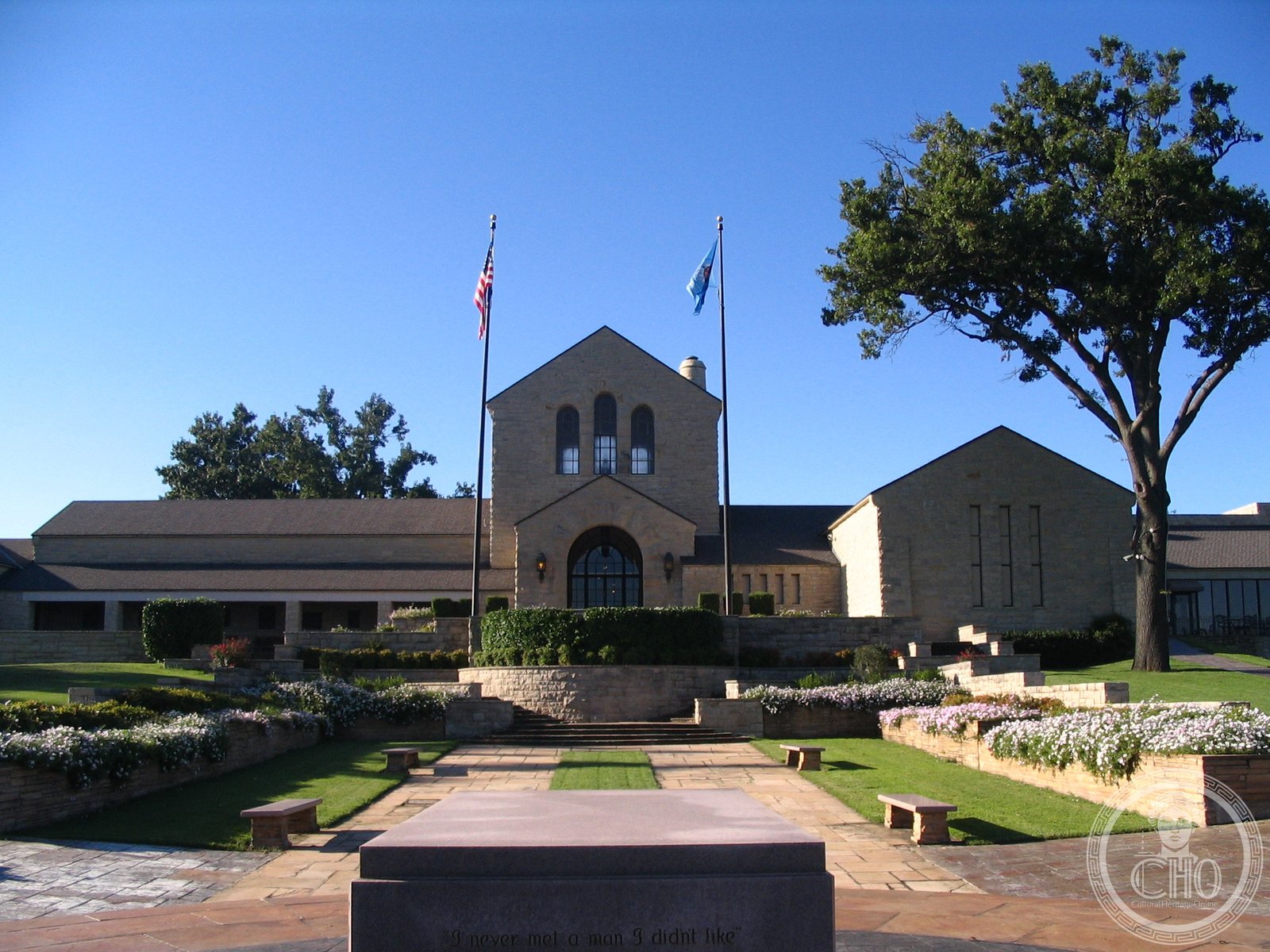
The official memorial museum and burial place of Will Rogers — America’s most celebrated humorist of the 1920s and 1930s — housed in a WPA Art Deco limestone building designed by John Duncan Forsyth and opened November 4, 1938, on what would have been Rogers’s 59th birthday.
At a glance
The Will Rogers Memorial Museum stands on a hill in Claremore, Oklahoma, the town closest to where Will Rogers was born in 1879 in the Cherokee Nation. The museum holds the papers, memorabilia, paintings, saddles, and film reels of one of the most genuinely popular Americans of his century: a Cherokee citizen who became the country’s leading vaudeville performer, radio comedian, newspaper columnist, and film actor, and who died in an Alaskan plane crash in 1935 at the peak of his fame. The WPA Art Deco building — faced in local Oklahoma limestone, formal in composition but warm in material — serves simultaneously as a civic monument and as a functioning museum, a combination that suits both its subject and its era.
Key facts
- Address: 1720 W Will Rogers Blvd, Claremore, Oklahoma 74017
- Architect: John Duncan Forsyth
- Style: Art Deco / WPA Federal
- Opened: November 4, 1938 (Rogers’s birth anniversary)
- Collection: Over 25,000 items — paintings, saddles, manuscripts, films, personal effects
- Burial site: Will Rogers, Betty Blake Rogers, and their infant son
- NRHP: Listed 1970
- Admission: Free (state-supported)
History
Will Rogers was born on November 4, 1879, near Oologah, Indian Territory — then part of the Cherokee Nation, now northeastern Oklahoma — to Clement Vann Rogers and Mary America Schrimsher Rogers, both of partial Cherokee descent. He grew up on the family cattle ranch before leaving in his twenties to work as a cowboy in Argentina and South Africa, then returning to the United States to launch a vaudeville career built on his skill with a lasso and his dry, improvisational wit. By the 1920s he was a national celebrity: a Broadway Ziegfeld Follies performer, a prolific film actor, and the most widely syndicated newspaper columnist in the country. His telegraphed daily commentaries on politics and public life ran in hundreds of papers.
Rogers died on August 15, 1935, in a plane crash near Point Barrow, Alaska, alongside aviator Wiley Post, who was piloting them on an exploratory flight toward Siberia. The shock of his death was genuinely national. Congress paid tribute; President Roosevelt delivered a radio address; theaters across the country went dark. Oklahoma moved quickly to memorialize him: the site in Claremore where Rogers had planned to build a retirement home was designated for a memorial museum. Congress authorized the project, WPA funds were allocated, and architect John Duncan Forsyth designed the building in the Art Deco/WPA Federal style consistent with New Deal-era public buildings across the country. The museum opened on November 4, 1938, three years to the month after Rogers’s death.
The museum has expanded several times since 1938, adding a research center, a children’s gallery, and dedicated archival storage for the Rogers collection, which grew as family members and collectors donated additional materials over the decades. The grounds include a bronze equestrian statue of Rogers by sculptor Jo Davidson, installed in 1939, and a reflecting pool. Rogers’s most famous aphorism — “I Never Met a Man I Didn’t Like” — is carved in stone near the entrance. His daughter Mary Rogers contributed significantly to the museum’s early collections.
What you see
The original 1938 building is a compact limestone-clad structure in the WPA Art Deco style: symmetrical, flat-roofed, with shallow decorative reliefs above the main entrance and metal-framed windows in the horizontal groupings typical of 1930s federal architecture. The use of local Oklahoma limestone — warm, buff-colored, roughly textured — gives the building an intimacy unusual for Art Deco federal commissions, most of which favor the cooler white marble or concrete found in Washington. The main facade is restrained but dignified, its massing communicating permanence without grandeur; it is the architecture of a place where people come to remember rather than to be impressed.
Inside, the twelve galleries trace Rogers’s life from the Cherokee Nation cattle country through his vaudeville years, his film career, and his newspaper columns. The collection includes saddles from his Wild West show performances, original film reels from his Fox and MGM pictures, manuscripts of newspaper columns, and photographs documenting his remarkable range of acquaintance: Roosevelt, Babe Ruth, Charlie Chaplin, Albert Einstein, Mussolini, Churchill. The bronze equestrian statue by Jo Davidson in the courtyard — Rogers in full cowboy regalia, twirling a lasso — was modeled from photographs and cast bronze shortly after his death.
Practical information
- Free admission: The museum is free to enter; donations are welcome
- Hours: Daily 8 am–5 pm (verify current hours at willrogers.com)
- Burial site: The tomb of Will and Betty Rogers is accessible in the grounds; respectful conduct requested
- Research library: The museum’s research library holds the Rogers papers and is open to qualified researchers by appointment
- Gift shop: Extensive selection of Rogers-related books, prints, and memorabilia
- Parking: Free on-site parking
Getting there
Claremore is located on US-66 (Route 66) approximately 25 miles northeast of Tulsa. From Tulsa, take I-44 East to Exit 255 (OK-20/Claremore), then north on OK-20 into Claremore; the museum is well signed from the highway. The drive from Tulsa takes about 30 minutes. The nearest commercial airports are Tulsa International Airport (TUL), 30 miles southwest, and Tulsa Transit provides bus service to Claremore via the Claremore Cimarron Connection route. By car from Oklahoma City, take I-44 East approximately 100 miles to the Claremore exit.
Nearby
- Will Rogers Birthplace Ranch, Oologah — the original family homestead cabin (Dog Iron Ranch) is preserved 15 miles north at Oologah Lake; the site includes the original log cabin where Rogers was born
- Gilcrease Museum, Tulsa — the premier collection of Western American art and Indigenous artifacts, 25 miles southwest; holdings include paintings by Remington, Russell, and Moran
- Philbrook Museum, Tulsa — a 1927 Italian Renaissance villa with fine arts collections; also 25 miles southwest
- Woolaroc Museum and Wildlife Preserve, Bartlesville — Frank Phillips’s Western art collection in a log lodge setting, 35 miles north
Sources
- Will Rogers Memorial Museum, About Will Rogers, willrogers.com
- Wikipedia, “Will Rogers Memorial Museum”
- Oklahoma Historical Society, Will Rogers biography
- Yagoda, Ben, Will Rogers: A Biography, Knopf, 1993
Find it on the map
See this place and what’s around it →📷 Become a Cultural Heritage Online photographer
Share your photos of places: they stay published under your name as the author. The more they're seen, the more you get noticed — and soon a contest will reward the most appreciated photos.
Log in or sign up free to add a photoDo you manage this place?
This page is read by travellers and heritage enthusiasts who find it on Google. Keep it accurate — and make it work for you. Free for non-profit heritage institutions.