
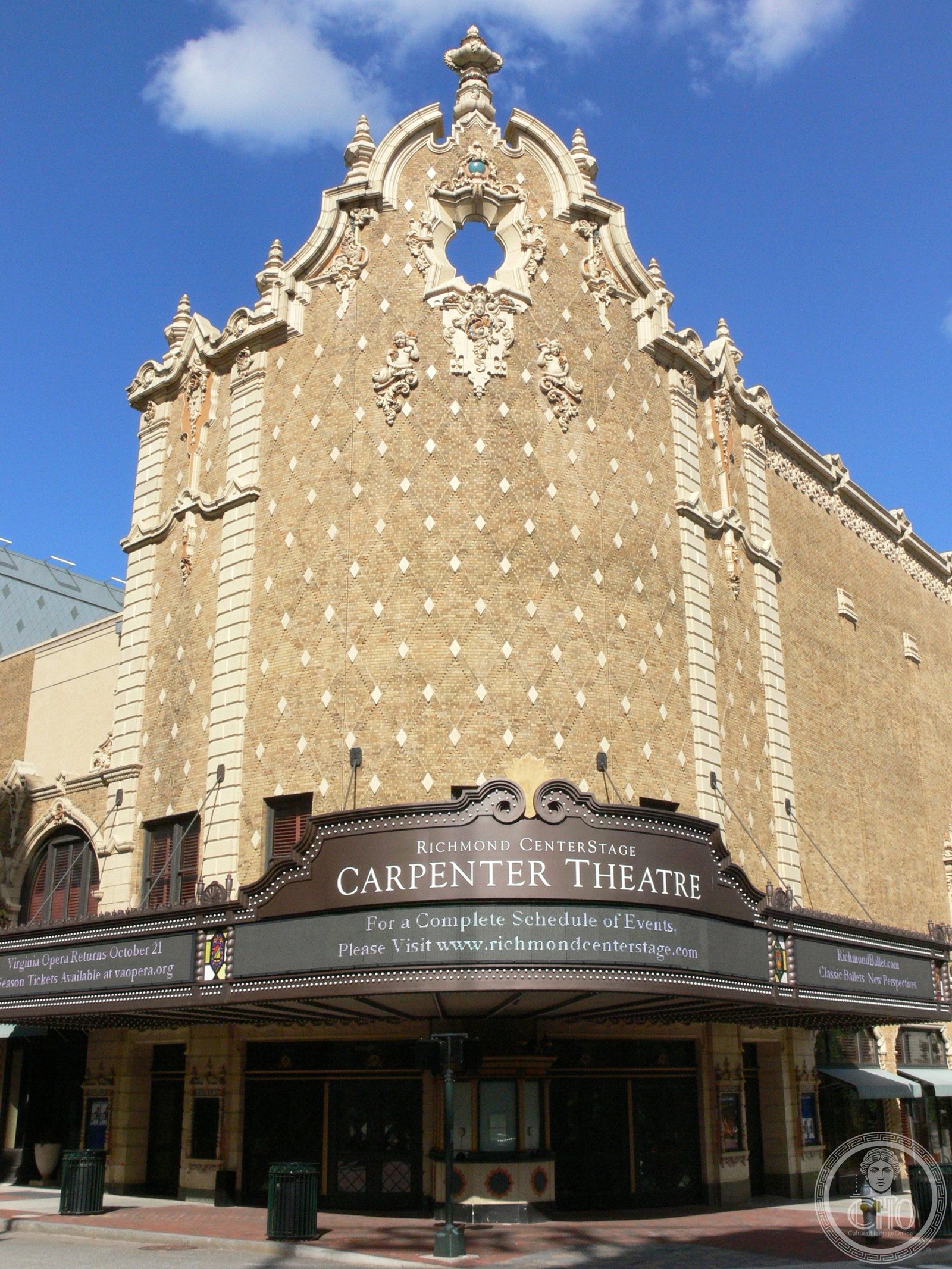
Built in 1928 on Grace Street in downtown Richmond, the theater now known as the Carpenter Theatre operated as a major commercial cinema for decades before transformation into a cornerstone of the Richmond CenterStage performing arts complex — a preservation story that mirrors the trajectories of grand movie palaces in American cities nationwide.
At a glance
Richmond, Virginia carries a historical weight that shapes everything built within its bounds: the capital of the Confederacy from 1861 to 1865, a city whose antebellum residential and commercial architecture survived the Civil War and Reconstruction to become among the most complete Victorian streetscapes in the American South, and a city that spent the twentieth century negotiating between its complicated historical identity and its role as the capital of Virginia’s contemporary economic and cultural life. The Carpenter Theatre, built in the year that Herbert Hoover was elected president and the American economy approached its moment of maximum expansion before the Depression, represents the optimistic investment in commercial entertainment infrastructure that the late 1920s supported in mid-sized American cities. The building has found a second purpose in the Richmond CenterStage arts complex, a public-private initiative that has made it the anchor of a performing arts campus in Richmond’s downtown core.
Key facts
- Built: 1928.
- Style: Art Deco / Atmospheric.
- Location: Grace Street, downtown Richmond, Virginia.
- Current operator: Richmond CenterStage — Virginia Repertory Theatre and presenting organization.
- GPS: 37.5410° N, −77.4400° W.
History
Richmond in 1928 was a city with an established theater tradition that predated the cinema by several decades: the Mechanic’s Hall, the Lyric Theatre, and other venues had served Richmond’s entertainment life before the film medium established its dominance in the 1910s and 1920s. The theater that would become the Carpenter was built in the late sound era — the conversion from silent film to talkies had happened in 1927-1929, and the theaters constructed at the turn of the 1930s were designed from the outset for amplified sound. The atmospheric decorative program that many 1920s theaters employed — the ceiling painted to simulate an outdoor sky, the ornamental program evoking Mediterranean or Moorish architectural vocabularies — suited Richmond’s audience and its expectation of the cinema as a space of escape from the city outside.
The subsequent decades brought the same pressures that ended the commercial lives of most American movie palaces: television, suburban multiplexes, and the disinvestment in downtown commercial districts that characterized mid-twentieth-century American urban development. Richmond’s decision, through the CenterStage initiative, to invest in the Grace Street building as a performing arts venue rather than allow its demolition or conversion to other uses represents the kind of civic commitment to the built inheritance of the twentieth century that has become increasingly common in cities that recognize the value of their Art Deco-era commercial buildings as cultural infrastructure.
The Carpenter Theatre name honors Walter Cecil Carpenter Jr., a prominent Virginia business leader whose support was instrumental in the building’s transformation into a performing arts center. The building now houses Virginia Repertory Theatre’s productions and serves as a presenting venue for touring companies and concerts, making it the primary professional theater in Richmond’s downtown core.
What you see
The Carpenter Theatre’s Grace Street facade is a substantial Art Deco composition whose scale reflects the ambition of a late-1920s commercial cinema in a mid-sized American city. The decorative program at the upper facade and the entrance canopy announce the building’s identity as an entertainment venue distinct from the office buildings and retail stores of the surrounding downtown blocks. The interior restoration has preserved the decorative character of the original atmospheric design while adapting the technical systems for contemporary theatrical production.
The Richmond CenterStage complex situates the Carpenter Theatre within a broader arts infrastructure that includes additional performance spaces and support facilities. The campus approach — a cluster of related performance venues rather than a single standalone building — is a characteristic development strategy for performing arts investment in American cities since the 1990s, and the Carpenter’s role as the complex’s primary anchor space reflects its scale and decorative quality.
Practical information
- Events: Virginia Repertory Theatre productions, touring Broadway productions, concerts; check the Richmond CenterStage calendar.
- Tickets: available online through Virginia Repertory and CenterStage box offices.
- Parking: downtown Richmond parking garages near Grace Street; GRTC transit connects to the downtown core.
- Time needed: allow time for the performance plus a walk through Richmond’s historic downtown blocks toward the Virginia State Capitol.
Getting there
Richmond International Airport (RIC) is approximately 8 miles east of downtown via Interstate 64 and Interstate 95; the airport connects to Charlotte, Atlanta, New York, and Washington Dulles. Amtrak’s Main Street Station serves Richmond with Northeast Corridor service and Carolinian/Piedmont service south toward Charlotte and Raleigh; the station is approximately 0.5 miles south of the theater along 14th Street. Interstate 95, the primary north-south corridor of the East Coast, passes through downtown Richmond with several exits serving the Grace Street area.
Nearby
- Virginia State Capitol — Thomas Jefferson’s design (1788), modeled on the Maison Carrée in Nîmes, France; one of the oldest state capitols in continuous use in the United States; approximately 3 blocks north on Capitol Square.
- Jefferson Hotel — Richmond’s grand Beaux Arts hotel (1895), notable for its Grand Staircase and Rotunda; a National Historic Landmark on Franklin Street; 0.3 miles north.
- Virginia Museum of Fine Arts — one of the largest art museums in the American South, with encyclopedic collections and a notable Art Nouveau and Art Deco decorative arts collection; approximately 1.5 miles west on Boulevard.
- Richmond Canal Walk — a 1.25-mile walk along the James River Kanawha Canal, one of the oldest canals in North America; connects the Shockoe Bottom historic district to the downtown core; 0.5 miles south.
Sources
- Richmond CenterStage / Virginia Repertory Theatre — venue history and programming.
- Valentine Museum, Richmond — Richmond commercial and architectural history.
- Virginia Department of Historic Resources — downtown Richmond architectural surveys.
- Historic Richmond Foundation — Grace Street district documentation.
- Wikimedia Commons — building image.
Find it on the map
See this place and what’s around it →Record researched and written by Luigi De Marchi for Cultural Heritage Online, 2026.
📷 Become a Cultural Heritage Online photographer
Share your photos of places: they stay published under your name as the author. The more they're seen, the more you get noticed — and soon a contest will reward the most appreciated photos.
Log in or sign up free to add a photoIs this page about you?
This page is read by travellers and heritage enthusiasts who find it on Google. Tell us how you are connected to this place and we will take it from there.