
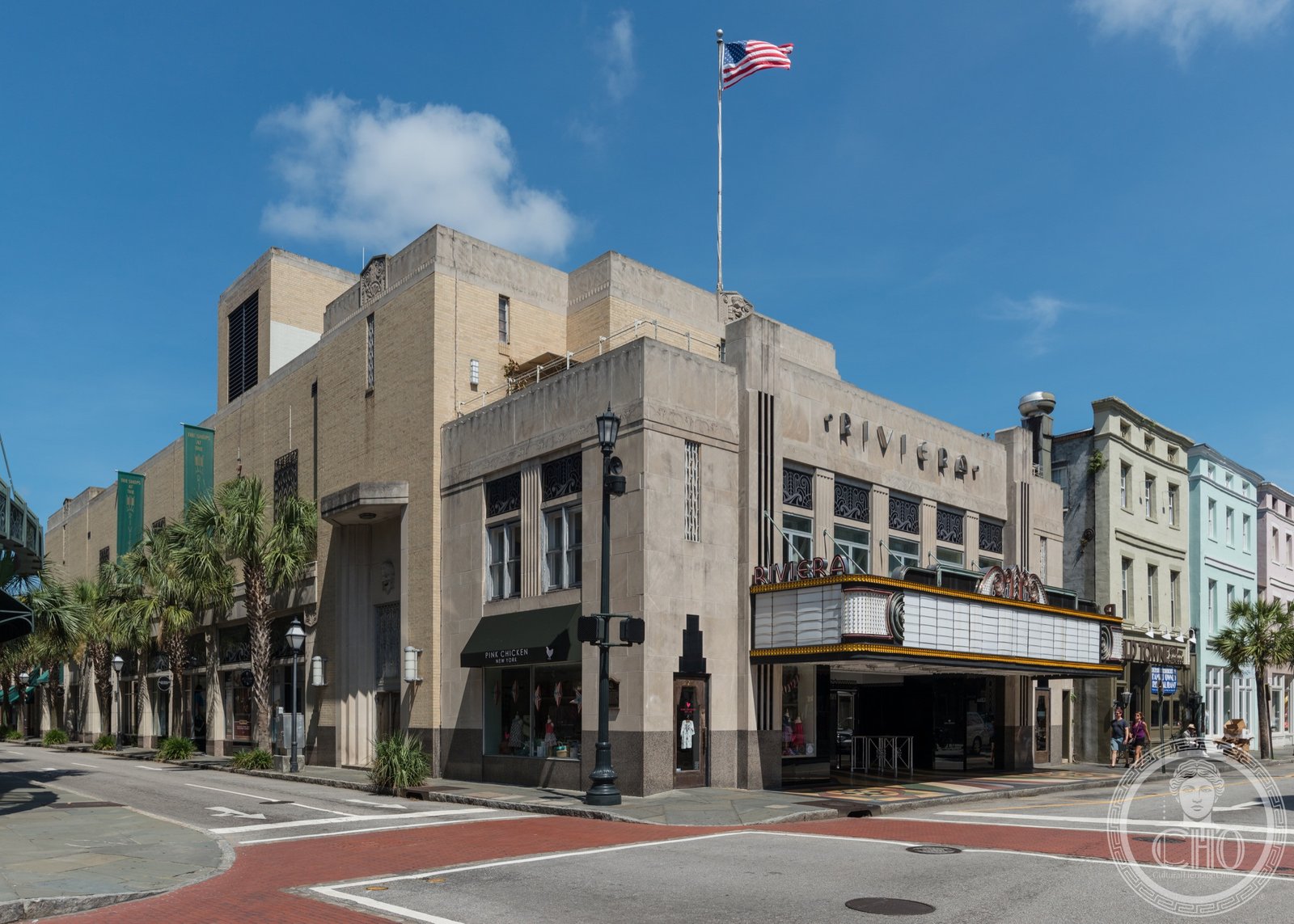
Opened in 1939 on King Street, Charleston’s principal commercial artery, the Riviera Theatre brought Art Deco cinema to a city whose architectural identity was built almost entirely on the colonial and antebellum heritage — a deliberate statement that the twentieth century had arrived in one of America’s oldest cities.
At a glance
King Street runs the length of Charleston’s downtown peninsula from the Old City Market south through the commercial and residential districts toward the Battery, and the variety of architecture along it represents the full span of the city’s commercial history. The colonial merchants’ buildings, the Greek Revival storefronts of the antebellum decade, and the brick commercial blocks of the late nineteenth century are all present; the Riviera’s 1939 Art Deco facade introduced a vocabulary that Charleston’s earlier commercial streetscape had not seen. The city that built Fort Sumter’s defenders and trained the nineteenth century’s great civil engineers was adding a cinema to King Street in the year that Hollywood released Gone with the Wind — the timing is hard to miss. The Riviera has operated as a music venue since its cinema days ended, and its neon marquee on King Street remains one of the most recognizable signs in downtown Charleston.
Key facts
- Built: 1939.
- Style: Art Deco.
- Address: 225 King Street, Charleston, South Carolina 29401.
- Location: King Street Historic District, downtown Charleston peninsula.
- Current use: Concert venue / live music.
- GPS: 32.7769° N, −79.9421° W.
History
Charleston’s film culture in the 1930s was centered on King Street, where several movie palaces served the city’s white and Black communities in the segregated South — separate theaters, separate entrances, separate stories for what the cinema meant in a city with Charleston’s social history. The Riviera opened at the end of the decade that had established sound film as the dominant medium and established the movie palace as the definitive American commercial building type. The Art Deco vocabulary it employed was the national standard of that moment: geometric ornament, streamlined surfaces, neon signage that made the building visible from the street at night as a destination separate from the daylight retail environment.
Charleston’s preservation culture, which had established the Old and Historic Charleston District in 1931 — the first historic preservation ordinance in the United States — shaped the context in which the Riviera was built. The city that preserved its colonial and antebellum buildings more systematically than almost any other American city was simultaneously building Art Deco theaters on its main commercial street, a juxtaposition that has become one of the defining features of the King Street streetscape. The Riviera’s survival as an operating venue, rather than the conversion or demolition that ended many American cinema buildings, reflects the preservation ethic that has shaped how Charleston manages its built environment.
The building’s later life as a concert venue placed it in a different relationship with the city’s social history: King Street has become the center of Charleston’s nightlife and entertainment economy, and the Riviera’s music programming has connected it to the city’s African American musical traditions — blues, jazz, gospel, and rhythm and blues — that the original cinema’s segregated operation had excluded from its audience.
What you see
The Riviera’s King Street facade is an Art Deco composition in the vocabulary of the late 1930s: smooth stucco surfaces, geometric ornament concentrated at the upper facade and the marquee canopy, and the neon sign that extends vertically above the entrance to mark the building’s position on the street from a distance. The building reads as distinctly mid-twentieth century against the brick commercial blocks on either side — not a rupture in the streetscape, but a different accent within it.
Inside, the auditorium has been adapted for live music performance. The original single-screen cinema configuration gave way to a standing-room concert floor; the stage replaces the screen; the acoustic volumes of the room serve the amplified performance differently than they served film projection. The transition is legible to anyone who has spent time in converted American cinemas, and the Riviera’s is among the more coherent examples: the room’s proportions remain those of a 1939 movie palace, even when what happens on its stage is not what its architects imagined.
Practical information
- Events: national touring acts, local Charleston musicians, and occasional events; check The Riviera Charleston calendar.
- Tickets: available online for scheduled events.
- Parking: street parking on King Street; city parking garages within 2 blocks on Queen Street and Wentworth Street.
- Time needed: allow time for the event plus a walk along the full length of King Street’s historic commercial blocks.
Getting there
Charleston International Airport (CHS) is approximately 12 miles northwest of downtown via Interstate 26 and US Route 17; the airport connects to major hubs including Atlanta, Charlotte, New York, and Washington. The downtown Charleston peninsula is compact enough to walk; King Street extends roughly 2.5 miles from the Old City Market to the Battery and is the organizing spine of the commercial district. The Charleston Area Regional Transportation Authority (CARTA) operates a downtown free shuttle on the DASH trolley route along Meeting and King Streets.
Nearby
- Charleston Museum — founded 1773, the oldest museum in the United States; natural history, decorative arts, and Charleston social history collections; 0.5 miles north on Meeting Street.
- College of Charleston — founded 1770, the oldest college in South Carolina; historic campus with buildings dating to the antebellum period; adjacent to King Street’s northern commercial district.
- Old City Market — the covered market hall at the north end of Market Street, operating since 1807; sweetgrass basket weavers and artisans; 0.5 miles northeast.
- Waterfront Park — pineapple fountain and promenade along the Cooper River waterfront, east of the peninsula; views of Fort Sumter and the harbor entrance; 0.8 miles east.
Sources
- The Riviera Charleston — venue history and programming.
- Charleston Preservation Society — King Street Historic District documentation.
- Historic Charleston Foundation — South Carolina architectural surveys.
- South Carolina Department of Archives and History — commercial building records.
- Wikimedia Commons — building image.
Find it on the map
See this place and what’s around it →Record researched and written by Luigi De Marchi for Cultural Heritage Online, 2026.
📷 Become a Cultural Heritage Online photographer
Share your photos of places: they stay published under your name as the author. The more they're seen, the more you get noticed — and soon a contest will reward the most appreciated photos.
Log in or sign up free to add a photoIs this page about you?
This page is read by travellers and heritage enthusiasts who find it on Google. Tell us how you are connected to this place and we will take it from there.