
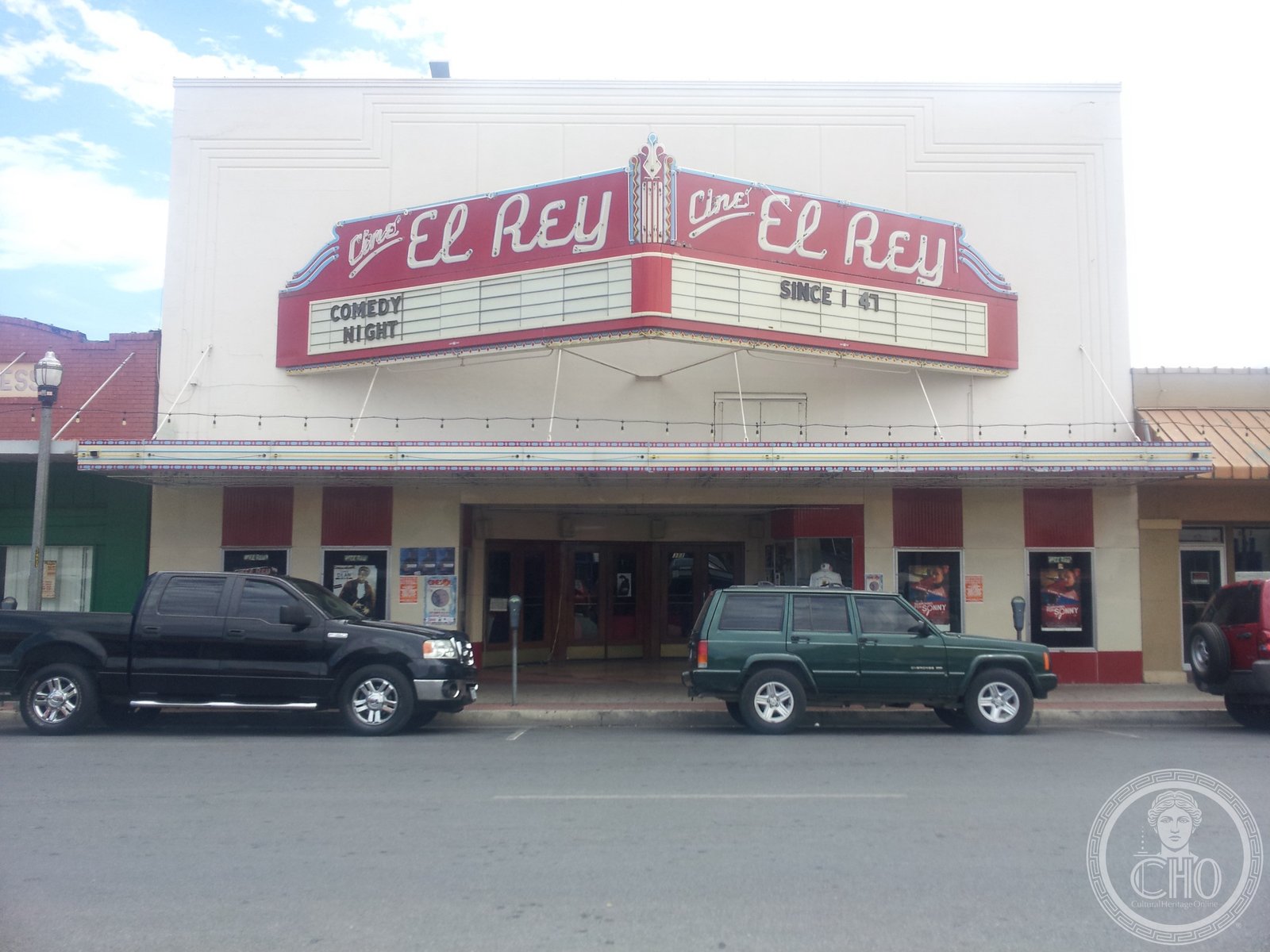
Built in the mid-twentieth century to serve McAllen’s predominantly Spanish-speaking community, the El Rey Theatre — Cine El Rey — brought Art Deco architecture to the Rio Grande Valley at a moment when the border region was developing its own visual culture distinct from both the Anglo Texas interior and the Mexican cities across the river.
At a glance
McAllen sits at the southern tip of Texas, in the Rio Grande Valley that separates the United States from Mexico along the river’s lower course. In the mid-twentieth century, the city’s commercial downtown served a population that was — and remains — overwhelmingly Hispanic, the descendants of the ranching families who had worked this land before it became American territory in 1848 and the migrants from the Mexican interior who had built the region’s agricultural economy through the twentieth century. The El Rey Theatre — “The King,” as its Spanish name translates — was a cinema built for this community: its name in Spanish announced its intended audience, its Art Deco styling matched the architectural ambitions of the period, and its programming in Spanish-language films served a market that Hollywood’s major studios were increasingly targeting as the postwar economy created new consumer spending across the border region. The building has since been adapted for community performing arts use and is listed on the National Register of Historic Places.
Key facts
- Built: circa 1947
- Style: Art Deco
- Name: El Rey Theatre (Cine El Rey — “Cinema the King”)
- Location: Downtown McAllen, Texas
- Current use: Community performing arts center
- GPS: 26.2040° N, −98.2301° W
- Status: National Register of Historic Places
History
The Rio Grande Valley in the 1940s was undergoing rapid economic transformation. The agricultural economy — cotton, citrus, vegetables, and the labor that harvested them — had generated sufficient wealth to support an expanding urban infrastructure in the valley’s cities, including McAllen, Harlingen, Brownsville, and the surrounding towns. The cinema was a central institution in this urban life, and in a community where Spanish was the first language of the great majority of residents, a theater named in Spanish and programmed in Spanish was a natural commercial proposition.
The El Rey operated through the golden era of Spanish-language cinema in the United States, a market served by both Mexican productions (which dominated the Spanish-language film industry in the postwar decades) and the Hollywood studios that produced Spanish-dubbed versions of their American releases. The audience was the Rio Grande Valley’s Mexican American community, increasingly settled and increasingly prosperous in the postwar expansion, but still culturally and linguistically distinct from the Anglo communities that patronized the English-language theaters elsewhere in the downtown.
The building’s later history followed the pattern of many urban cinemas: decline as television and suburban entertainment drew audiences away, eventual closure as a movie house, and eventual recognition of its architectural and cultural significance. Listing on the National Register of Historic Places brought the building back to active community use as a performing arts venue serving the valley’s arts and cultural organizations.
What you see
The El Rey’s facade is a mid-century Art Deco composition in the commercial vernacular of the postwar Texas border: the simplified geometric ornament, the vertical emphasis of the name display, and the stepped parapet that reads as distinctly of its era against the flat South Texas sky. The building belongs to the phase of Art Deco that prevailed in smaller American cities after World War II — stripped of the elaborate ornamental programs of the 1930s but retaining the clean geometric vocabulary and the upward visual thrust that the style had established as the language of entertainment architecture.
Inside, the auditorium has been adapted for flexible use as a performing arts space. The original single-screen configuration has been modified to accommodate the requirements of live performance, but the spatial proportions of the original cinema design remain legible in the room’s volume.
Practical information
- Events: performing arts events, community programs, and cultural presentations; check the El Rey Theatre calendar
- Tickets: available online and at the venue for scheduled events
- Time needed: allow time for the event plus a walk through downtown McAllen’s commercial corridor
Getting there
McAllen-Miller International Airport (MFE) provides connections to Houston, Dallas, and Mexico City; the airport is approximately 5 miles north of downtown. Interstate 2 (the Expressway) runs east-west through the McAllen metropolitan area; US Highway 83 parallels the Rio Grande along the valley. The Hidalgo-Reynosa International Bridge, crossing to Reynosa, Tamaulipas, is approximately 5 miles south of downtown McAllen.
Nearby
- International Museum of Art & Science — regional art and science institution in McAllen, with programming that reflects the binational Rio Grande Valley culture; approximately 2 miles northeast at 1900 Nolana Avenue
- McAllen Botanical Garden — botanical collection emphasizing South Texas and Mexican native plants; 1 mile north on Bicentennial Boulevard
- Reynosa, Tamaulipas, Mexico — the sister city across the Hidalgo International Bridge, the most-crossed international bridge in the Rio Grande Valley
- Santa Ana National Wildlife Refuge — one of the most important birding sites in North America, approximately 8 miles southeast near Alamo TX, at the confluence of three migratory flyways
Sources
- El Rey Theatre, McAllen — venue history and programming
- National Register of Historic Places — McAllen El Rey Theatre nomination
- Hidalgo County Historical Commission — Rio Grande Valley theater history
- Texas Historical Commission — border region architectural surveys
- Wikimedia Commons — building image
Find it on the map
See this place and what’s around it →Record researched and written by Luigi De Marchi for Cultural Heritage Online, 2026.
📷 Become a Cultural Heritage Online photographer
Share your photos of places: they stay published under your name as the author. The more they're seen, the more you get noticed — and soon a contest will reward the most appreciated photos.
Log in or sign up free to add a photoIs this page about you?
This page is read by travellers and heritage enthusiasts who find it on Google. Tell us how you are connected to this place and we will take it from there.