
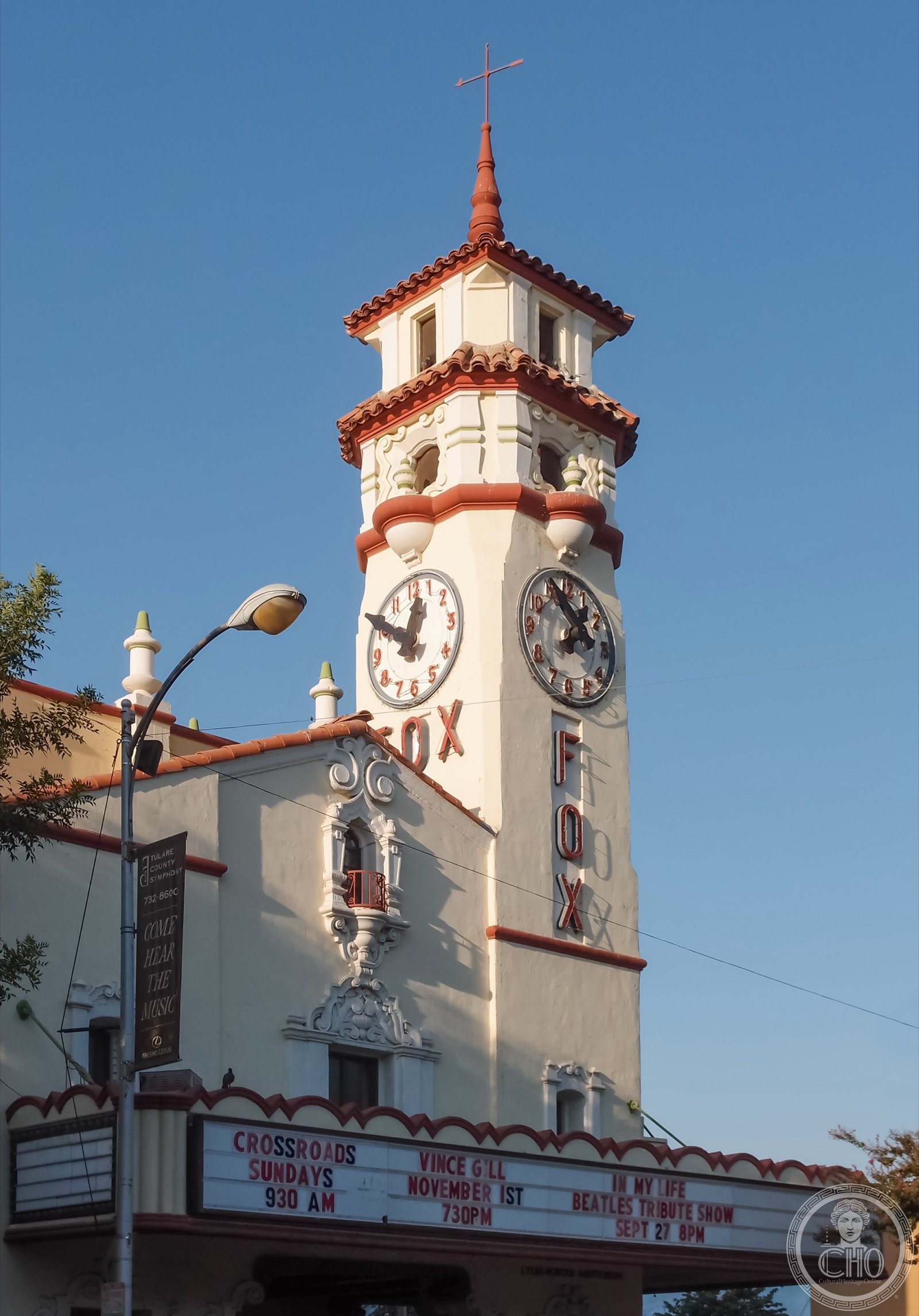
An intact Art Deco movie palace built for the Fox West Coast Theatres circuit in 1930, the Fox Theatre in downtown Visalia stands as the cultural anchor of Tulare County and one of the finest surviving examples of 1930s entertainment architecture in California’s San Joaquin Valley.
At a glance
The Fox Theatre at 300 West Main Street in downtown Visalia opened in 1930 as the premier first-run cinema for a prosperous agricultural county whose fields of citrus, grapes, cotton, and grain made it one of California’s most productive growing regions. Built by the Fox West Coast Theatres circuit — which constructed and operated a network of ornate movie palaces throughout California, Oregon, and Washington — the Visalia Fox was designed to bring metropolitan entertainment standards to a regional market. Its Art Deco facade of ivory-toned terracotta, its illuminated vertical marquee, and its carefully preserved auditorium interior have survived the consolidation of the entertainment industry to emerge as one of the Valley’s most visited performing arts venues. Today the theatre operates as a nonprofit performing arts center under the stewardship of the Fox Visalia Foundation.
Key facts
- Opened: 1930
- Address: 300 West Main Street, Visalia, California 93291
- Style: Art Deco (Zigzag Moderne), terracotta cladding, vertical marquee
- Capacity: Approximately 1,000 seats
- Original operator: Fox West Coast Theatres, a major California-based cinema circuit
- Current use: Performing arts center, live concerts, film screenings
- NRHP: Listed on the National Register of Historic Places
History
The Fox West Coast Theatres chain, headquartered in Los Angeles, built its California network during the 1920s and early 1930s by acquiring or constructing ornate picture palaces in cities across the state. Visalia — seat of Tulare County and the commercial hub of the south-central San Joaquin Valley — was a natural target for the circuit’s expansion. The Fox Theatre opened in 1930 at the moment when sound pictures had fully displaced silent films, making a premium cinema experience dependent on both the visual spectacle of the palace setting and the acoustic quality of the auditorium.
The building operated as a first-run Fox venue through the studio system era, screening major Hollywood releases for Tulare County audiences whose agricultural prosperity insulated the region somewhat from the worst of the Depression years. As the suburban multiplex era eroded the economics of single-screen downtown theatres in the 1960s and 1970s, the Fox passed through several ownership and use configurations before civic advocates organized the Fox Visalia Foundation to undertake restoration. The restored theatre reopened to regional acclaim and has since established a programming calendar mixing touring Broadway shows, pop and country music concerts, and classic film screenings.
The Fox Theatre’s survival is in part a function of Visalia’s relative stability as an agricultural service city; unlike urban cores in larger California cities, downtown Visalia was not subject to large-scale urban renewal demolitions in the postwar decades. The building’s listing on the National Register of Historic Places provided both symbolic recognition and practical protection during its most vulnerable years.
What you see
The Main Street facade presents the Zigzag Moderne vocabulary that Fox West Coast Theatres deployed across its California portfolio: a tower of cream-colored terracotta panels rises above the marquee canopy, ornamented with chevron banding, stylized geometric reliefs, and sunburst motifs that catch the Central Valley sun with emphatic clarity. The tall vertical sign — a signature element of the Fox chain’s house style — announces the building from several blocks’ distance along Main Street, its illuminated letters defining the theatre’s presence after dark as forcefully as the terracotta does by day. The main entrance is framed by engaged pilasters with stylized capitals and a continuous band of ornament at cornice level.
Inside, the auditorium preserves its original plaster ceiling with applied decorative banding, the proscenium arch with its flanking ornamental panels, and the curved balcony front whose carved detail echoes the exterior terracotta program. The sightlines are generous and raked, with unobstructed views from all sections. The lobby retains much of its period character, including the original ticket booth housing and the decorative tilework of the entry vestibule — elements that complete the spatial sequence from sidewalk to auditorium seat that Fox West Coast designers calibrated to build anticipation at every step.
Practical information
- Hours: Open on performance evenings; box office hours vary by event — check the Fox Visalia website for current programming
- Tickets: Available online and at the box office; advance purchase recommended for sold-out touring shows
- Access: Accessible entrance and designated seating sections; contact the box office in advance for specific requirements
- Time needed: 1.5 to 3 hours depending on the performance; the lobby and facade reward 10-15 minutes of independent exploration
- Parking: Downtown parking structures and surface lots available within a short walk
Getting there
Visalia sits off State Route 198 in the south-central San Joaquin Valley, approximately 45 miles south of Fresno and 185 miles north of Los Angeles via Highway 99. By air, Visalia Regional Airport (VIS) offers limited service; Fresno Yosemite International Airport (FAT), about 45 miles north, provides more connections. Amtrak’s San Joaquin trains stop in Hanford, approximately 8 miles west of Visalia; connecting bus service links Hanford to central Visalia. By car, take Highway 99 to the Tulare Avenue/Visalia exit and head east into downtown, or use State Route 198 from the east via the Three Rivers corridor. The Fox Theatre is on West Main Street in the downtown core, easily accessible from the main highway approaches.
Nearby
- Sequoia National Park — The giant sequoia groves of Kings Canyon and Sequoia National Parks are approximately 50 miles east via State Route 198, making Visalia a natural base for a combined architecture-wilderness itinerary
- Tulare County Museum, Mooney Grove Park — Outdoor and indoor history museum approximately 3 miles south of downtown, featuring agricultural implements, pioneer buildings, and an original End of the Trail sculpture
- Pacific Southwest Building (c. 1928), Fresno — Art Deco office tower in Fresno’s downtown Fulton Mall area, approximately 45 miles north, illustrating the Valley’s pre-war commercial ambitions
- Fox Theatre (1930), Bakersfield CA — Contemporary Fox West Coast Theatres commission from the same year, approximately 100 miles south on Highway 99
Sources
- Fox Visalia Foundation, official history and restoration documentation
- National Register of Historic Places nomination, California Office of Historic Preservation
- Visalia Times-Delta archive, theatre opening and restoration coverage
- David Naylor, American Picture Palaces: The Architecture of Fantasy (1981)
- Library of Congress, Historic American Buildings Survey (HABS), Fox Theater, Visalia, California
Find it on the map
See this place and what’s around it →Record researched and written by Luigi De Marchi for Cultural Heritage Online, 2026.
📷 Become a Cultural Heritage Online photographer
Share your photos of places: they stay published under your name as the author. The more they're seen, the more you get noticed — and soon a contest will reward the most appreciated photos.
Log in or sign up free to add a photoIs this page about you?
This page is read by travellers and heritage enthusiasts who find it on Google. Tell us how you are connected to this place and we will take it from there.