
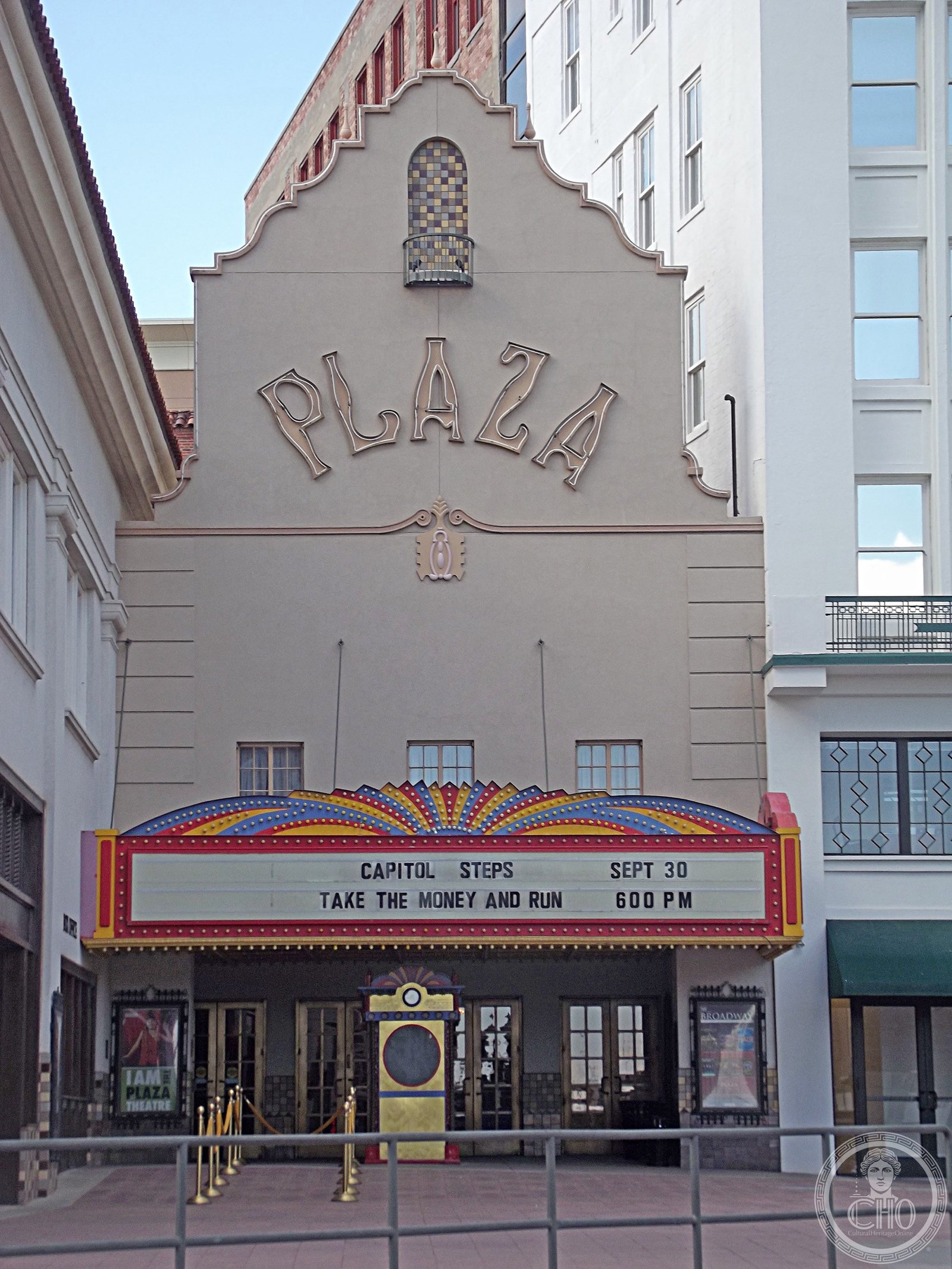
A Spanish Colonial Revival movie palace whose horseshoe arcade and terra cotta ornament anchor the civic heart of downtown El Paso.
At a glance
The Plaza Theatre opened in 1930 on the edge of San Jacinto Plaza as a grand movie house for a leading American theatre circuit. Its façade works the Spanish Colonial vocabulary that architects in the American Southwest were folding into every major building of the decade — rounded arches, decorative tile, and an ornamental marquee that read across the plaza’s sunlit expanse. Inside, the auditorium seated roughly 2,400 patrons under a painted sky canopy and a procession of plasterwork in glazed polychrome. After decades as a cinema and a long vacancy, the theatre was restored in the late 1990s and reopened as a performing arts center serving the border city’s cultural life.
Key facts
- Opened: 1930
- Style: Spanish Colonial Revival with Art Deco detailing
- Capacity: approximately 2,400 seats
- Original use: Major American theatre circuit movie palace
- Current use: Performing arts center
- Designation: Listed on the National Register of Historic Places
- Location: 125 Pioneer Plaza, downtown El Paso
History
El Paso in the late 1920s was a fast-growing border city, its economy tied to the cattle and cotton trades and to the Fort Bliss military installation that had expanded during the First World War. A leading theatre circuit chose the city for a flagship house at the edge of the central plaza — the open square where the city’s commercial and civic life converged. The building that opened in 1930 was designed to make an impression: its arched loggia and decorative parapet in Spanish Colonial ornament placed it unmistakably in the architectural tradition of the Southwest, while its Art Deco marquee and neon lighting connected it to the modern commercial culture of the moment.
Through the 1930s and 1940s the Plaza was the premier entertainment venue in the city, presenting first-run films and occasional live acts from touring circuits. By the 1970s, like many downtown movie palaces, it had lost its audience to suburban multiplexes and closed. A restoration campaign in the 1990s brought the theatre back to life as a performing arts center — concerts, touring productions, and local cultural events now fill the calendar that once ran newsreels and westerns. The restored interior preserves the plasterwork and painted ceiling that made the Plaza one of the finest surviving theatre spaces in the Texas borderlands.
The Plaza Theatre is listed on the National Register of Historic Places and is considered one of the best-preserved examples of the Spanish Colonial Revival movie palace type in the American Southwest.
What you see
The main façade presents a horseshoe arcade at street level, its arches framing the box office and entrance vestibule beneath a decorative frieze of Spanish Renaissance ornament in polychrome tile and cast plaster. The marquee — now restored with period-style neon lettering — projects over the sidewalk in the manner of the great downtown theatres of the late 1920s. Above the roofline, the building rises in a stepped parapet with terracotta relief panels and a corner tower that reads across the full width of the plaza.
Inside, the auditorium ceiling is painted to suggest a deep blue sky framed by arched ribs — a theatrical device borrowed from Spanish Colonial ecclesiastical architecture and adapted for the secular pleasure palace of the cinema age. The side walls carry plasterwork niches and decorative brickwork. The proscenium arch is flanked by ornamental columns in a free Spanish Baroque register that gives the room a weightiness unusual for a theatre of its period.
Practical information
- Address: 125 Pioneer Plaza, El Paso, TX 79901
- Access: Open for scheduled events; check the theatre’s programming calendar for performance dates
- Exterior: The façade is visible from San Jacinto Plaza and the surrounding pedestrian area at all hours
- Best time: Arrive before a performance to see the interior; the illuminated marquee is at its best at dusk
Getting there
The Plaza Theatre sits in the pedestrian core of downtown El Paso, a short walk from the El Paso Convention Center and from the international border bridge to Ciudad Juárez. El Paso International Airport (ELP) is approximately 8 miles northeast; the Sun Metro bus network reaches downtown from the airport. The city’s streetcar line (Sun Link), where operational, runs along Mesa Avenue near the downtown hotel district. By car, parking structures are available within two blocks of Pioneer Plaza.
Nearby
- San Jacinto Plaza: El Paso’s central public square, one block from the theatre; site of the city’s alligator pond from 1883 to 1967 and still the civic gathering point for the downtown grid
- El Paso Museum of Art: Located in the downtown arts district; permanent collection includes Southwestern and borderlands art alongside European and American work
- El Paso Museum of History: Chronicles the long history of the Pass of the North, from pre-Columbian Pueblo settlements through Spanish colonial governance and the Mexican-American borderlands
- Concordia Cemetery: The city’s Victorian-era burial ground, containing the grave of John Wesley Hardin and notable as a key document of the city’s frontier-era social geography
Sources
- National Register of Historic Places — The Plaza Theatre, El Paso, Texas
- Texas Historical Commission — Recorded Texas Historic Landmark designation documentation
- El Paso Community Foundation — Plaza Theatre restoration project records
- Library of Congress, Historic American Buildings Survey (HABS) — El Paso survey documentation
Find it on the map
See this place and what’s around it →Record researched and written by Luigi De Marchi for Cultural Heritage Online, 2026.
📷 Become a Cultural Heritage Online photographer
Share your photos of places: they stay published under your name as the author. The more they're seen, the more you get noticed — and soon a contest will reward the most appreciated photos.
Log in or sign up free to add a photoIs this page about you?
This page is read by travellers and heritage enthusiasts who find it on Google. Tell us how you are connected to this place and we will take it from there.