
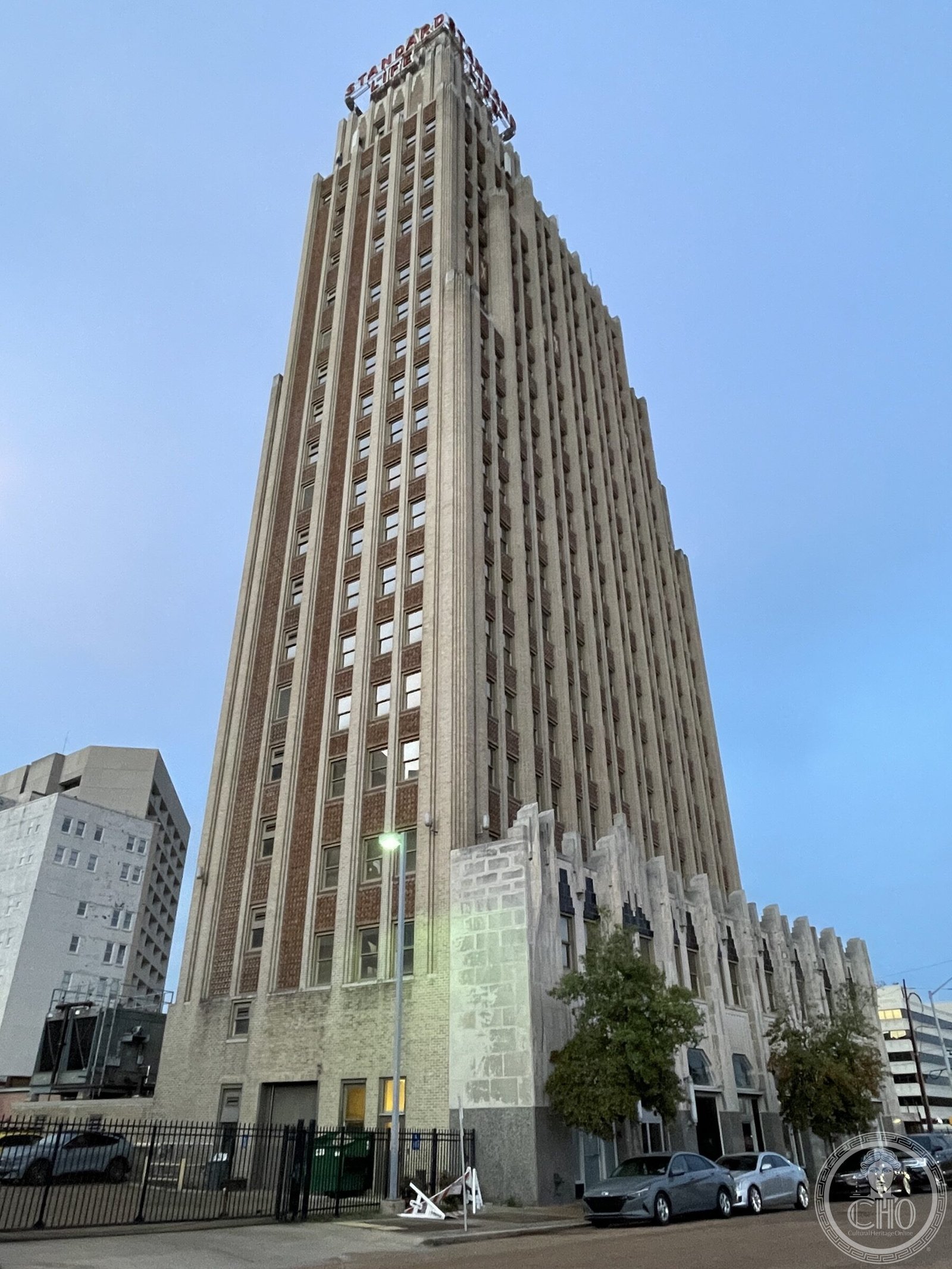
Rising above the state capitol corridor in Jackson since 1929, the Standard Life Building is the most significant Art Deco skyscraper in Mississippi — a terracotta-clad tower that announced the ambitions of a capital city growing rapidly alongside the oil and agriculture economies of the interwar Deep South.
At a glance
The Standard Life Building at East Capitol Street in downtown Jackson is Mississippi’s preeminent surviving Art Deco commercial tower, completed in 1929 at the height of the decade’s building activity. The building’s terracotta ornament, setback massing, and vertical emphasis mark it as a product of the transitional moment between the Beaux-Arts commercial architecture of the previous generation and the streamlined modernism that would follow. Listed on the National Register of Historic Places, the Standard Life Building has anchored the East Capitol Street commercial corridor for nearly a century and remains one of the defining elements of downtown Jackson’s historic skyline.
Key facts
- Address: East Capitol Street, downtown Jackson, MS 39201
- Completed: 1929
- Style: Art Deco — terracotta cladding, setback massing, vertical piers
- Status: NRHP Listed; commercial office building
- Setting: East Capitol Street corridor, heart of downtown Jackson
- Theme: Art Deco USA
History
Jackson in the late 1920s was undergoing rapid growth driven by the expansion of state government, the development of the Mississippi Delta agricultural economy, and the first commercial exploitation of oil and natural gas in the northern part of the state. The city’s population had more than doubled in the preceding two decades, and the commercial activity generated by state government contracting, insurance, and banking created demand for a new generation of multi-story office buildings that would consolidate the downtown business district along Capitol Street.
The Standard Life Building was commissioned in this context, at a moment when the Art Deco vocabulary — arriving from New York and Chicago via the architectural trade press and the offices of regional firms — was being applied for the first time to major commercial construction in Mississippi. The building’s terracotta ornament and setback profile brought a cosmopolitan aesthetic to a capital city that had, to that point, been dominated by revival styles and modest commercial construction. Its completion in 1929 made it the most modern large building in Jackson, a role it would hold until the postwar development that transformed much of the city’s downtown in the 1950s and 1960s.
The building remained an important address for Mississippi insurance companies, law firms, and financial institutions through the mid-twentieth century. Its NRHP listing recognized both its architectural significance as the state’s finest Art Deco skyscraper and its importance to the historical development of Jackson’s commercial core. Today the building continues in commercial use, its terracotta facade a distinctive presence on the East Capitol Street streetscape.
What you see
The East Capitol Street elevation is a composition of vertical piers rising through a central mass from a rusticated base to a setback crown, the characteristic Art Deco formula of the late 1920s applied at a scale appropriate to a capital city of Jackson’s size. The terracotta ornament concentrates at the crown and base, with the intervening shaft largely unadorned — a hierarchy that emphasizes the building’s height relative to its neighbors and creates a reading of vertical movement rather than static mass.
The building is best appreciated in its street context: along East Capitol Street, looking toward the Mississippi State Capitol (1903) a few blocks west, the Standard Life Building anchors the commercial portion of the corridor. The contrast between the Standard Life’s Art Deco terracotta and the Beaux-Arts limestone of the Capitol dome encapsulates two decades of American architectural history compressed into a single view.
Practical information
- Access: East Capitol Street, downtown Jackson; street-level views of the facade are the primary experience
- Interior: commercial building; lobby viewable during business hours
- Time needed: 20–30 minutes for exterior and nearby Capitol area; combine with the Mississippi State Capitol and the Old Capitol Museum on a 2-hour downtown walking tour
- Best season: year-round; early morning and late afternoon light is most favorable for the terracotta ornament
Getting there
Jackson-Medgar Wiley Evers International Airport (JAN) is approximately 7 miles east of downtown. The Standard Life Building is in the center of downtown Jackson, within a 5-minute walk of the Mississippi State Capitol. Amtrak’s City of New Orleans (Chicago–New Orleans) stops at the Jackson Amtrak station approximately 0.5 miles south of the Capitol corridor.
Nearby
- Mississippi State Capitol (1903) — the Beaux-Arts state capitol by Theodore Link, with its distinctive dome visible from the Standard Life Building, approximately 0.4 miles west on Capitol Street
- Old Capitol Museum (1839) — the Greek Revival former state capitol, now a history museum documenting Mississippi political history, approximately 0.5 miles west
- Lamar Life Building (1925) — the Art Deco-influenced insurance company headquarters and an adjacent landmark of the East Capitol Street corridor
Sources
- National Register of Historic Places — Standard Life Building listing, Mississippi Department of Archives and History
- Mississippi Department of Archives and History — downtown Jackson architectural history documentation
- Historic Jackson Foundation — East Capitol Street corridor surveys
- Wikimedia Commons — Standard Life Building (Jackson, Mississippi) 02.jpg, CC BY 4.0
Find it on the map
See this place and what’s around it →Record researched and written by Luigi De Marchi for Cultural Heritage Online, 2026.
📷 Become a Cultural Heritage Online photographer
Share your photos of places: they stay published under your name as the author. The more they're seen, the more you get noticed — and soon a contest will reward the most appreciated photos.
Log in or sign up free to add a photoIs this page about you?
This page is read by travellers and heritage enthusiasts who find it on Google. Tell us how you are connected to this place and we will take it from there.