
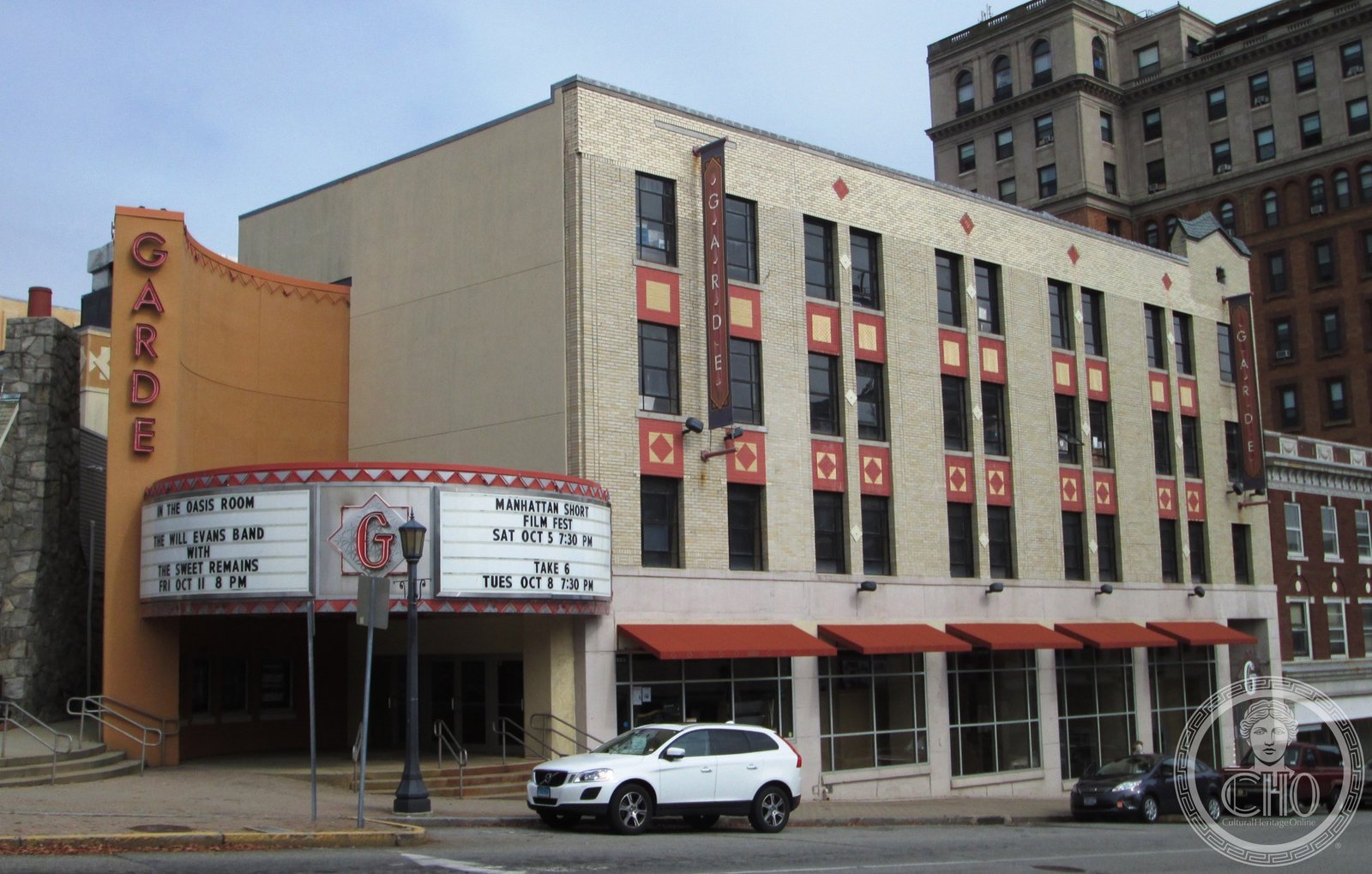
Opened in 1926 as the Garde Theatre, this New London landmark merges Moorish atmospheric splendor with Art Deco ornament in one of New England’s best-preserved picture palaces, now operating as a regional performing arts center.
At a glance
Architect Léon Lempert Jr. designed the Garde Theatre in 1926 to offer New London audiences the full experience of the atmospheric picture palace: a building that transported visitors into a fantastical environment, where Moorish arches, Spanish courtyards, and Art Deco ornament combined into an immersive interior landscape. The theater’s State Street facade and its 1,400-seat auditorium survive largely intact, making the Garde one of the most significant historic theaters in Connecticut and a vital cultural resource for southeastern New England.
Key facts
- Address: 325 State Street, New London, CT 06320
- Opened: 1926 as the Garde Theatre
- Architect: Léon Lempert Jr.
- Style: Atmospheric (Moorish) with Art Deco ornament
- Capacity: approximately 1,400 seats
- Listed: National Register of Historic Places
- Current name: Garde Arts Center (since 1985 restoration)
History
New London in the 1920s was an active port city at the mouth of the Thames River, its economy built on maritime commerce, manufacturing, and the proximity of the U.S. Navy submarine base across the river in Groton. The city’s commercial district on State Street was a natural location for a major picture palace, and the Garde Theatre opened in 1926 to serve a population eager for the entertainment that the silent film era’s greatest theaters could provide.
Léon Lempert Jr. designed the theater in the atmospheric style pioneered by John Eberson: an interior conceived as an outdoor courtyard under a night sky, with Moorish architectural elements — horseshoe arches, decorative plasterwork, and painted surfaces — creating an illusion of being transported to medieval Andalusia. The arrival of talking pictures in 1927 and 1928 did not alter the building’s essential character; the atmospheric interior remained the experiential core of the theatrical experience.
Like many American movie palaces, the Garde fell into decline after the mid-twentieth century as audiences migrated to suburban multiplexes. The theater was closed and faced demolition before a community preservation effort secured the building and funded a restoration that reopened it in 1985 as the Garde Arts Center. The renovation preserved the auditorium’s original plasterwork and decorative scheme while updating the facility for contemporary performing arts use.
What you see
The State Street facade is a restrained commercial front that gives little warning of the interior spectacle beyond. A modest lobby sequence leads into the main auditorium, where the atmospheric illusion fully asserts itself. The ceiling, painted to suggest an open sky, is framed by Moorish arches that recede into the depth of the hall. Plasterwork in the Hispano-Moorish tradition — interlacing geometric bands, stylized vegetal ornament, and calligraphic panels — covers the side walls in a dense, layered composition. Art Deco ornamental details appear throughout, visible in the geometric precision of the frieze work and the streamlined profiles of the lighting fixtures.
The combination of Moorish atmosphere and Art Deco ornament is characteristic of the transitional period in which the Garde was built: the early 1920s aesthetic of pure atmospheric illusionism was already being modified by the emerging Art Deco vocabulary, producing hybrid theaters whose interiors read simultaneously as exotic fantasy and modernist ornament.
Practical information
- Access: Downtown New London on State Street, the main commercial corridor
- Hours: Box office and lobby open for scheduled performances; check the website for current programming
- Best for: Atmospheric theater architecture, performing arts, New England heritage travel
- Tip: The interior is the main attraction; try to book for a performance rather than visiting solely for architecture, as interior access is generally limited to ticketed events
Getting there
New London is located on the Connecticut shoreline at the junction of I-95 and I-395. Amtrak’s Shore Line East and the northeast corridor trains stop at New London Union Station, approximately a 10-minute walk from the Garde Arts Center on State Street. The ferry to Fishers Island and Orient Point (Long Island) departs from the Cross Sound Ferry terminal near the Amtrak station. New London is roughly equidistant between New Haven (50 miles west) and Providence (60 miles east).
Nearby
- Eugene O’Neill Theater Center — in Waterford, Connecticut (5 miles), the national center for theatrical development named for New London’s most famous son
- Monte Cristo Cottage — Eugene O’Neill’s boyhood home in New London, now a museum; setting for Long Day’s Journey Into Night
- Lyman Allyn Art Museum — on the Connecticut College campus, presenting American and European art in a neoclassical building above the Thames River
- U.S. Coast Guard Academy — in New London, approximately 1.5 miles north of downtown, with a visitors center and the historic sailing vessel USCGC Eagle
Sources
- Garde Arts Center — official history and architecture documentation
- National Register of Historic Places — Garde Theatre, New London, Connecticut
- Connecticut Trust for Historic Preservation — atmospheric theaters in Connecticut
- Hall, Ben M. The Best Remaining Seats: The Story of the Golden Age of the Movie Palace. New York: Bramhall House, 1961.
Find it on the map
See this place and what’s around it →📷 Become a Cultural Heritage Online photographer
Share your photos of places: they stay published under your name as the author. The more they're seen, the more you get noticed — and soon a contest will reward the most appreciated photos.
Log in or sign up free to add a photoIs this page about you?
This page is read by travellers and heritage enthusiasts who find it on Google. Tell us how you are connected to this place and we will take it from there.