
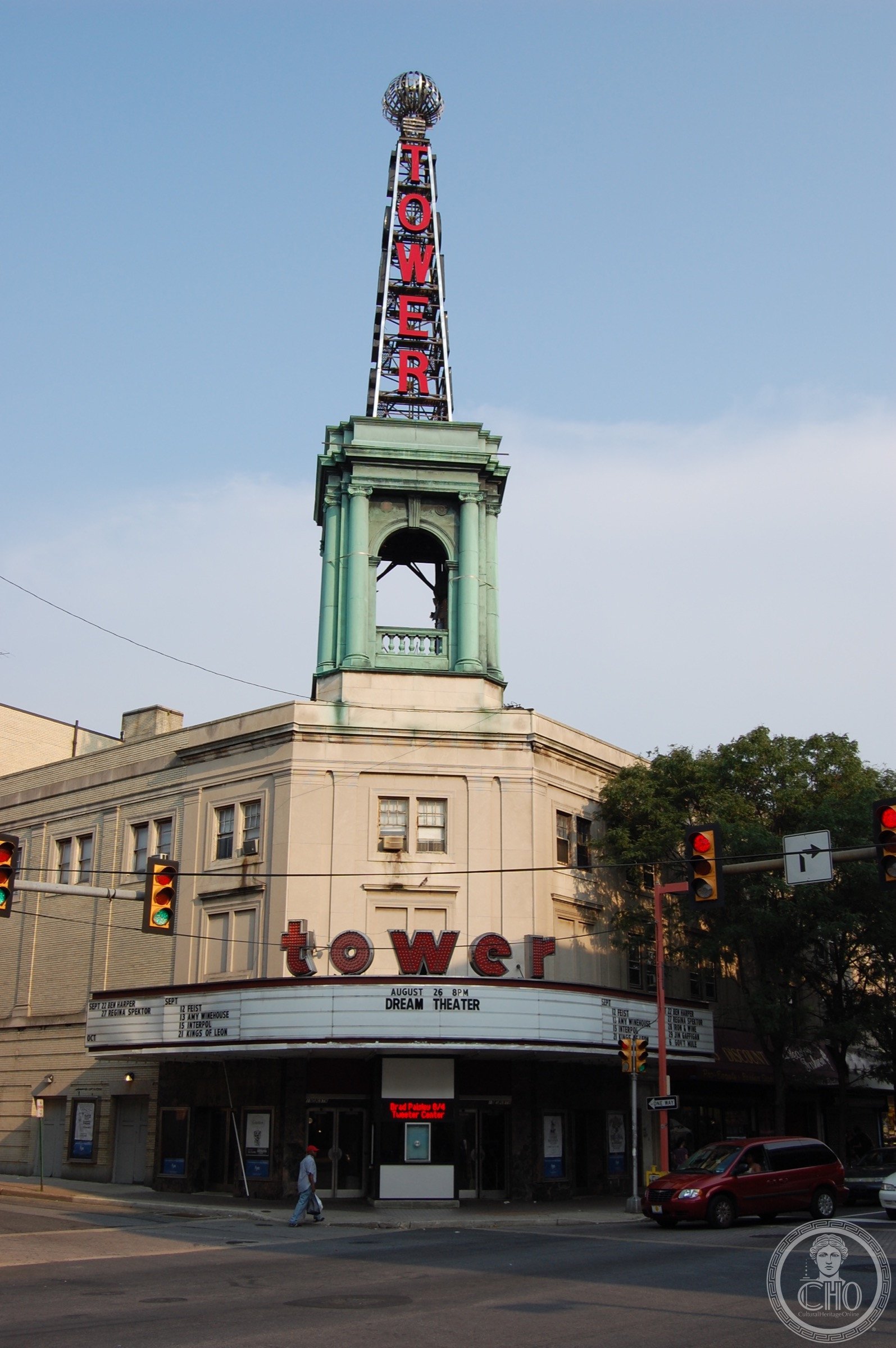
The Tower Theatre in Upper Darby wrote itself into rock music history through the 1970s—David Bowie, The Who, and Bruce Springsteen all recorded landmark live albums on its stage—while the 1927 Moorish atmospheric interior behind the marquee remained intact through every era of programming.
At a glance
The Tower Theatre stands at the 69th Street Transportation Center in Upper Darby, Pennsylvania, at the western terminus of the Market-Frankford elevated line that runs into Philadelphia. Built in 1927 as a neighborhood atmospheric movie palace, it was adopted as a rock concert venue in the 1970s at a moment when its sightlines, acoustics, and intimate scale made it a preferred choice for artists recording live albums. The theater survives today as an active concert venue, its Moorish atmospheric interior—domed plaster ceilings simulating an outdoor courtyard under a night sky—intact behind a marquee that has announced acts from Vaudeville to hip-hop across a hundred years of programming.
Key facts
- Address: 69 N 69th Street, Upper Darby, PA 19082
- GPS: 39.9612° N, 75.2589° W
- Built: 1927
- Style: Atmospheric theater / Moorish Revival
- Capacity: approximately 3,200 seats
- Status: Active concert venue (Live Nation)
- NRHP: Listed on National Register of Historic Places
History
The stretch of 69th Street in Upper Darby anchored the residential and commercial growth of the western Philadelphia suburbs in the early twentieth century. The 69th Street Transportation Center—where the Market-Frankford elevated line met trolley and bus routes to Chester County—drew enough foot traffic to support a major entertainment venue. The Tower, designed in the Moorish atmospheric style popularized by architect John Eberson through the 1920s, opened in 1927 as a movie palace serving the suburban audience that lived west of Philadelphia proper.
The atmospheric interior—plaster walls imitating Moorish stonework, a domed ceiling painted to suggest a star-filled sky with cloud formations moving across it, and side walls carved to evoke an open-air courtyard—provided the escapist environment that the atmospheric theater formula promised. The Tower ran first-run Hollywood films through the studio era, with vaudeville acts supplementing the bill in its earliest seasons.
The transition from cinema to rock concert venue in the late 1960s and 1970s preserved the building when urban movie houses across the Philadelphia area closed. The Tower’s size—large enough for major acts, intimate enough for excellent sightlines—and its transit access made it a preferred Philadelphia-area venue. David Bowie recorded “David Live” there in 1974; The Who recorded a live album at the Tower in 1973; Bruce Springsteen’s performances there became part of his early-career legend. The rock programming established the Tower’s identity for subsequent decades and funded the maintenance that kept the atmospheric interior alive.
What you see
The 69th Street facade presents a masonry composition with the theater’s identifying marquee and vertical sign above the entrance. The Moorish vocabulary—arched entrance portals with geometric ornament, tile inserts, and surface detail derived from Andalusian and North African architecture—distinguishes the building from the commercial streetscape of the transportation hub it anchors.
Inside, the atmospheric formula achieves its intended effect. The auditorium ceiling is painted and modeled to simulate a Moorish courtyard open to a night sky; clouds appear to drift across a field of stars behind the main viewing surface. Side walls carry plaster relief imitating stone battlements and arched colonnades; niches hold decorative figures. The proscenium arch carries Moorish ornamental detail in plaster. The atmospheric ceiling was maintained rather than replaced through the building’s transition to rock venue—the acoustically neutral overhead expanse that works for cinema works equally well for amplified performance.
Practical information
- The Tower operates as a concert venue; check Live Nation or the Tower’s website for the current event calendar.
- No regular film programming; fully configured for amplified live performance.
- Accessible via SEPTA Market-Frankford Line to 69th Street terminal; the theater is at street level adjacent to the station.
- Street parking on 69th Street and surrounding blocks; additional lots near the 69th Street transit hub.
- The lobby and facade are worth inspecting before the show; arrive early for the best view of the atmospheric plaster details.
Getting there
The Tower Theatre is at 69 N 69th Street in Upper Darby, Delaware County, Pennsylvania—at the 69th Street terminus of SEPTA’s Market-Frankford Line (MFL Blue Line), making it one of the most transit-accessible concert venues in the Philadelphia region. From Center City Philadelphia, take the MFL from 8th Street or 15th Street stations west to the 69th Street terminal; total travel time is approximately 25 minutes. By car from Philadelphia, take US-30 (Lancaster Avenue) west into Upper Darby or take I-76 west to US-30; limited street parking is available on 69th Street.
Nearby
- 69th Street Transportation Center: the SEPTA hub directly adjacent to the theater connects the Market-Frankford Line with trolley lines to Chester County and bus routes throughout Delaware County.
- Philadelphia Museum of Art (5 miles east): the museum on the Benjamin Franklin Parkway holds one of the largest art collections in the United States.
- Bartram’s Garden (3 miles southeast): the 18th-century botanical garden on the Schuylkill River is the oldest surviving botanic garden in North America.
- Haverford College (3 miles west): the Quaker liberal arts college has an arboretum campus with walking trails open to the public.
Sources
- Tower Theatre, Philadelphia venue history documentation
- National Register of Historic Places, “Tower Theatre Upper Darby” nomination
- Cinema Treasures, “Tower Theatre, Upper Darby” database entry
- SEPTA Market-Frankford Line operational records
Find it on the map
See this place and what’s around it →Record researched and written by Luigi De Marchi for Cultural Heritage Online, 2026.
📷 Become a Cultural Heritage Online photographer
Share your photos of places: they stay published under your name as the author. The more they're seen, the more you get noticed — and soon a contest will reward the most appreciated photos.
Log in or sign up free to add a photoIs this page about you?
This page is read by travellers and heritage enthusiasts who find it on Google. Tell us how you are connected to this place and we will take it from there.