
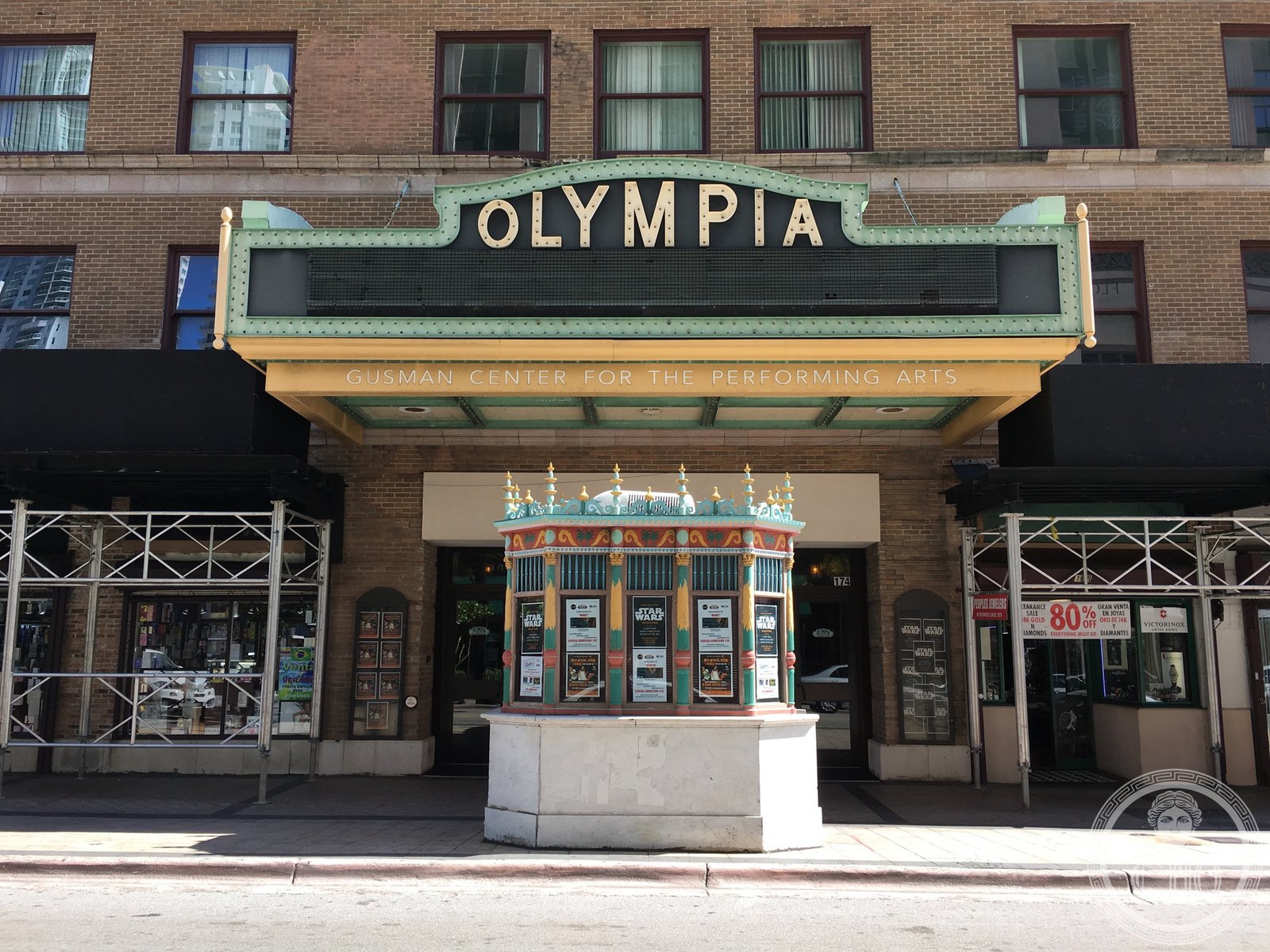
At 174 East Flagler Street in downtown Miami, the Gusman Center for the Performing Arts stands as one of the finest surviving Atmospheric theaters in the American South — an ornate 1926 movie palace designed by John Eberson whose Spanish Colonial exterior and elaborate interior have survived Miami’s cycles of boom and reinvention to serve as the city’s premier venue for film, opera, and performing arts.
At a glance
The Gusman Center at 174 East Flagler Street is Miami’s most architecturally significant historic theater and a landmark of the Atmospheric theater movement that transformed American movie palace design in the 1920s. Opened in 1926 as the Olympia Theatre, it was designed by John Eberson, the Austrian-born architect who pioneered the Atmospheric style — theaters designed to simulate the experience of watching a performance outdoors in a Mediterranean or Spanish courtyard, with twinkling stars projected on the ceiling, climbing vines on the walls, and architectural fragments suggesting ancient colonnades. The Olympia was one of Eberson’s masterworks, and its exterior on Flagler Street presents an equally impressive Spanish Colonial Revival composition to downtown Miami. Renamed the Gusman Center in honor of philanthropist Maurice Gusman, it now serves as the primary venue for the Miami Film Festival, classical concerts, and community programming.
Key facts
- Address: 174 East Flagler Street, Miami, FL 33131
- Opened: 1926 as the Olympia Theatre
- Architect: John Eberson (1875–1954)
- Style: Atmospheric Theater / Spanish Colonial Revival
- Renamed: Gusman Center for the Performing Arts (after Maurice Gusman)
- Designation: National Register of Historic Places
- Notable event: Miami Film Festival primary venue
History
Miami in 1926 was in the grip of its first great real estate boom, a period of explosive growth that had transformed a small railroad terminus city into a subtropical metropolis in less than two decades. The Florida East Coast Railway had reached Miami in 1896; Henry Flagler’s real estate developments had established the city’s street pattern and its early civic ambition; and the 1920s boom had brought speculative development, Mediterranean Revival architecture, and the aspirations of a city determined to become a world resort.
Into this environment John Eberson brought his most southern movie palace. The Austrian-born Eberson had developed the Atmospheric theater concept — theaters designed to feel like open-air courtyards in Spain, Italy, or the Islamic world — in the early 1920s, and the style had proven enormously popular with American audiences who found the experience of watching a film under a simulated night sky magical. The Olympia on Flagler Street was Eberson’s gift to Miami: a building whose Spanish Colonial exterior fit perfectly with the Mediterranean Revival aesthetic dominating the boom-era city, and whose interior transported audiences from the subtropical heat to an imaginary Spanish courtyard with a ceiling of projected stars.
The theater survived the collapse of the Florida land boom in 1926, the Great Depression, and the postwar shift to suburban cinemas, though not without difficulty. It closed as a commercial theater and was rescued by a preservation effort that brought the city of Miami and the philanthropist Maurice Gusman together to restore and operate it as a nonprofit cultural institution. The renamed Gusman Center has since become one of Miami’s most beloved cultural assets, host to the Miami Film Festival, classical music performances, and community programming that draws on the diverse populations of one of America’s most international cities.
What you see
The East Flagler Street facade presents the Gusman Center’s Spanish Colonial Revival exterior to downtown Miami: a composition of ornamental stonework, arched window openings, and decorative terra cotta that established the Olympia’s character among Flagler Street’s commercial buildings when it opened in 1926 and has maintained it through all the subsequent transformations of the downtown streetscape.
Inside, the Atmospheric theater experience is preserved in extraordinary completeness. The auditorium ceiling is designed to simulate a night sky over a Spanish courtyard, with a projection system that creates the illusion of stars and moving clouds. The walls are decorated with architectural fragments — colonnades, reliefs, climbing plantings — that evoke a Mediterranean building in ruin, open to the sky. The effect, produced by plasterwork, paint, and light, is unlike anything in conventional theater design: the audience sits outdoors, under the stars, in a city that does not exist.
Practical information
- Events: Miami Film Festival (primary venue, usually in March), classical concerts, opera, community programming; check gusmancenter.org for schedule
- Downtown Miami: The Gusman Center is on Flagler Street, the main commercial artery of historic downtown Miami, surrounded by the Brickell financial district and the emerging Wynwood arts district
- Parking: Multiple garages within two blocks; the Metromover free shuttle stops nearby
Getting there
The Gusman Center is at 174 East Flagler Street in downtown Miami, steps from the Government Center Metrorail and Metromover stations. Miami International Airport (MIA) is 8 miles west; Fort Lauderdale-Hollywood International (FLL) is 25 miles north. Amtrak’s Silver Meteor and Silver Star trains serve Miami’s downtown station. The center is walkable from Brickell and much of downtown Miami.
Nearby
- Dade County Courthouse (1928) — the Art Deco skyscraper courthouse at 73 West Flagler Street, one block west of the Gusman Center; part of the concentration of civic and commercial architecture that gives downtown Miami its historic character
- Bayside Marketplace and Bayfront Park — the waterfront park and outdoor entertainment complex on Biscayne Bay, one block east; the setting for outdoor concerts and community events with the Miami skyline as backdrop
- Freedom Tower (1925) — the ornate Spanish-Baroque tower at 600 Biscayne Boulevard, built as the Miami Daily News building and later used as a processing center for Cuban refugees; now a museum and cultural center associated with the Cuban-American community
- Wynwood Walls — the internationally recognized outdoor street art museum in the Wynwood neighborhood, two miles north of downtown; created on former warehouse walls, it has become one of the defining cultural attractions of contemporary Miami
Sources
- National Register of Historic Places, Olympia Theatre/Gusman Center nomination
- John Eberson Papers, Cincinnati History Library and Archives
- Miami-Dade Historic Preservation Office records
- Miami Herald archives — Olympia Theatre/Gusman Center history
- HistoryMiami Museum documentation
Find it on the map
See this place and what’s around it →📷 Become a Cultural Heritage Online photographer
Share your photos of places: they stay published under your name as the author. The more they're seen, the more you get noticed — and soon a contest will reward the most appreciated photos.
Log in or sign up free to add a photoDo you manage this place?
This page is read by travellers and heritage enthusiasts who find it on Google. Keep it accurate — and make it work for you. Free for non-profit heritage institutions.