
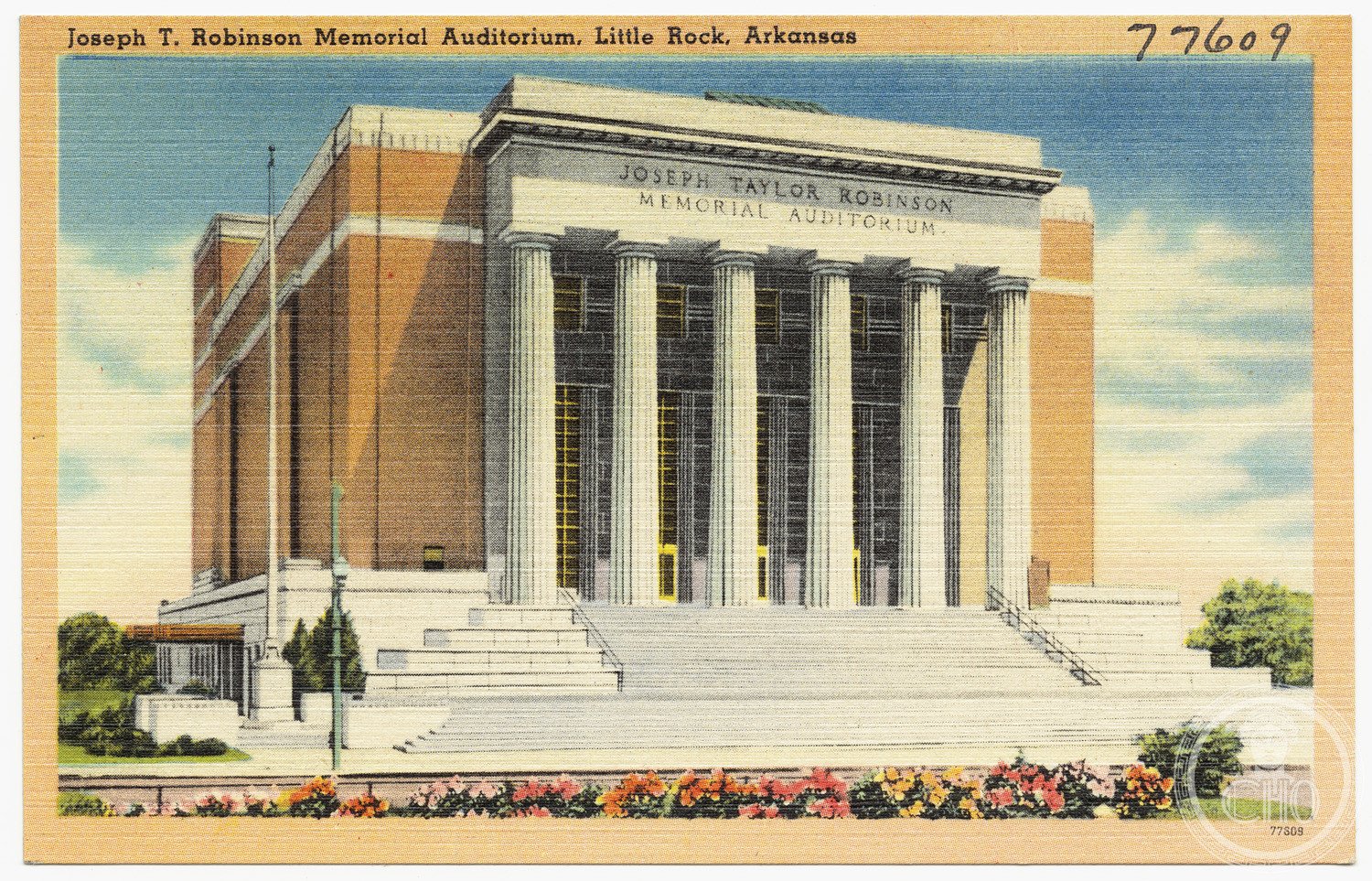
On West Markham Street in the heart of Little Rock, the Robinson Center has been Arkansas’s primary performing arts venue since 1939 — named for one of the most powerful senators in American history, built in the Art Deco style that defined the era’s civic ambitions, and restored in the twenty-first century to serve a capital city discovering its own cultural complexity.
At a glance
The Robinson Center for the Performing Arts at 426 West Markham Street is the finest Art Deco performing arts venue in Arkansas and the cultural anchor of downtown Little Rock. Built in 1939 as the Joseph Taylor Robinson Municipal Auditorium — named in honor of Arkansas’s most celebrated United States Senator — it has served the state capital as the primary venue for conventions, concerts, theatrical productions, and civic gatherings for over eight decades. A thorough renovation completed in 2016 by Arkansas’s leading architectural firms restored the building’s Art Deco character while equipping it with state-of-the-art theatrical facilities for the twenty-first century. It is now home to the Arkansas Symphony Orchestra and a primary venue for touring Broadway productions in the mid-South region.
Key facts
- Address: 426 West Markham Street, Little Rock, AR 72201
- Opened: 1939 as the Joseph Taylor Robinson Municipal Auditorium
- Named for: Joseph Taylor Robinson (1872–1937), U.S. Senator from Arkansas and Senate Majority Leader
- Style: Art Deco
- Renovation: Major restoration completed 2016
- Resident company: Arkansas Symphony Orchestra
- Designation: National Register of Historic Places
History
Joseph Taylor Robinson was the most powerful Arkansan in Washington in the first decades of the twentieth century. Elected to the United States Senate in 1913, he rose to become Senate Majority Leader in 1933 — a position he used in close partnership with President Franklin D. Roosevelt to advance the New Deal legislation that reshaped American governance. Robinson was Franklin Roosevelt’s choice to lead the Senate’s New Deal coalition, and his death in July 1937 in the midst of the Supreme Court packing fight was a genuine shock to the administration.
The municipal auditorium named in his honor was built during the period of intense public construction that the New Deal itself had made possible. The 1939 building brought to Little Rock a major civic venue whose Art Deco design reflected both the era’s architectural preferences and the federal programs’ tendency to invest in buildings of genuine permanence and ambition. The Robinson Auditorium immediately became the cultural center of the Arkansas capital, hosting political conventions, traveling Broadway productions, orchestral concerts, and the full range of public entertainment that a state capital city requires.
The building served Little Rock through the mid-twentieth century and beyond, accumulating the accumulated wear of continuous use. By the 2010s, a major renovation had become both possible and necessary. The 2016 restoration — led by Polk Stanley Wilcox Architects and Heery International — preserved and restored the Art Deco exterior while completely rebuilding the interior to modern acoustic and theatrical standards. The result, reopened as the Robinson Center for the Performing Arts, has been recognized as one of the finest theater restoration projects in the American South.
What you see
The West Markham Street facade presents the Robinson Center’s Art Deco character with civic authority: a symmetrical limestone composition with decorative ornamental panels, vertical pilasters, and the geometric precision characteristic of the style’s application to public buildings. The design avoids the theatrical excess of the commercial movie palaces of the same era, instead applying Art Deco’s vocabulary to a civic scale that reads as serious, public, and permanent.
The restored interior has transformed the original 1939 building into a contemporary performing arts venue without sacrificing its architectural character. The main performance hall — rebuilt for acoustic excellence appropriate to orchestral and theatrical use — seats over 2,000 in a room whose proportions and sight lines reflect both the scale of the original building and the technical requirements of twenty-first-century production. The lobby and public spaces have been restored to their Art Deco finish while being enlarged and modernized to serve a contemporary audience.
Practical information
- Events: Arkansas Symphony Orchestra, touring Broadway, concerts, special events; check robinsoncenter.com for schedule
- Location: West Markham Street in the walkable downtown core, near the River Market District and the Arkansas State Capitol
- Parking: Garage and surface parking available within the downtown district
Getting there
Little Rock is the capital of Arkansas, at the crossroads of Interstate 30 and Interstate 40 in the center of the state. Bill and Hillary Clinton National Airport (LIT) is 4 miles from downtown. Amtrak’s Texas Eagle stops at Little Rock on its Chicago–San Antonio route. The Robinson Center is in the downtown core, a 10-minute walk from the River Market District and the Clinton Presidential Library.
Nearby
- William J. Clinton Presidential Library and Museum — one of the largest presidential libraries in the United States, housed in a striking contemporary building on the Arkansas River; the archives and museum focus on the Clinton administration (1993–2001); a 10-minute walk east along the riverfront
- River Market District — the revitalized historic riverfront district east of downtown, with a farmers’ market pavilion, restaurants, and access to the Arkansas River and the Two Rivers Park bridge network; one of Little Rock’s most active neighborhoods
- Arkansas State Capitol (1915) — the state capitol building modeled on the United States Capitol, at the western end of Capitol Avenue; the building and its grounds have been the center of Arkansas political history including the 1957 Central High School desegregation crisis
- Little Rock Central High School National Historic Site — the school where the 1957 desegregation crisis unfolded when Arkansas Governor Orval Faubus attempted to block federal court orders; now a National Historic Site with a visitor center; three miles south of downtown
Sources
- National Register of Historic Places, Robinson Center nomination
- Robinson Center for the Performing Arts, institutional history
- Arkansas Historic Preservation Program records
- Arkansas Democrat-Gazette archives — Robinson Center renovation coverage
- Arkansas Symphony Orchestra, institutional history
Find it on the map
See this place and what’s around it →Record researched and written by Luigi De Marchi for Cultural Heritage Online, 2026.
📷 Become a Cultural Heritage Online photographer
Share your photos of places: they stay published under your name as the author. The more they're seen, the more you get noticed — and soon a contest will reward the most appreciated photos.
Log in or sign up free to add a photoIs this page about you?
This page is read by travellers and heritage enthusiasts who find it on Google. Tell us how you are connected to this place and we will take it from there.