
.jpg)
Fort Worth built it in 1936 to upstage Dallas — and named it after a man who had died the year before, one of the most beloved Americans of his generation. Nearly ninety years later, the livestock shows still run and the towers still stand.
At a glance
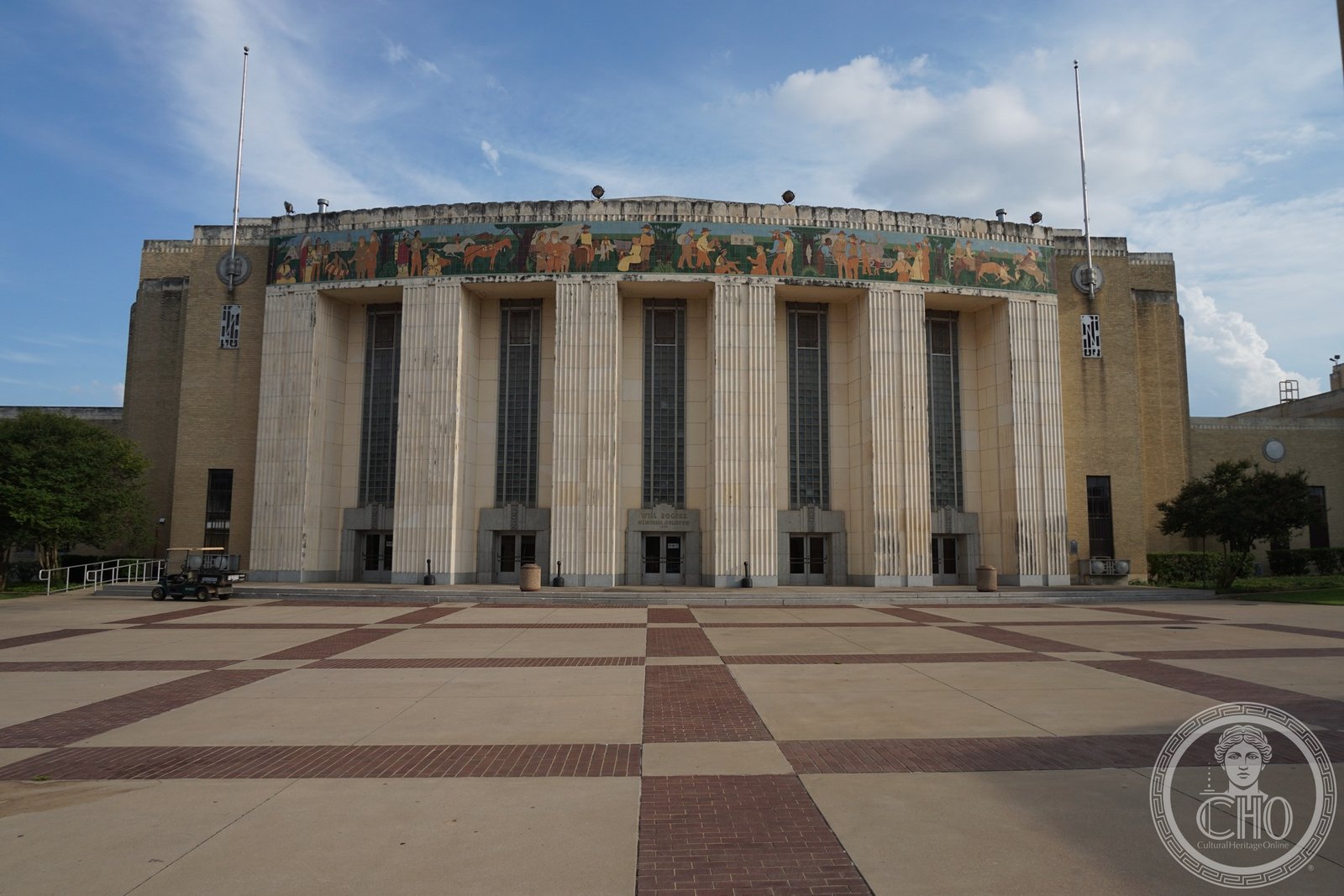
The Will Rogers Memorial Center at 3401 West Lancaster Avenue anchors Fort Worth’s Cultural District with a complex of brick buildings in the Art Deco Moderne manner, completed in 1936 as the city’s response to the Texas Centennial celebrations centred in Dallas. Named in honour of Will Rogers — the Cherokee-heritage comedian, actor, and folk philosopher who died in an Alaskan plane crash in August 1935 — the complex has functioned continuously as the home of the Southwestern Exposition and Livestock Show and as Fort Worth’s principal venue for equestrian events, concerts, and civic gatherings. Its Coliseum, Auditorium, and Memorial Tower together form one of the most cohesive ensembles of late Art Deco public architecture in Texas.
Key facts
- Address: 3401 West Lancaster Avenue, Fort Worth, TX 76107
- Completed: 1936
- Named after: Will Rogers (1879–1935), actor, humorist, and folk philosopher
- Style: Art Deco Moderne
- Key event: Southwestern Exposition and Livestock Show (annual)
- Status: Contributing property, Fort Worth Cultural District
History
The 1936 Texas Centennial was intended to mark a hundred years of Texas independence from Mexico, and Dallas won the competition to host the official state celebration. Fort Worth, famously competitive with its neighbour 30 miles to the east, organised its own programme under the slogan “Where the West Begins,” investing in a series of permanent civic facilities that would outlast the centennial year. Chief among them was the complex at West Lancaster Avenue, designed to serve the livestock industry that remained the economic backbone of Tarrant County and the surrounding ranch country.
Will Rogers had died on 15 August 1935 in a plane crash near Barrow, Alaska, together with aviator Wiley Post. Rogers was at the peak of his national fame — one of the most-quoted men in America, famous for his rope tricks, his gentle political commentary, and his identification with ordinary working people. Naming the complex in his honour was a natural tribute from a community that saw in Rogers the values of the Texas and Oklahoma cattle country he had come from.
The Southwestern Exposition and Livestock Show, which has taken place in Fort Worth annually since the late nineteenth century, moved to the new complex and has remained there. The show is one of the oldest continuously running livestock exhibitions in the United States and draws competitors and visitors from across the country each winter. The Coliseum has also hosted concerts, rodeos, circuses, and civic events since its opening, giving the complex a programme that extends well beyond the agricultural calendar.
What you see
The Will Rogers Memorial Center presents a unified brick-and-concrete composition whose dominant element is the Memorial Tower — a slender, streamlined shaft that rises above the Coliseum roof and identifies the complex from the surrounding boulevards of the Cultural District. The tower’s vertical emphasis and geometric silhouette are characteristic of the Art Deco Moderne idiom of the mid-1930s, when the geometric ornament of the previous decade was being stripped back to a cleaner, more horizontal vocabulary. The surrounding buildings share this restraint: broad walls of warm buff brick, horizontal string courses, and ornamental details concentrated at the entrances rather than dispersed across the entire surface.
The Coliseum interior is a working arena — a functional space for livestock judging and performance events — whose utilitarian character is offset by the quality of its permanent finishes. The equestrian facilities adjacent to the main building have been expanded and modernised over the decades, but the 1936 core of the complex maintains its period character. The Memorial Tower is the element that visitors remember most: a slender index finger of brick and concrete pointing at the Texas sky, with a bronze bust of Will Rogers in the rotunda at its base.
Practical information
- Access: Exterior freely viewable; interior access depends on scheduled events
- Stock Show: Typically held January–February each year; check the Southwestern Exposition and Livestock Show website for dates
- Admission: Free to view exterior and grounds; event tickets required for shows and exhibitions
- Photography: The Memorial Tower is best photographed from Lancaster Avenue to the east; the Coliseum entrance provides the most architecturally legible facade view
Getting there
The Will Rogers Memorial Center is on West Lancaster Avenue in Fort Worth’s Cultural District, approximately 2 miles west of downtown. Dallas–Fort Worth International Airport (DFW) is about 30 minutes northeast by highway. The Kimbell Art Museum and the Modern Art Museum of Fort Worth are within a few minutes’ walk to the north. Street parking is available; the Cultural District is also served by the Fort Worth Transportation Authority bus network.
Nearby
- Kimbell Art Museum — Louis Kahn’s 1972 masterwork directly north — considered one of the finest small art museums in the world and among the most beautiful modern buildings in America; the vaulted concrete and travertine interior is a study in natural light management.
- Modern Art Museum of Fort Worth — Tadao Ando’s 2002 concrete pavilions flanking a reflecting pool, one block north; permanent collection emphasising post-1945 American and European art.
- Amon Carter Museum of American Art — Philip Johnson’s 1961 portico building (expanded 2001) one block north, with an outstanding collection of American painting and photography including major holdings of Frederic Remington and Charles Russell.
Sources
- City of Fort Worth — Cultural District and Will Rogers Memorial Center historical documentation.
- Southwestern Exposition and Livestock Show — institutional history publications.
- Milner, Clyde A. et al. The Oxford History of the American West. New York: Oxford University Press, 1994 — context for Will Rogers’s cultural significance in the American West.
- Wikimedia Commons — Will Rogers Coliseum photograph (Michael Barera, CC BY-SA 4.0).
Find it on the map
See this place and what’s around it →📷 Become a Cultural Heritage Online photographer
Share your photos of places: they stay published under your name as the author. The more they're seen, the more you get noticed — and soon a contest will reward the most appreciated photos.
Log in or sign up free to add a photoIs this page about you?
This page is read by travellers and heritage enthusiasts who find it on Google. Tell us how you are connected to this place and we will take it from there.