
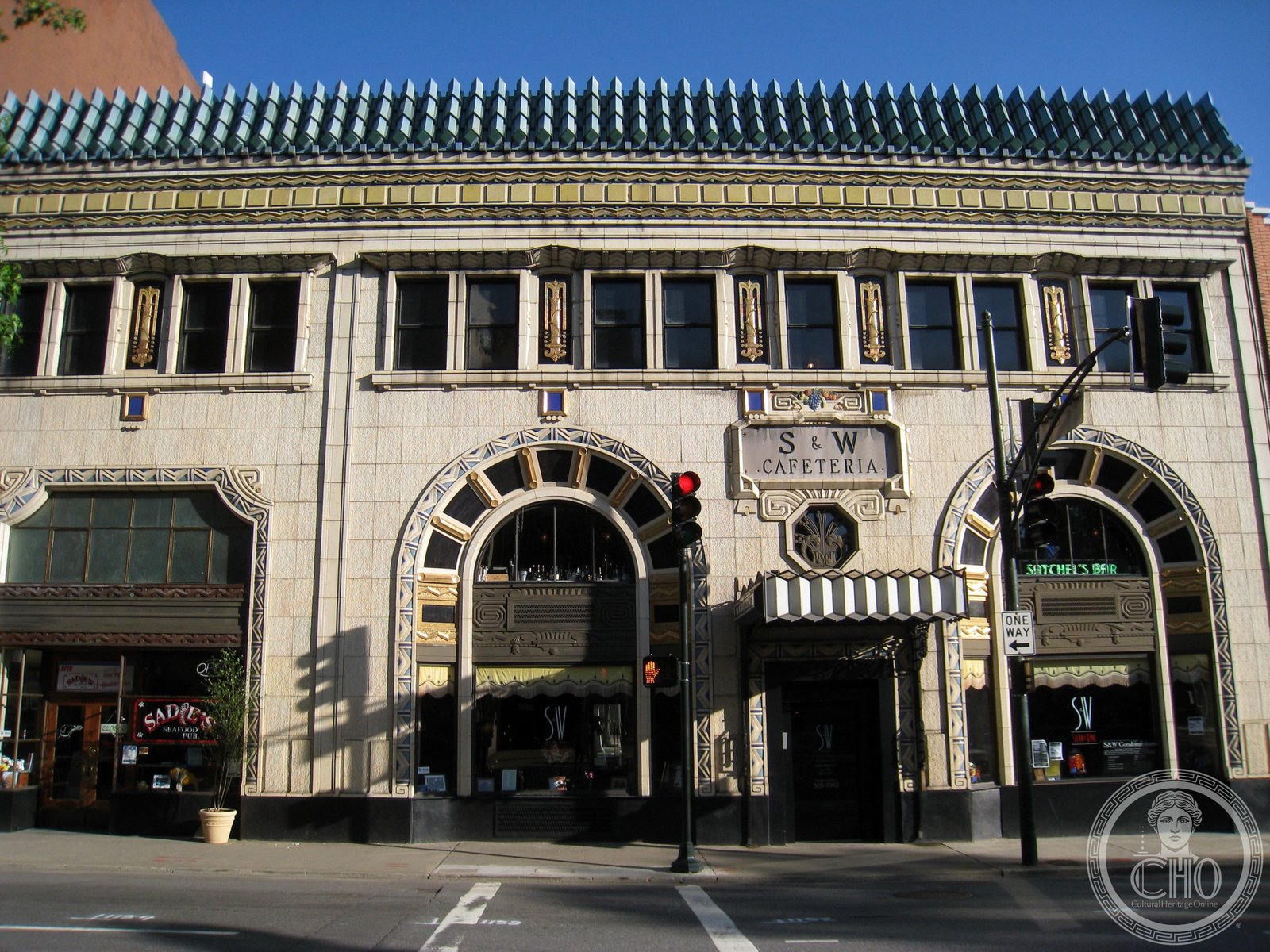

Built at the peak of Asheville’s 1920s boom, the S&W Cafeteria gave a downtown lunch counter the façade of a movie palace — and somehow the city never forgot either the ambition or the food.
At a glance
The S&W Cafeteria Building at 56 Patton Avenue is one of the finest Art Deco commercial façades in the American South — a narrow but theatrical composition of alternating dark and light marble panels, stylised geometric ornament, and an entrance composition that draws the eye upward from the pavement. Built in 1929 as a branch of the S&W cafeteria chain, it opened just as the real-estate and tourism boom that had transformed Asheville’s downtown was entering its last frenzied months before the Depression closed in. The cafeteria closed decades ago, but the building has survived largely intact as a rare monument to the architectural aspirations of 1920s Appalachian commercial culture.
Key facts
- Address: 56 Patton Avenue, Asheville, NC 28801
- Completed: 1929
- Original use: S&W Cafeteria restaurant
- Style: Art Deco commercial
- Status: Contributing building, Asheville Downtown Historic District
- Current use: Commercial / event space
History
Asheville in the 1920s was a city possessed by a vision of itself as a resort capital. The Blue Ridge Mountains drew health-seekers and tourists, wealthy northerners built grand summer homes on the ridges, and the city invested aggressively in infrastructure, hotels, and civic buildings. Property values soared and the downtown was rebuilt in a matter of years. The S&W Cafeteria Building was a product of this boom — a mid-scale restaurant chain investing in a building of theatrical quality because Patton Avenue in 1929 demanded it. Its polychrome marble façade announced its presence with the confidence of a department store or theatre rather than a lunchroom.
The collapse came fast. Asheville had borrowed heavily to fund its improvements, and when the Depression struck the city’s bond payments became a burden the community carried for decades. Asheville famously refused to declare bankruptcy and instead undertook a long slow repayment programme that lasted into the 1970s — which had the paradoxical effect of freezing much of the downtown in amber. Buildings that would have been demolished in prosperous cities were retained because there was no capital for replacement. The S&W Cafeteria Building survived this era of inadvertent preservation.
The cafeteria itself operated for many decades before closing. The building subsequently passed through various commercial uses and was eventually recognised as an important example of 1920s Art Deco design in the Mountain South. It now sits within the Asheville Downtown Historic District, which acknowledges the extraordinary concentration of 1920s commercial architecture on and around Patton Avenue.
What you see
The S&W Cafeteria façade is a masterclass in how to give a narrow commercial building on a busy shopping street theatrical weight. The ground floor entrance is flanked by polished dark marble panels that contrast sharply with the lighter cladding of the upper floors; the transition is marked by a band of stylised ornament in low relief. Above the entrance, the composition steps slightly forward and rises to a parapet of geometric ornament — the same vocabulary of Art Deco motifs that appears throughout Asheville’s downtown but here executed with particular finesse in the use of contrasting materials.
The scale is domestic by the standards of the grand Art Deco civic buildings of the era, but the building repays close attention: the craftsmanship in the marble panels and ornamental details is of a quality unusual for a commercial building in a city of Asheville’s size. The interior has been altered significantly over the decades of reuse and is no longer accessible in its original configuration, but the exterior has retained the character that makes it one of the more photographed façades on Patton Avenue.
Practical information
- Access: Exterior on a public street, viewable at any time; interior access depends on current tenants
- Admission: Free to view exterior
- Photography: Best from across Patton Avenue on a clear morning; the polychrome façade reads well in direct light
- Time needed: 10–15 minutes as part of the Patton Avenue Art Deco walking circuit
Getting there
The S&W Cafeteria Building stands on Patton Avenue in the heart of Asheville’s walkable downtown, two blocks east of Pack Square. The Asheville Regional Airport (AVL) is approximately 20 minutes south by car. Street parking and garages are available throughout the downtown. The building is most effectively visited as part of a self-guided Art Deco walk that takes in the Asheville City Hall (1928), First Baptist Church (1927), and the other extraordinary concentration of 1920s commercial and civic architecture within a few blocks’ radius.
Nearby
- Asheville City Hall (1928) — Douglas Ellington’s masterpiece of polychrome Art Deco civic design, two blocks east, arguably the most accomplished Art Deco building in the Southeast United States outside of a major metropolitan centre.
- First Baptist Church (1927) — Ellington’s church building on Oak Street, pink-brick Art Deco with an octagonal dome — an unusual combination that works because of the confidence of the design.
- Pack Square — The civic heart of Asheville two blocks east, where the Vance Monument (1897) and the former courthouse frame the open plaza that gives the downtown its orientation point.
Sources
- National Register of Historic Places — Asheville Downtown Historic District nomination, United States Department of the Interior.
- Bishir, Catherine W. North Carolina Architecture. Chapel Hill: University of North Carolina Press, 1990 — survey of significant North Carolina buildings including the Asheville downtown commercial district.
- Wikimedia Commons — S&W Cafeteria exterior photograph (Daderot, Public domain).
Find it on the map
See this place and what’s around it →📷 Become a Cultural Heritage Online photographer
Share your photos of places: they stay published under your name as the author. The more they're seen, the more you get noticed — and soon a contest will reward the most appreciated photos.
Log in or sign up free to add a photoDo you manage this place?
This page is read by travellers and heritage enthusiasts who find it on Google. Keep it accurate — and make it work for you. Free for non-profit heritage institutions.