
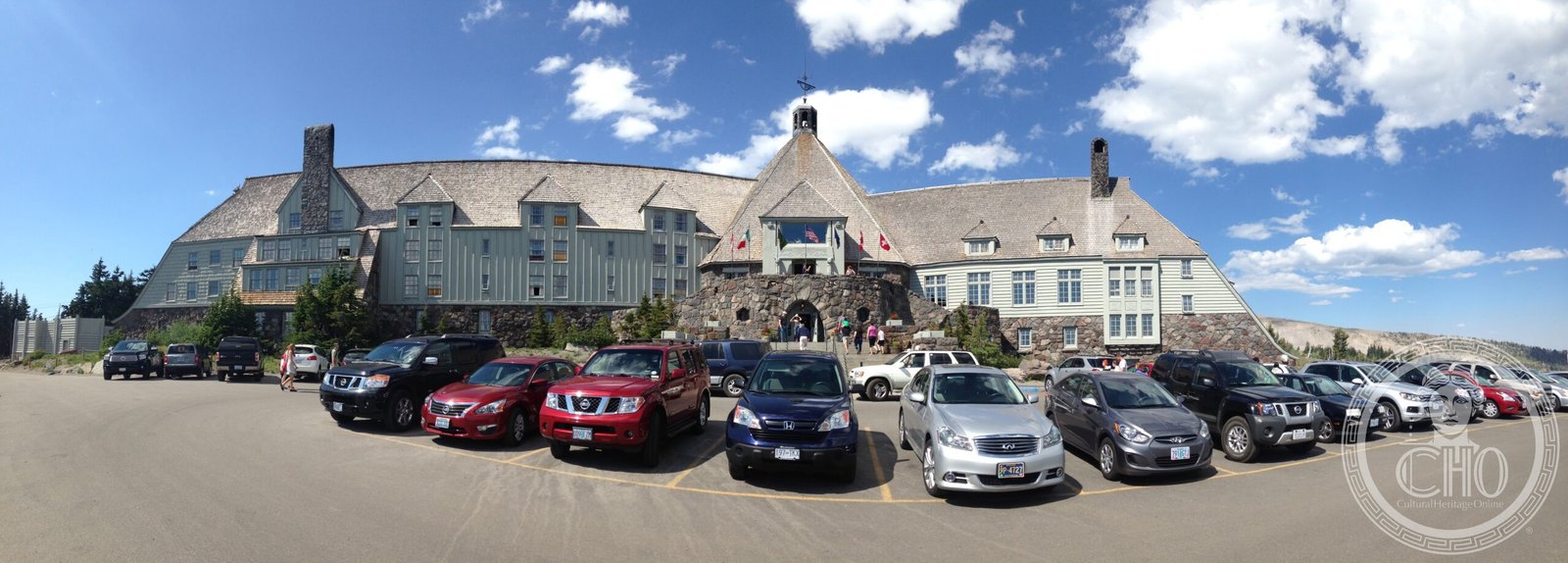
Built by hundreds of WPA craftsmen between 1936 and 1937 on the south slope of Mount Hood, Timberline Lodge combined the geometry of Art Deco with materials entirely from the Pacific Northwest — basalt, timber, hand-wrought iron — in a building that has not aged so much as it has deepened into the mountain it inhabits.
At a glance
Timberline Lodge sits at approximately 5,960 feet on the southern slope of Mount Hood, Oregon’s highest peak at 11,239 feet. The lodge was constructed between June 1936 and September 1937 by workers employed through the Works Progress Administration (WPA) and the Civilian Conservation Corps (CCC), using stone quarried from the mountain itself and timber milled in the surrounding national forest. President Franklin D. Roosevelt dedicated the lodge on September 28, 1937, describing it as “a monument to the skill and to the imagination of our American workers.” The building remains in operation as a year-round ski resort hotel and is designated a National Historic Landmark.
- Completed: September 1937
- Dedicated: September 28, 1937, by President Franklin D. Roosevelt
- Elevation: 5,960 feet (1,816 m)
- Construction: WPA and CCC; approximately 500 workers at peak
- Materials: Local basalt stone, Douglas-fir timber, hand-wrought iron
- National Historic Landmark
- Film: Exterior used by Stanley Kubrick for The Shining (1980)
Key facts
- Style: WPA Rustic Moderne — handcraft tradition combined with Art Deco geometric ornament
- Head House fireplace: A central hexagonal tower whose chimney is faced with 750 tons of native basalt
- WPA artisan work: Approximately 150 workers produced hand-carved panels, hooked rugs, wrought-iron hardware, mosaic tile, and painted wood furniture on site
- Ski season: One of the longest in the continental United States; lifts operate September through April on average
- Year-round operation: Open 365 days per year, including summer hiking and Palmer Snowfield skiing
- Rooms: 70 lodge rooms across several wings
History
The WPA lodge on Mount Hood was conceived in 1935 as part of President Roosevelt’s New Deal effort to put unemployed Americans back to work while simultaneously building lasting public amenities. Oregon’s Mount Hood National Forest had attracted hikers and winter recreation enthusiasts since the late nineteenth century, but overnight accommodation at the timberline level was limited. A federal lodge on the south slope would serve recreational visitors while providing months of employment for workers whose trades had been destroyed by the Depression: stonecutters, carpenters, metalworkers, weavers, woodcarvers.
Construction began in June 1936 under the supervision of the WPA Oregon district and the United States Forest Service. The basalt for the exterior walls was quarried from volcanic outcrops on the mountain; the timber came from the surrounding national forest. At the peak of construction, approximately 500 workers were employed on site. The WPA Federal Art Project assigned additional craftsmen to produce the interior furnishings entirely by hand: hooked and appliqued rugs, hand-wrought iron chandeliers and door hardware, carved newel posts depicting local animals, painted wood furniture, and mosaic tile panels.
President Roosevelt, accompanied by a large delegation, arrived on September 28, 1937, for the dedication ceremony. The lodge opened for visitors immediately. Its subsequent history has been one of continuous operation: through the Second World War, when it served military personnel stationed on the mountain, through the ski boom of the 1950s and 1960s, and through a period of deferred maintenance in the 1970s that led to its designation as a National Historic Landmark in 1977 and a subsequent federally supported restoration. RLK & Company has operated the lodge under Forest Service permit since 1955.
What you see
The plan of Timberline Lodge centres on the hexagonal Head House, a six-sided tower whose interior rises to a stone chimney built from 750 tons of native basalt. The hearth at the base of this chimney — burning year-round — is the thermal and visual heart of the building. From the Head House, two wings extend to the east and west, housing the hotel rooms and service facilities. The exterior reads as a continuous mass of rough-cut stone at the lower levels, transitioning to vertical board-and-batten timber siding above the snow line, with steeply pitched copper roofs that shed the heavy snowfall typical at six thousand feet.
The WPA artisan work is embedded into every surface. The carved newel posts at the foot of the main staircase depict the animals of Mount Hood: bear, deer, beaver, and mountain goat, each rendered in a stylised manner that sits between the naturalistic tradition of American wood carving and the geometric conventions of Art Deco. The iron chandeliers in the Head House, each individually forged, repeat a hexagonal motif that echoes the plan of the tower they hang in. The hooked rugs — most of them still in use — were produced by women in the WPA Sewing Room and depict Pacific Northwest flora and fauna in flat, jewel-coloured panels that read as pure Art Deco textile design.
Practical information
- Access: Year-round hotel; dining open to non-guests; day-lodge open during ski season
- Ski season: September–May most years; the Palmer Snowfield often extends summer skiing to July
- Dress: Mountain weather applies even in summer; temperature at the lodge is 20–30°F cooler than Portland on average
- Driving: Via US-26 east from Portland (approximately 60 miles); turn north at Rhododendron on Oregon Route 35 or continue on US-26 to Government Camp; the Timberline Road climbs 6 miles from Government Camp to the lodge
- Reservations: Required for accommodation; timberlinelodge.com
Getting there
Timberline Lodge is 60 miles east of Portland on the south slope of Mount Hood. From Portland, take I-84 east to Exit 16 (Wood Village), then US-26 east through Sandy and Rhododendron, and continue to Government Camp; the signed Timberline Road branches north from US-26 and climbs 6 miles to the lodge at 5,960 feet. No public transport serves the lodge directly; Portland’s MAX light rail connects to bus services running as far as Sandy. In winter, a snow-chain requirement may apply on Timberline Road; check ODOT TripCheck before departure.
Nearby
- Mount Hood Summit (11,239 ft) — The highest peak in Oregon, visible directly above the lodge and accessible by technical mountaineering route from the Timberline trailhead.
- Mirror Lake Trail — A day hike from US-26 below Government Camp to a lake reflecting Mount Hood; approximately 4.4 miles round-trip, moderate elevation gain.
- Multnomah Falls — The 620-foot Columbia River Gorge waterfall, 35 miles northwest via US-26 and I-84; one of the most visited natural sites in Oregon.
- Government Camp Village — The small resort community 6 miles below Timberline, with alternative ski area access, restaurants, and accommodation.
Sources
- National Historic Landmark designation documentation, Timberline Lodge, 1977
- National Park Service — National Register of Historic Places, Timberline Lodge nomination
- United States Forest Service, Mt. Hood National Forest — Timberline Lodge historical records
- Vaughan, Thomas, and Virginia Guest Ferriday, eds. Space, Style and Structure: Building in Northwest America. Oregon Historical Society, 1974
- RLK & Company — Timberline Lodge operational history documentation
Find it on the map
See this place and what’s around it →📷 Become a Cultural Heritage Online photographer
Share your photos of places: they stay published under your name as the author. The more they're seen, the more you get noticed — and soon a contest will reward the most appreciated photos.
Log in or sign up free to add a photoIs this page about you?
This page is read by travellers and heritage enthusiasts who find it on Google. Tell us how you are connected to this place and we will take it from there.