
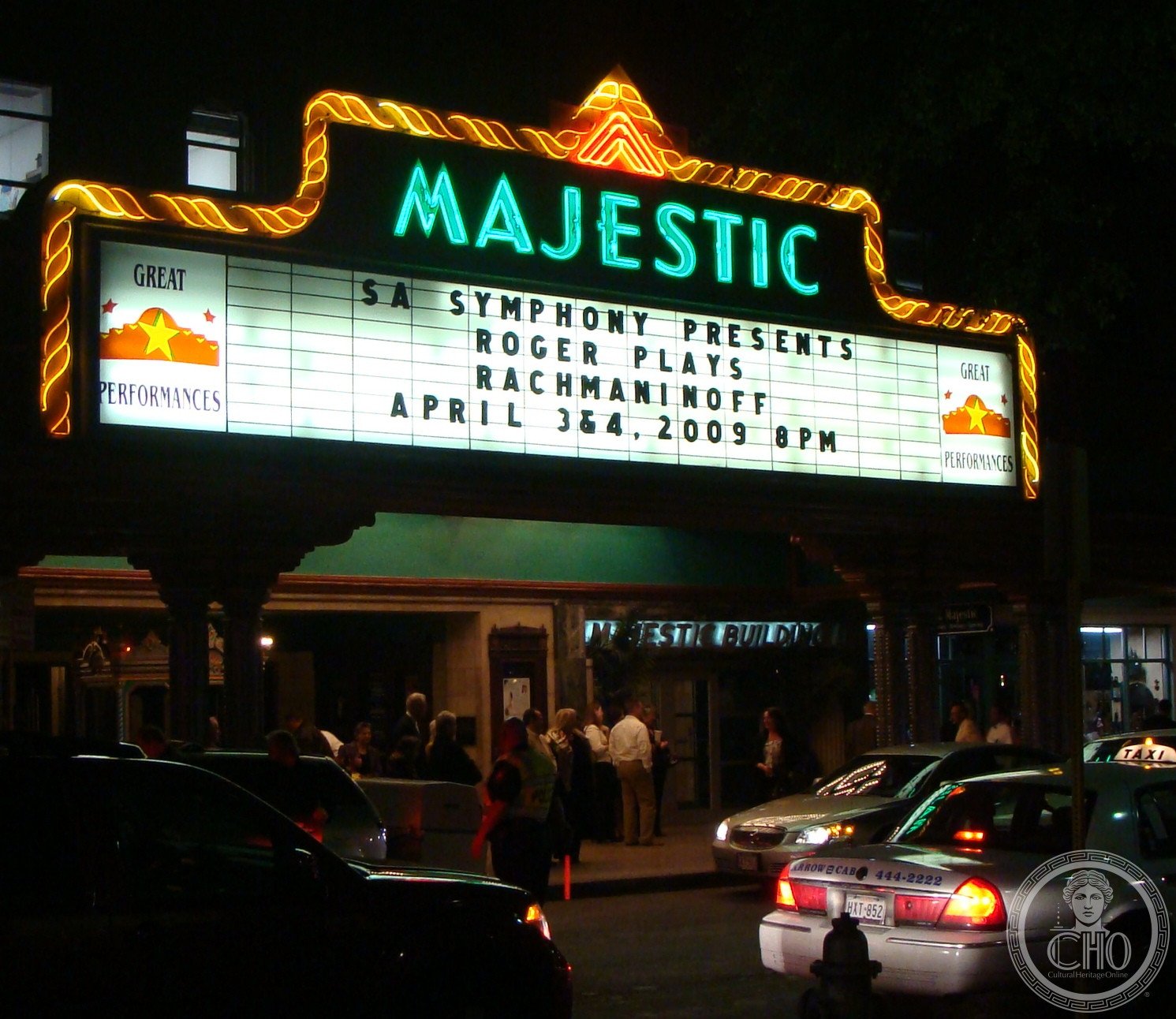
John Eberson designed the Majestic in 1929 as an Atmospheric theatre: inside, the ceiling becomes a Spanish night sky of moving clouds and pinpoint stars, the walls rise as plaster façades of a Mediterranean courtyard, and the audience sits, in effect, outdoors under the southern constellations.
At a glance
The Majestic Theatre at 224 East Houston Street opened on June 14, 1929, as one of the grandest movie palaces in Texas. Designed by architect John Eberson — the originator of the “Atmospheric” theatre concept — it seats approximately 2,300 people in an auditorium whose defining feature is the illusion of sitting beneath an open night sky in a Spanish Colonial garden. The ceiling above the orchestra level slowly cycles through projected cloud formations against a deep blue field studded with star lights; the surrounding walls present an elaborate fiction of castle towers, arched balconies, and ivy-covered parapets. Designated a National Historic Landmark, the Majestic is now the home theatre of the San Antonio Symphony and a premier touring venue for Broadway productions.
- Opened: June 14, 1929
- Architect: John Eberson, creator of the Atmospheric theatre concept
- Style: Atmospheric — Spanish Colonial / Mediterranean night-garden illusion
- Seating: Approximately 2,300 (current configuration)
- National Historic Landmark
- Operator: Venue San Antonio (San Antonio Symphony home venue)
Key facts
- Original capacity: Approximately 3,700 seats — one of the largest theatres in Texas at opening
- Builder: Karl Hoblitzelle, Interstate Theatres circuit
- Organ: Original Wurlitzer theatre organ — partially preserved
- Projected sky: Brenograph projectors cycle cloud formations across the ceiling throughout performances
- Renovation: Major restoration 1989–1990 reduced seating to improve sightlines and acoustics
- NRHP: Listed on the National Register of Historic Places
History
John Eberson developed the Atmospheric theatre concept in the mid-1920s after observing that audiences in the American South and Southwest were accustomed to evening entertainment in outdoor settings and responded warmly to the illusion of being in an outdoor garden or courtyard. The key technical element was the Brenograph projector, which could cast slow-moving cloud formations across a domed or raked ceiling, combined with hundreds of fibre-optic or incandescent star points set into the ceiling surface. The effect, Eberson found, was more transportative than any painted backdrop.
Karl Hoblitzelle’s Interstate Theatres circuit commissioned the Majestic as the flagship of its Texas operations. Hoblitzelle had already built profitable theatres in Dallas and Houston; he wanted a San Antonio showpiece that would draw audiences from the entire surrounding region. Eberson delivered a building whose exterior, on East Houston Street near the city’s commercial centre, was relatively modest — a formal façade with a vertical marquee — but whose interior was one of the most sustained pieces of theatrical illusion he had produced. The theatre opened with a full programme of vaudeville and silent film; with the arrival of sound cinema in 1929–1930, the vaudeville programme was wound down and the Majestic became primarily a cinema.
The theatre remained a major cinema and live entertainment venue through the 1970s, when declining attendance and rising maintenance costs prompted a prolonged period of uncertainty. A restoration project completed in 1989–1990 converted the Majestic into a performing arts centre: the seating was reduced from the original 3,700 to approximately 2,300 to improve sightlines and acoustic quality, and the interior was carefully returned to its original colour scheme and plasterwork condition. The San Antonio Symphony became the theatre’s anchor tenant.
What you see
The Majestic’s interior is the complete realisation of Eberson’s Atmospheric method: the auditorium is designed to read not as an enclosed room but as an exterior space. The ceiling, which rises above the orchestra level to a wide flat field, is deep indigo blue and carries hundreds of small lights that approximate the southern stars. The Brenograph projectors — mounted in the ceiling at the rear of the house — cast slow cloud formations across this field throughout the performance, so that the illusion of an outdoor night never fully resolves into a ceiling. The walls on either side of the auditorium present plaster façades of a Spanish colonial garden: arched windows behind which darkness suggests interior rooms, towers whose upper courses are lost in shadow, balconies draped with plaster vegetation, and niches occupied by heraldic figures. The overall colour palette runs from warm ochre and terracotta at the lower levels to deep blue overhead.
The stage opening — the proscenium arch — is framed in elaborate plasterwork cartouches and heraldic ornament, flanked by boxes whose railings carry Spanish Colonial ironwork details. At full seating capacity the theatre creates an unusual acoustic condition: the audience fills a space that reads visually as open, but which is acoustically enclosed, producing the warm reverberation time favoured by orchestral music. The 1989 restoration concentrated particularly on preserving this acoustic, which the Symphony had identified as one of the venue’s principal assets.
Practical information
- Access: Performance nights only; check the Majestic schedule at majesticempire.com
- Box office: 224 East Houston Street; also via Ticketmaster
- Parking: Paid garages within one block on East Houston Street and Commerce Street
- Location: Two blocks from the River Walk; easily combined with an evening on the canal-side restaurant strip
- Nearby dining: The Houston Street corridor has restaurants within walking distance
Getting there
The Majestic Theatre is in the heart of downtown San Antonio, two blocks east of Alamo Plaza and three blocks north of the River Walk. By VIA Metropolitan Transit: several bus lines serve East Houston Street; the nearest stop is at Houston and Bowie Streets. By car from San Antonio International Airport (SAT), take US-281 South to I-35 North, exit at Commerce Street, and proceed east to the theatre — approximately 8 miles and 15 minutes. The Alamo Station of the VIA streetcar connects the convention centre area to the downtown core.
Nearby
- The Alamo (Mission San Antonio de Valéro, 1718) — Two blocks west; the 1836 battle site and museum, one of the most visited historic sites in Texas.
- San Antonio River Walk — Three blocks south; the network of riverside walkways lined with restaurants and hotels in the bend of the San Antonio River.
- Tower Life Building (1929) — The Gothic-Art Deco skyscraper three blocks southeast; opened the same year as the Majestic and together they bookend the city’s 1929 architectural ambitions.
- San Fernando Cathedral (1749) — Four blocks west on Main Plaza; the oldest cathedral sanctuary in the contiguous United States.
Sources
- National Register of Historic Places Nomination, Majestic Theatre, San Antonio
- National Historic Landmark designation documentation, Majestic Theatre
- Hall, Ben M. The Best Remaining Seats: The Golden Age of the Movie Palace. Clarkson N. Potter, 1961
- Naylor, David. American Picture Palaces: The Architecture of Fantasy. Van Nostrand Reinhold, 1981
- Venue San Antonio — Majestic Theatre restoration records
Find it on the map
See this place and what’s around it →📷 Become a Cultural Heritage Online photographer
Share your photos of places: they stay published under your name as the author. The more they're seen, the more you get noticed — and soon a contest will reward the most appreciated photos.
Log in or sign up free to add a photoIs this page about you?
This page is read by travellers and heritage enthusiasts who find it on Google. Tell us how you are connected to this place and we will take it from there.