
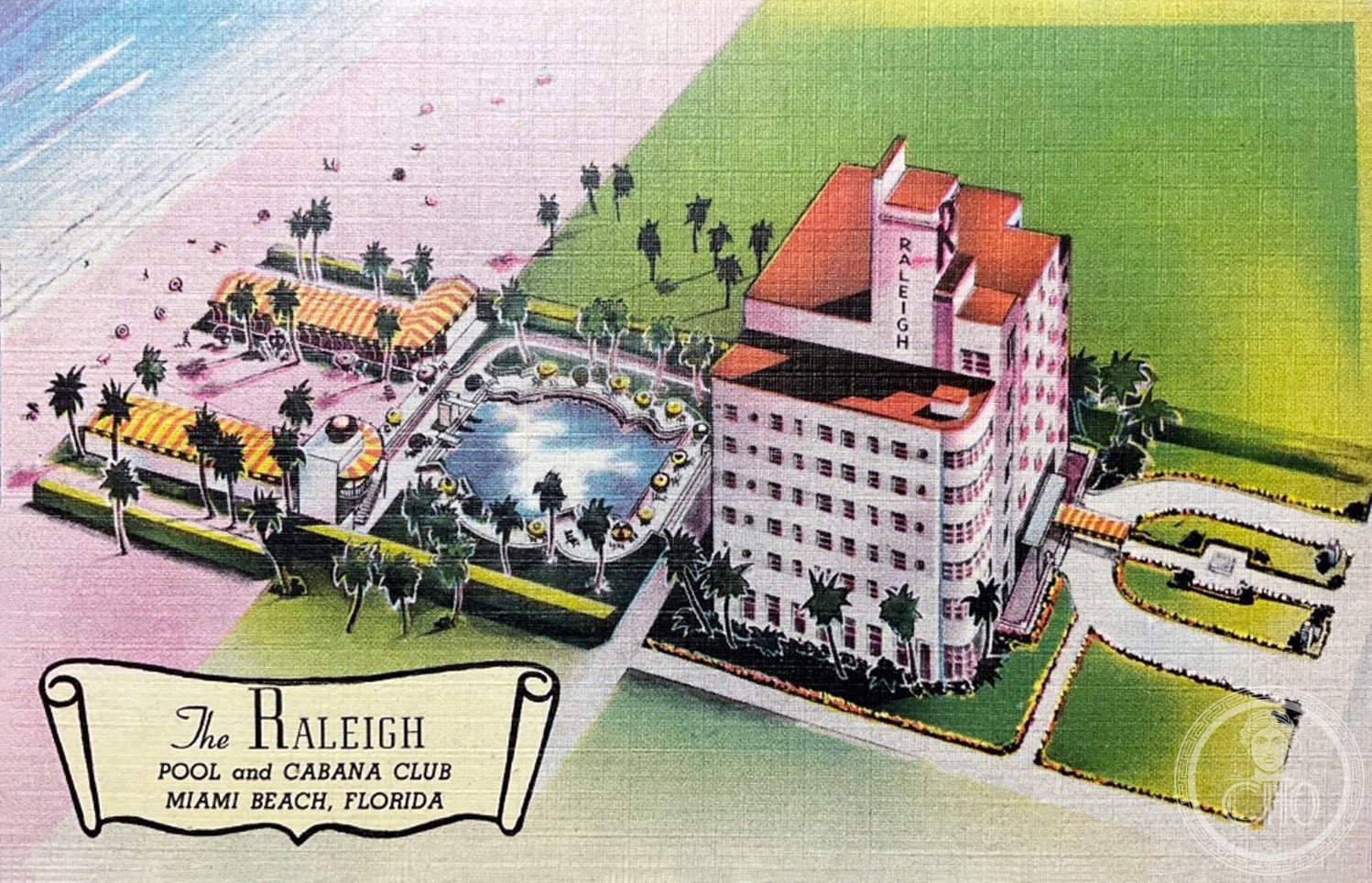
L. Murray Dixon’s 1940 masterwork on Collins Avenue combines an intact Art Deco facade with a free-form pool that became one of the most photographed in the world — a stage for the glamour the Miami Beach hotel industry cultivated in the mid-twentieth century.
At a glance
The Raleigh Hotel at 1775 Collins Avenue in Miami Beach was completed in 1940 to designs by L. Murray Dixon, the most prolific architect of Miami Beach’s Art Deco period. The building is a refined example of the streamlined Deco style that Dixon refined across dozens of Miami Beach hotels: horizontal racing stripes, a symmetrical principal facade with a modest marquee, and an interior that opens to the pool and garden. The pool itself, with its curvilinear form designed to echo a tropical leaf, became the hotel’s defining image and attracted a series of notable guests and fashion photographers across the postwar decades. The Raleigh is within the Miami Beach Architectural District, listed on the National Register of Historic Places.
Key facts
- Location: 1775 Collins Avenue, Miami Beach, Florida
- Architect: L. Murray Dixon
- Completed: 1940
- Style: Streamline Art Deco (Miami Beach Deco)
- Feature: Free-form curvilinear pool, one of the most photographed in the United States
- Status: Contributing building, Miami Beach Architectural District (NRHP)
- Current use: Hotel
History
L. Murray Dixon designed over 30 buildings in Miami Beach in a career concentrated in the period from the mid-1930s to the mid-1940s, making him the most prolific individual architect in the district. His approach was to refine rather than invent: each successive hotel took the previous vocabulary of horizontal banding, eyebrow shades, and vertical decorative elements and compressed it further, producing buildings of increasing formal efficiency. The Raleigh, completed just before the United States entered the Second World War, represents the near-final expression of this refinement.
The hotel’s pool was the source of its postwar fame. The curvilinear form, unusual in an era when most hotel pools were rectangular, made it a natural subject for photography, and a series of famous swimwear and lifestyle images established the Raleigh as one of the defining locations of the mid-century Miami Beach aesthetic. The hotel went through several ownership changes and periods of decline in the 1970s and 1980s before its restoration in the 1990s, when it became a symbol of the broader Art Deco preservation effort in the district.
The building is a contributing structure within the Miami Beach Architectural District, which was listed on the National Register of Historic Places in 1979, the first urban district so designated in the United States.
What you see
The Collins Avenue facade is symmetrical, with a slightly projecting central block and the characteristic horizontal racing stripes — narrow bands of stucco relief — that run across the facade between floors. The entrance canopy or marquee is restrained compared to some of Dixon’s more theatrical designs, and the overall effect is of disciplined elegance rather than exuberance. The eyebrow shades above the windows, standard in Miami Beach Deco for solar control, give the facade a rhythmical texture when seen in strong afternoon light.
Behind the facade, the pool terrace is the architectural centrepiece. The pool’s leaf-like form is best appreciated from the upper floors of the hotel or from the terrace itself, where the organic outline contrasts with the geometric gridding of the surrounding paving. The landscaping — palms and tropical plantings — completes the composition that photographers have returned to for decades.
Practical information
- Access: Active hotel; pool and terrace accessible to hotel guests.
- Best viewing: The Collins Avenue facade is best photographed in early morning or late afternoon light. The pool is accessible to guests.
- Time needed: The exterior can be seen in 15 minutes; the broader Miami Beach Art Deco Historic District rewards a half-day walk.
- Nearby: Ocean Drive’s concentration of Deco hotels is six blocks east; the Art Deco Welcome Center is at 1001 Ocean Drive.
Getting there
The Raleigh Hotel is on Collins Avenue between 17th and 18th Streets in Miami Beach. Miami International Airport (MIA) is approximately nine miles west; the Miami Beach SunTrolley and Miami-Dade Transit buses connect the airport area to Collins Avenue. The hotel is three blocks west of the Atlantic Ocean and two blocks north of Lincoln Road, the pedestrian shopping corridor. The SunTrolley Collins/Washington route runs along Collins Avenue past the hotel.
Nearby
- Colony Hotel (1935) — Henry Hohauser’s landmark Deco hotel on Ocean Drive, a ten-minute walk east through Lincoln Road.
- Miami Beach Convention Center (1957, expanded 2018) — Two blocks north; the older 1957 section retains mid-century Moderne character.
- Lincoln Road Mall — The pedestrian shopping street two blocks south, designed by Morris Lapidus in 1960, preserving the character of 1950s Miami Beach commerce.
- Wolfsonian-FIU Museum — Design museum in a 1927 storage building at 1001 Washington Avenue, with major collections on Deco and Moderne design, about six blocks south.
Sources
- Miami Beach Architectural District, National Register of Historic Places nomination (1979).
- Capitman, Barbara Baer. Deco Delights: Preserving the Beauty and Joy of Miami Beach Architecture. E. P. Dutton, 1988.
- Gebhard, David, and Deborah Nevins. 200 Years of American Architectural Drawing. Whitney Library of Design, 1977.
- Porges, Seth. Art Deco Miami Beach: A Visual Guide to the Architecture. Pelican Publishing, 2013.
- Wikipedia, “Raleigh Hotel, Miami Beach,” https://en.wikipedia.org/wiki/Raleigh_Hotel_(Miami_Beach).
Find it on the map
See this place and what’s around it →📷 Become a Cultural Heritage Online photographer
Share your photos of places: they stay published under your name as the author. The more they're seen, the more you get noticed — and soon a contest will reward the most appreciated photos.
Log in or sign up free to add a photoIs this page about you?
This page is read by travellers and heritage enthusiasts who find it on Google. Tell us how you are connected to this place and we will take it from there.