
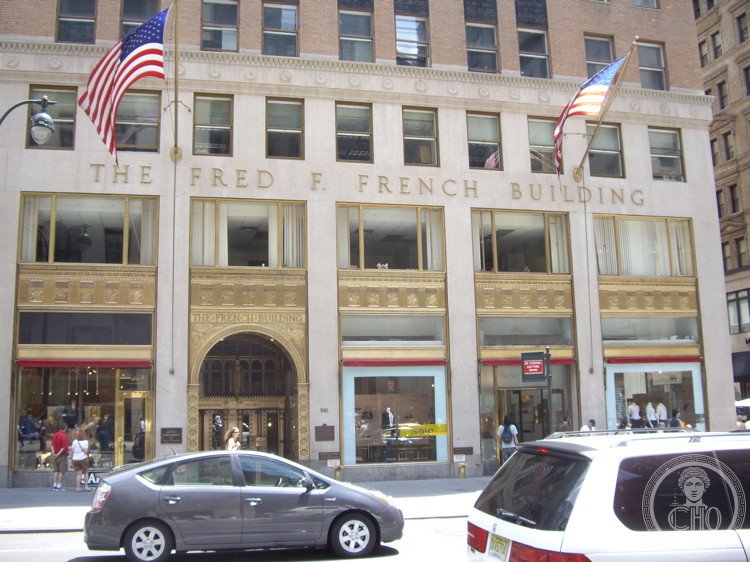
A polychrome crown of Babylonian-inspired terracotta rises above Fifth Avenue, making this 38-story tower one of the most distinctive pieces of ornament in Midtown Manhattan.
At a glance
The Fred F. French Building at 551 Fifth Avenue stands as one of the most ornamented skyscrapers of its era. Completed in 1927, the tower’s polychrome crown is clad in glazed terracotta in shades of gold, yellow, and blue, incorporating winged griffins, beehives, and stylised sunrise motifs drawn from ancient Mesopotamian architecture. It was a deliberate statement by developer Fred F. French that a commercial building could carry the visual richness of a monument. The upper setbacks and the lantern that crowns the tower remain extraordinarily intact, a vivid presence among the largely monochrome towers that surround it between 45th and 46th Streets.
Key facts
- Location: 551 Fifth Avenue, between 45th and 46th Streets, Midtown Manhattan
- Architect: H. Douglas Ives
- Completed: 1927
- Height / floors: approximately 440 feet / 38 stories
- Style: Art Deco with polychrome Babylonian-inspired terracotta ornament
- Status: New York City Individual Landmark; National Register of Historic Places
- Current use: Mixed-use office building
History
Fred F. French was one of the most active real estate developers in 1920s New York, responsible for Tudor City (1927), a major residential complex on the East Side, and several other large-scale projects. The building at 551 Fifth Avenue was his company headquarters, and he was personally involved in directing its decorative programme. The choice of Babylonian and Assyrian ornamental motifs was a calculated departure from the Gothic and classical idioms then dominant in skyscraper design, aligning the building with the contemporary fashion for ancient Near Eastern archaeology, driven in the public imagination by the discovery of Tutankhamun’s tomb in 1922 and the popular interest in Mesopotamian excavations.
The architect H. Douglas Ives produced a tower that was rational and efficient in plan while being highly theatrical at the crown, where the ornament intensifies toward the polychrome lantern. The building opened in 1927 at the peak of New York’s skyscraper boom, a moment when developers competed to put their names on buildings that would be recognisable from blocks away. The French Company occupied the tower as its headquarters until the Depression transformed the speculative real estate market.
The building was designated a New York City Individual Landmark and listed on the National Register of Historic Places, recognition that secured the long-term preservation of its polychrome crown, which remained intact through decades of commercial use.
What you see
The building is a steel-frame tower clad in limestone at the lower floors, with the ornamental programme concentrating in the upper setbacks and crown. The polychrome glazed terracotta features winged griffins at the corners, a beehive motif that recurs in the spandrels, and sunburst patterns in gold and blue ceramic tile that animate the uppermost three stories. The contrast between the sober midshaft and the exuberant crown is deliberate: the tower reads as conventional at street level and becomes increasingly ornate as it rises, reaching maximum colour and detail at the lantern. The entrance lobby preserves Art Deco metalwork and decorative plaster.
Seen from Fifth Avenue toward the north, the building is framed between its taller neighbours and the polychrome crown catches low afternoon light in a way that shifts its apparent colour from amber to gold. The motif of the rising sun, drawn from Mesopotamian iconography, recurs in compressed relief around the windows of the upper setbacks, giving the crown a tapestry-like surface at close range.
Practical information
- Access: The building is a working office tower; the lobby is publicly accessible during business hours.
- Best viewing: The polychrome crown is best seen from the opposite side of Fifth Avenue, looking north from 44th or 45th Street.
- Time needed: 10 minutes for exterior and lobby viewing; combine with the nearby Chrysler Building and Grand Central Terminal for an Art Deco Midtown walk.
- Nearby food: Bryant Park and the surrounding blocks have extensive café and restaurant options.
Getting there
The Fred F. French Building is in central Midtown Manhattan at 551 Fifth Avenue, between 45th and 46th Streets. The nearest subway stations are Grand Central–42nd Street (4/5/6/S trains) two blocks south, and 47th–50th Streets–Rockefeller Center (B/D/F/M) two blocks north. The building is within a five-minute walk of Grand Central Terminal, the Chrysler Building, and the New York Public Library’s main branch at Fifth and 42nd.
Nearby
- Chanin Building (1929) — Irwin Chanin’s polychrome Art Deco tower at 122 East 42nd Street, two blocks south, with equally elaborate terracotta ornament at the crown and an extraordinary Art Deco lobby.
- Chrysler Building (1930) — The most celebrated Art Deco spire in New York, visible from Fifth Avenue looking east along 42nd Street.
- Bryant Park — The public park immediately west of the New York Public Library, two blocks south, flanked by the Art Deco American Radiator Building (1924).
- Grand Central Terminal (1913) — The Beaux-Arts rail hub two blocks south, whose 42nd Street concourse is one of the great interiors in New York.
Sources
- New York City Landmarks Preservation Commission, Individual Landmark Designation Report: 551 Fifth Avenue (Fred F. French Building).
- New York City Landmarks Preservation Commission, Skyscraper Museum exhibition materials.
- National Register of Historic Places, nomination form, Fred F. French Building.
- Stern, Robert A. M., Gregory Gilmartin, and Thomas Mellins. New York 1930: Architecture and Urbanism Between the Two World Wars. Rizzoli, 1987.
- Robins, Anthony W. New York Art Deco: A Guide to Gotham’s Jazz Age Architecture. Excelsior Editions, 2017.
Find it on the map
See this place and what’s around it →📷 Become a Cultural Heritage Online photographer
Share your photos of places: they stay published under your name as the author. The more they're seen, the more you get noticed — and soon a contest will reward the most appreciated photos.
Log in or sign up free to add a photoIs this page about you?
This page is read by travellers and heritage enthusiasts who find it on Google. Tell us how you are connected to this place and we will take it from there.