
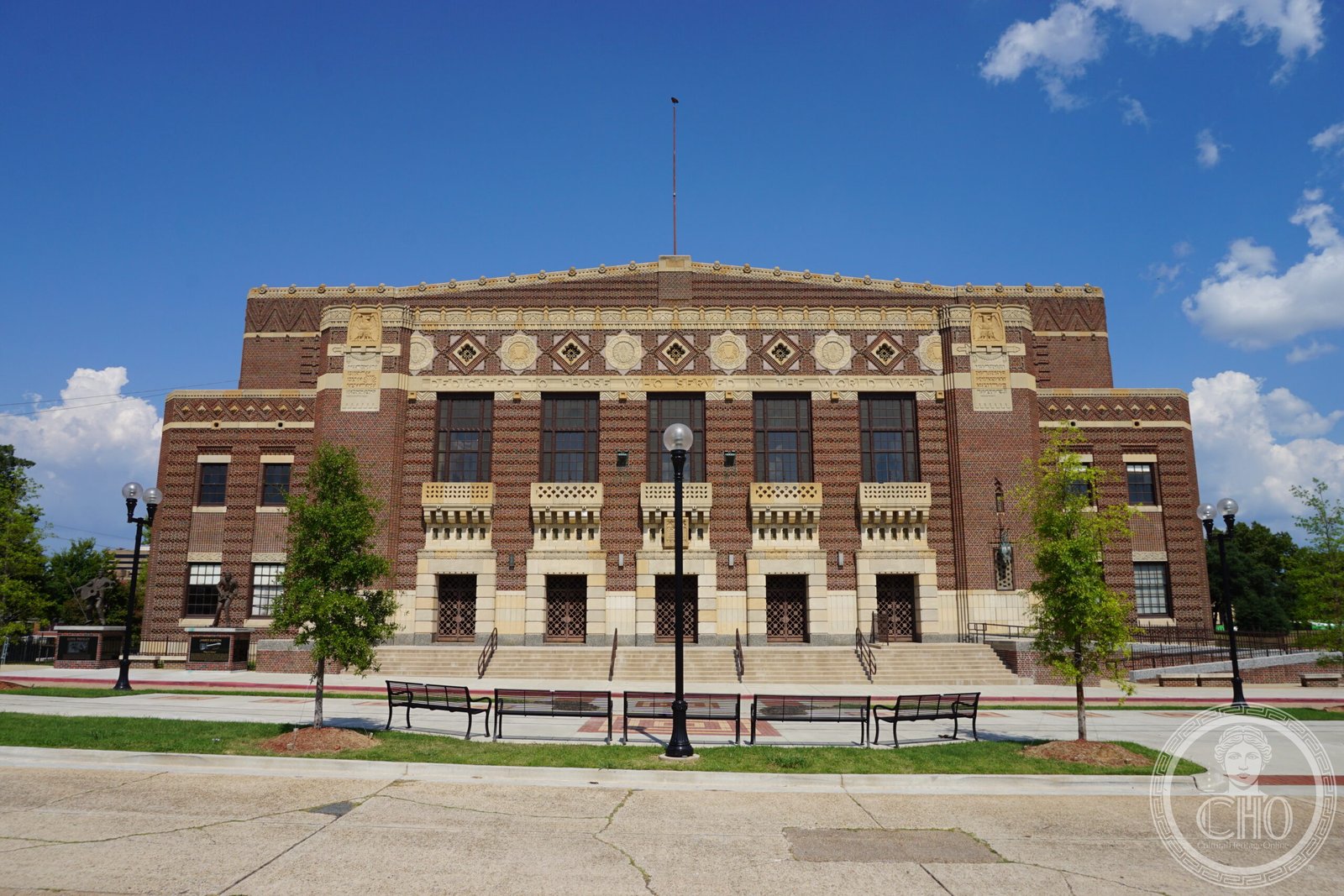
Built to honor the fallen of World War I, this Art Deco civic hall became the stage where American popular music found some of its most legendary early voices.
At a glance
The Shreveport Municipal Memorial Auditorium opened in 1929 on what is now Elvis Presley Avenue, combining war-memorial gravitas with the decorative confidence of late-1920s Art Deco. Its buff-brick facade, arched entrance loggia, and restrained terra-cotta ornament give the building a civic authority that outlasted the politicians who commissioned it. The auditorium gained its lasting reputation not from civic ceremonies but from the Louisiana Hayride, a live country-music radio broadcast that ran here from 1948 to 1960 and introduced dozens of artists — Elvis Presley, Hank Williams, Johnny Cash, Patsy Cline, Kitty Wells — to national audiences before Nashville solidified its grip on the industry.
Key facts
- Opened: 1929
- Style: Art Deco, war-memorial civic type
- Capacity: approximately 3,700 seats
- Address: 705 Elvis Presley Avenue, Shreveport, Louisiana 71101
- Historic designation: National Register of Historic Places
- Louisiana Hayride: Saturday-night radio broadcasts, 1948–1960, KWKH
- Nickname: “The Cradle of the Stars”
History
Shreveport dedicated the auditorium in memory of Caddo Parish residents who died in World War I. The building commission chose a monumental Art Deco design with echoes of Romanesque massing — an approach common in Southern civic projects of the late 1920s that wanted dignity without the full cost of a classical column order. The auditorium served every civic purpose from political conventions to touring orchestras through the 1930s and 1940s.
The transformation into a music landmark came in 1948 when KWKH radio launched the Louisiana Hayride as a regional rival to Nashville’s Grand Ole Opry. The Hayride had looser rules and a willingness to gamble on unknowns. Hank Williams performed here after the Opry fired him for unreliability. Elvis Presley, eighteen years old and just signed to Sun Records in Memphis, made his radio debut on the Hayride stage on October 16, 1954. He returned nearly every Saturday for over a year. The street outside was renamed Elvis Presley Avenue in his honor; the building itself became the site of a regular Presley tribute concert that still draws visitors decades later.
After the Hayride ended in 1960 the auditorium continued as a general-purpose civic venue. Restoration efforts in the twenty-first century preserved the Art Deco interior and maintained the building’s role as an active performance space, ensuring that the hall where American rock and roll took its first national breath remains open and usable.
What you see
The entrance facade presents a symmetrical composition: a broad arched loggia of three bays framed by flat pilasters with incised geometric ornament typical of American Deco civic work. The buff-brick walls above read as a clean plane punctuated by narrow vertical windows that emphasize the building’s mass without historical ornament. Terra-cotta panels at the cornice level carry stylized floral and angular motifs that reward close inspection but never compete with the building’s war-memorial solemnity.
Inside, the main auditorium retains its original sloped-floor configuration with a raised stage and a balcony wrapping three sides. The ceiling features geometric coffers and indirect lighting channels in the Deco manner. The acoustic volume — designed to carry unamplified speech to three thousand seats — proved equally suited to amplified country, rockabilly, and eventually rock and roll once electrification changed live performance in the early 1950s.
Practical information
- Access: Open during scheduled events; lobby accessible on weekdays
- Best time to visit: Check local event listings; concerts and festivals year-round
- Nearby parking: Municipal lots along Texas Street and Commerce Street
- Time needed: 45 minutes for exterior and lobby; longer for events
Getting there
The auditorium stands in downtown Shreveport at 705 Elvis Presley Avenue, one block west of Commerce Street. Shreveport Regional Airport (SHV) lies about six miles south. Interstate 20 and Interstate 49 intersect at Shreveport; from downtown exits the auditorium is a five-minute drive or ten-minute walk from the Red River waterfront. Dallas is approximately 180 miles southeast on I-20.
Nearby
- Strand Theatre (1925) — Shreveport’s grand movie palace, three blocks east on Texas Street
- Shreveport Riverwalk — Red River waterfront promenade and casino district, ten-minute walk south
- Louisiana State Exhibit Museum — WPA-era Art Deco museum with dioramas of Louisiana history, Greenwood Road
- Barksdale Air Force Base Heritage Museum — aviation history collection, 20 minutes by car
Sources
- National Register of Historic Places, nomination file: Shreveport Municipal Memorial Auditorium
- Louisiana Office of Cultural Development, Historic Preservation Division
- KWKH Louisiana Hayride archive documentation, Louisiana State University Libraries
- Peter Guralnick, Last Train to Memphis: The Rise of Elvis Presley (1994) — Hayride chapter
Find it on the map
See this place and what’s around it →📷 Become a Cultural Heritage Online photographer
Share your photos of places: they stay published under your name as the author. The more they're seen, the more you get noticed — and soon a contest will reward the most appreciated photos.
Log in or sign up free to add a photoIs this page about you?
This page is read by travellers and heritage enthusiasts who find it on Google. Tell us how you are connected to this place and we will take it from there.