
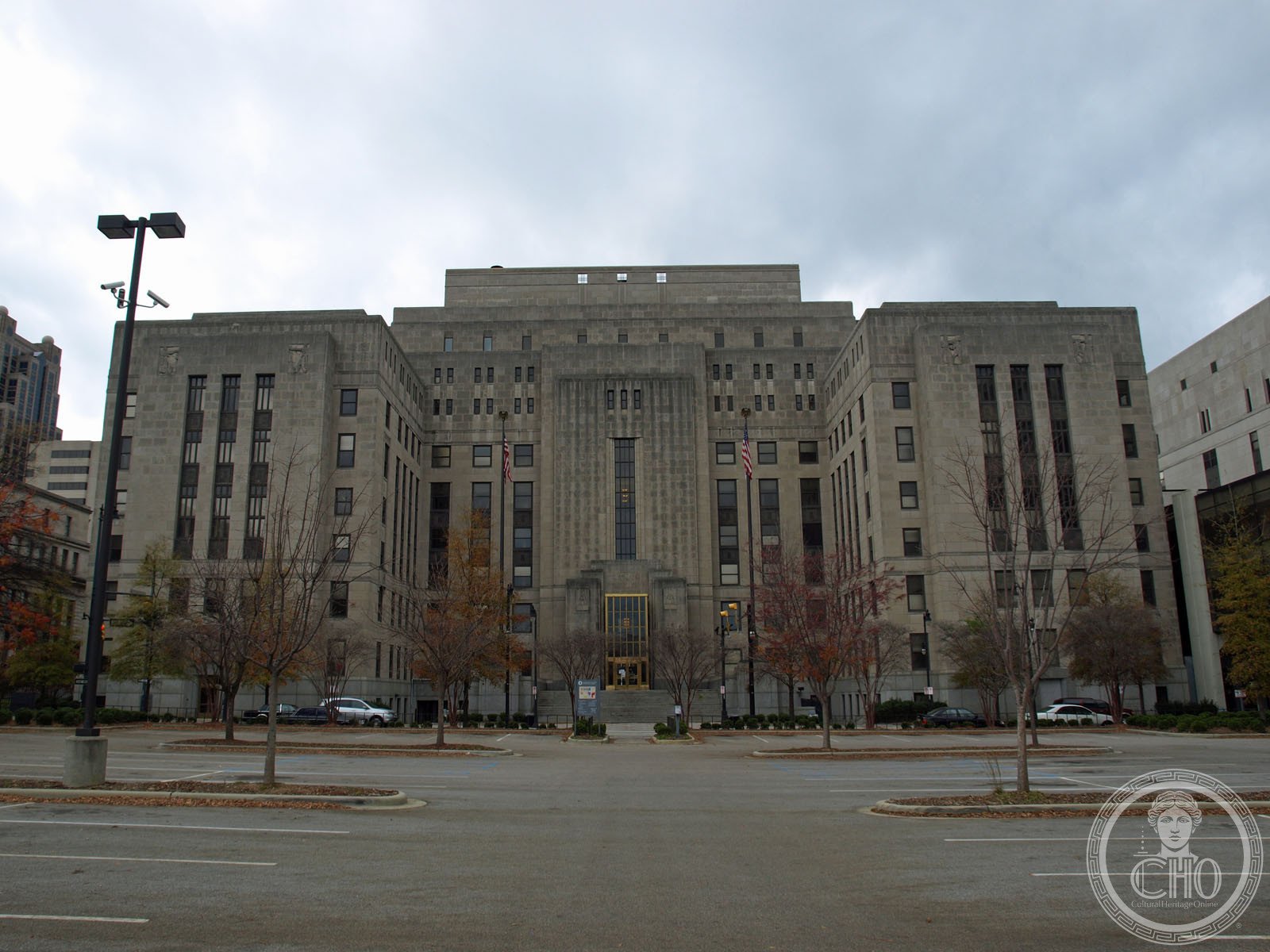
Birmingham’s civic anchor since the early Depression, the Jefferson County Courthouse is an Art Deco tower in Alabama limestone whose monumental lobby — coffered ceilings, ornamental ironwork, and marble floors — was designed to project permanence and institutional authority at the moment both seemed most precarious.
At a glance
Completed in 1931 at 716 Richard Arrington Jr. Boulevard North in downtown Birmingham, the Jefferson County Courthouse replaced an earlier structure on the same civic block. Its twelve-story Art Deco tower, clad in Alabama limestone and Georgia marble, anchors the civic center with a scale and material quality that places it among the South’s most distinguished Depression-era public buildings. The building remains in active courthouse use and is listed on the National Register of Historic Places.
Key facts
- Address: 716 Richard Arrington Jr. Boulevard North, Birmingham, AL 35203
- Year completed: 1931
- Style: Art Deco civic / Moderne
- Height: 12 stories
- Materials: Alabama limestone cladding, Georgia marble interior
- Function: Jefferson County civil and criminal courthouse (active)
- Designation: National Register of Historic Places
History
Jefferson County was established in 1819 and named for Thomas Jefferson; Birmingham, its county seat, was incorporated only in 1871 as a planned industrial city at the intersection of two railroads. By the 1920s Birmingham had become the industrial capital of the American South, its steel mills and iron furnaces drawing workers and capital from across the region. The decision to replace the earlier courthouse with a new twelve-story building was taken in the late 1920s, at the height of the boom; construction proceeded through the first years of the Depression.
The courthouse was completed in 1931. Its Art Deco vocabulary — restrained exterior ornament concentrated at the entrance portal and cornice, geometric spandrel panels, and monumental entrance bay — projected civic authority in the idiom of its era. The Depression made the building a statement of institutional confidence at the precise moment when both the county’s finances and the broader economy were under severe stress. The building has served continuously as the county’s primary courthouse ever since, making it one of Birmingham’s longest-serving civic institutions.
What you see
From Richard Arrington Jr. Boulevard the courthouse presents a vertical shaft of Alabama limestone: the lower stories form a monumental base, the middle stories rise with minimal articulation, and the top three floors step back beneath a flat Art Deco parapet. Ornamental carving is concentrated at the main entrance bay, where stylised eagles, geometric patterns, and the county seal appear in relief. The overall effect is of civic weight without decorative excess — a building that impresses through scale and material quality rather than ornamental exuberance.
The lobby interior carries the formal program further: coffered plaster ceilings, ornamental ironwork railings on the staircases, marble flooring, and brass hardware throughout. The scale of the lobby — proportioned for a public building expected to receive thousands of visitors per week — gives it a grandeur that many contemporary courthouses lack. Upper floors contain courtrooms of varying size, some retaining original woodwork and judicial furnishings.
Practical information
- The building is an active courthouse; public areas are accessible during operating hours (Monday–Friday, approximately 8 AM–5 PM). Security screening at entry.
- Photography in public lobby areas is generally permitted; courtroom photography policies vary by judge.
- The building is fully accessible; elevator service to all courtroom floors.
- Birmingham’s downtown is compact; the courthouse is a short walk from City Hall, the Alabama Theatre, and the Birmingham Civil Rights Institute.
Getting there
Birmingham-Shuttlesworth International Airport (BHM) is approximately 5 miles northeast of downtown, served by major US carriers. Amtrak’s Crescent route (New York–New Orleans) stops at Birmingham’s Amtrak station approximately 1 mile from the courthouse. By car, Birmingham is at the intersection of I-20/I-59 and I-65; the courthouse is at the intersection of Richard Arrington Jr. Blvd North and 8th Avenue North. The MAX Transit bus network serves downtown; parking garages are available on adjacent blocks.
Nearby
- Alabama Theatre (1927) — Art Deco movie palace, 0.3 miles south on 3rd Avenue North
- Birmingham Civil Rights Institute (1992) — 0.4 miles southeast at 16th Street and 6th Avenue North
- 16th Street Baptist Church (1911) — site of the 1963 bombing, a landmark of the Civil Rights movement, 0.4 miles southeast
- Linn Park — civic green between the courthouse and City Hall, with the Birmingham Museum of Art on its north edge
Sources
- National Register of Historic Places nomination form, Jefferson County Courthouse, Birmingham
- Norrell, Robert J. A Promising Field: Engineering at Alabama 1837–1987. University of Alabama Press, 1990
- Garrow, David J. Bearing the Cross: Martin Luther King Jr. and the Southern Christian Leadership Conference. William Morrow, 1986
- Alabama Historical Commission, designation records
- Birmingham Historical Society, architectural documentation
Find it on the map
See this place and what’s around it →📷 Become a Cultural Heritage Online photographer
Share your photos of places: they stay published under your name as the author. The more they're seen, the more you get noticed — and soon a contest will reward the most appreciated photos.
Log in or sign up free to add a photoIs this page about you?
This page is read by travellers and heritage enthusiasts who find it on Google. Tell us how you are connected to this place and we will take it from there.