
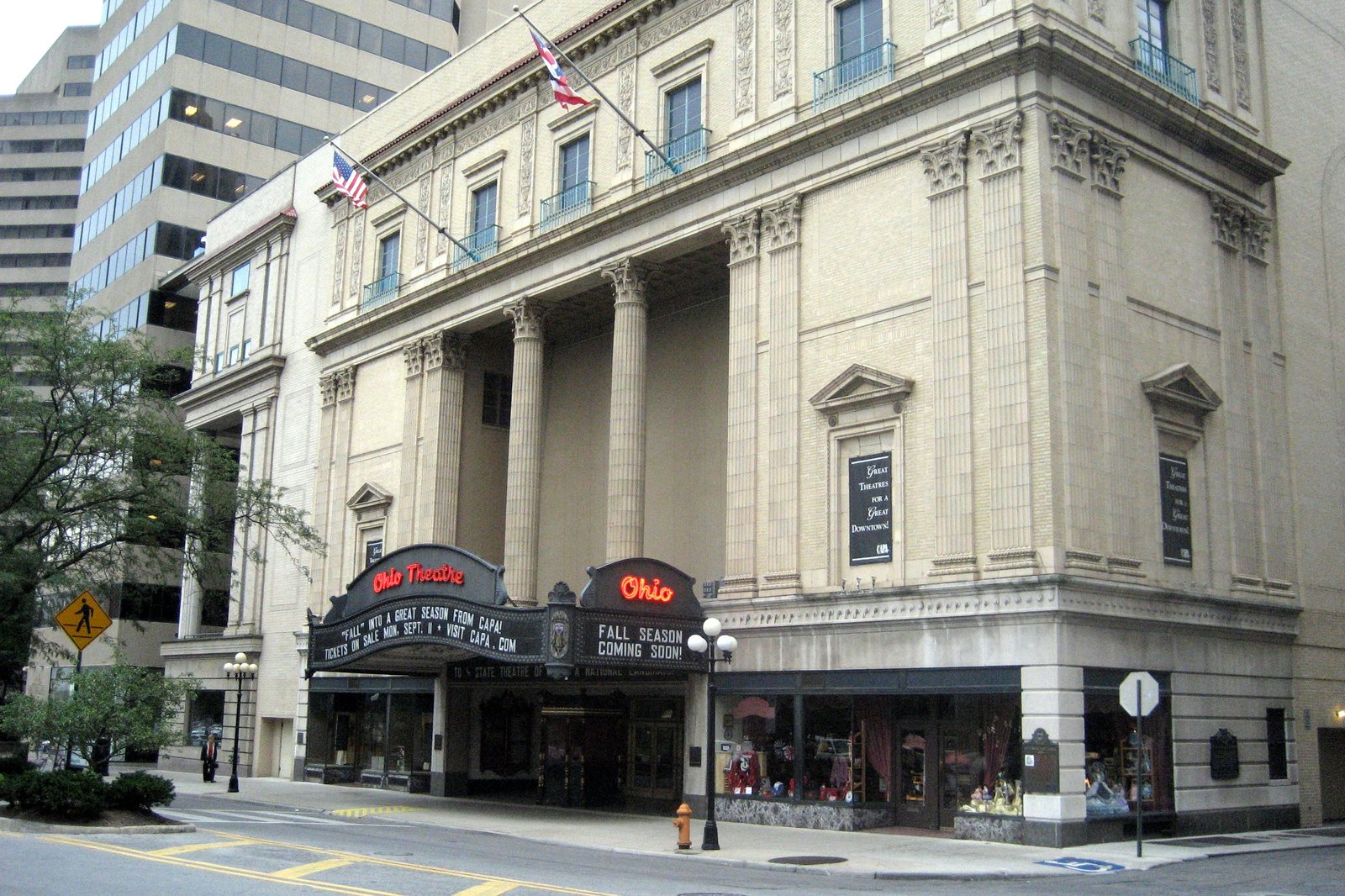
Thomas W. Lamb’s Spanish Baroque movie palace nearly disappeared in 1969 when it faced demolition—its rescue by a determined preservation campaign transformed it into one of the landmark victories of the American historic preservation movement and gave Columbus its most architecturally distinctive performing arts venue.
At a glance
The Ohio Theatre opened in 1928 at 39 E. State Street as one of the grandest movie palaces in the American Midwest, its Churrigueresque ornament—a Spanish Baroque vocabulary of dense, exuberant carving derived from the work of eighteenth-century Mexican silversmiths—covering every surface from the ticket lobby to the upper balcony in a profusion of gilded plaster, ceramic tile, and painted panels. Thomas W. Lamb, one of the most prolific theatre architects of the early twentieth century, designed the Ohio as a total environment: a building whose interior was so consuming in its detail and scale that audiences entering it were transported, before the film began, from the streets of downtown Columbus to a realm of Mediterranean fantasy. The theatre is now the flagship venue of the Columbus Association for the Performing Arts and the home of the Columbus Symphony Orchestra.
Key facts
- Address: 39 E. State Street, Columbus, OH 43215
- Architect: Thomas W. Lamb
- Opened: 1928
- Style: Spanish Baroque / Churrigueresque
- Capacity: approximately 2,700 seats
- Landmark status: National Historic Landmark (1977); National Register of Historic Places
- Current use: Flagship venue of Columbus Association for the Performing Arts (CAPA); home of Columbus Symphony Orchestra
History
The Ohio Theatre was built for the Loew’s cinema chain, whose exhibition circuit operated major movie palaces across the eastern and midwestern United States. Thomas W. Lamb, the architect Loew’s preferred for its flagship properties, applied a more ornate stylistic programme to the Ohio than to many of his commissions, the Churrigueresque vocabulary being particularly suited to the building’s large auditorium and double-height lobby.
The theatre operated as a successful first-run cinema for decades before the downtown cinema market contracted in the 1950s and 1960s. In 1969 Loew’s announced its intention to demolish the building and replace it with a parking facility. The announcement galvanized Columbus’s preservation community: a campaign organized through the Columbus Area Chamber of Commerce raised funds to purchase the building, which was sold to the new owners for a nominal amount. The Ohio was designated a National Historic Landmark in 1977, and subsequent restoration work brought the gilded plasterwork and original mechanical systems back to working condition. A major renovation in the 1980s converted the stage and auditorium for symphony and performing arts use.
The theatre’s Mighty Morton pipe organ—a large theatre organ installed at the original opening—is maintained in playable condition and performed before selected events, continuing a tradition from the silent-film era. The Ohio is widely cited as a model for the adaptive reuse of threatened downtown theatres in the United States.
What you see
The façade on E. State Street presents a relatively restrained composition—a tripartite arrangement of arched windows and terracotta ornament—that gives little indication of the spatial intensity within. The entry sequence moves through a marquee vestibule into a two-storey lobby of Spanish Baroque ornament: cartouches, twisted columns, ceramic tile dados, and plaster reliefs packed into every available surface at a density that Lamb associated specifically with the Churrigueresque mode.
The auditorium amplifies this intensity across a much larger volume. The ceiling dome and upper balcony soffits carry painted decorations in warm ochres and reds; the proscenium arch rises through multiple gilded tiers to a height that makes it one of the most imposing of any American theatre of its generation. The side boxes are framed by plaster baldachins of an intricacy that rewards extended examination from the orchestra level. The combined effect—warm light, dense ornament, a scale that dwarfs the individual without overwhelming the sense of occasion—explains why the building was considered worth fighting for in 1969.
Practical information
- Open for performances and events; check CAPA and Columbus Symphony schedules for programming
- The lobby is accessible during box office hours; guided tours available by arrangement
- The Mighty Morton pipe organ performed before selected Columbus Symphony concerts; check listings
- Fully accessible; elevator access to all levels including the upper balcony
- Allow 30 minutes before the performance to explore the lobby and stairways at leisure
Getting there
The Ohio Theatre stands at 39 E. State Street in the heart of Columbus’s downtown, one block east of the Statehouse. COTA bus lines serve E. State Street and High Street directly. Columbus John Glenn International Airport (CMH) is approximately 8 miles east; by car, take I-670 west to the downtown exits. The Short North arts district is approximately 0.5 miles north of the theatre along N. High Street.
Nearby
- Ohio Statehouse (1857) — 1 block west; Greek Revival capitol building in a park setting, open for tours
- Columbus Museum of Art — approximately 0.5 miles east on E. Broad Street; permanent collection including Wonder Room and Wexner Collection
- Short North Arts District — 0.5 miles north on N. High Street; galleries, restaurants, and independent shops in Columbus’s principal arts neighborhood
Sources
- National Historic Landmark designation file, National Park Service, 1977
- Columbus Association for the Performing Arts: institutional history of the Ohio Theatre
- Valentine, Maggie. The Show Starts on the Sidewalk: An Architectural History of the Movie Theatre, Starring S. Charles Lee. New Haven: Yale University Press, 1994 (cited for Lamb context)
- Columbus Dispatch archive: coverage of the 1969 preservation campaign
Find it on the map
See this place and what’s around it →📷 Become a Cultural Heritage Online photographer
Share your photos of places: they stay published under your name as the author. The more they're seen, the more you get noticed — and soon a contest will reward the most appreciated photos.
Log in or sign up free to add a photoIs this page about you?
This page is read by travellers and heritage enthusiasts who find it on Google. Tell us how you are connected to this place and we will take it from there.