
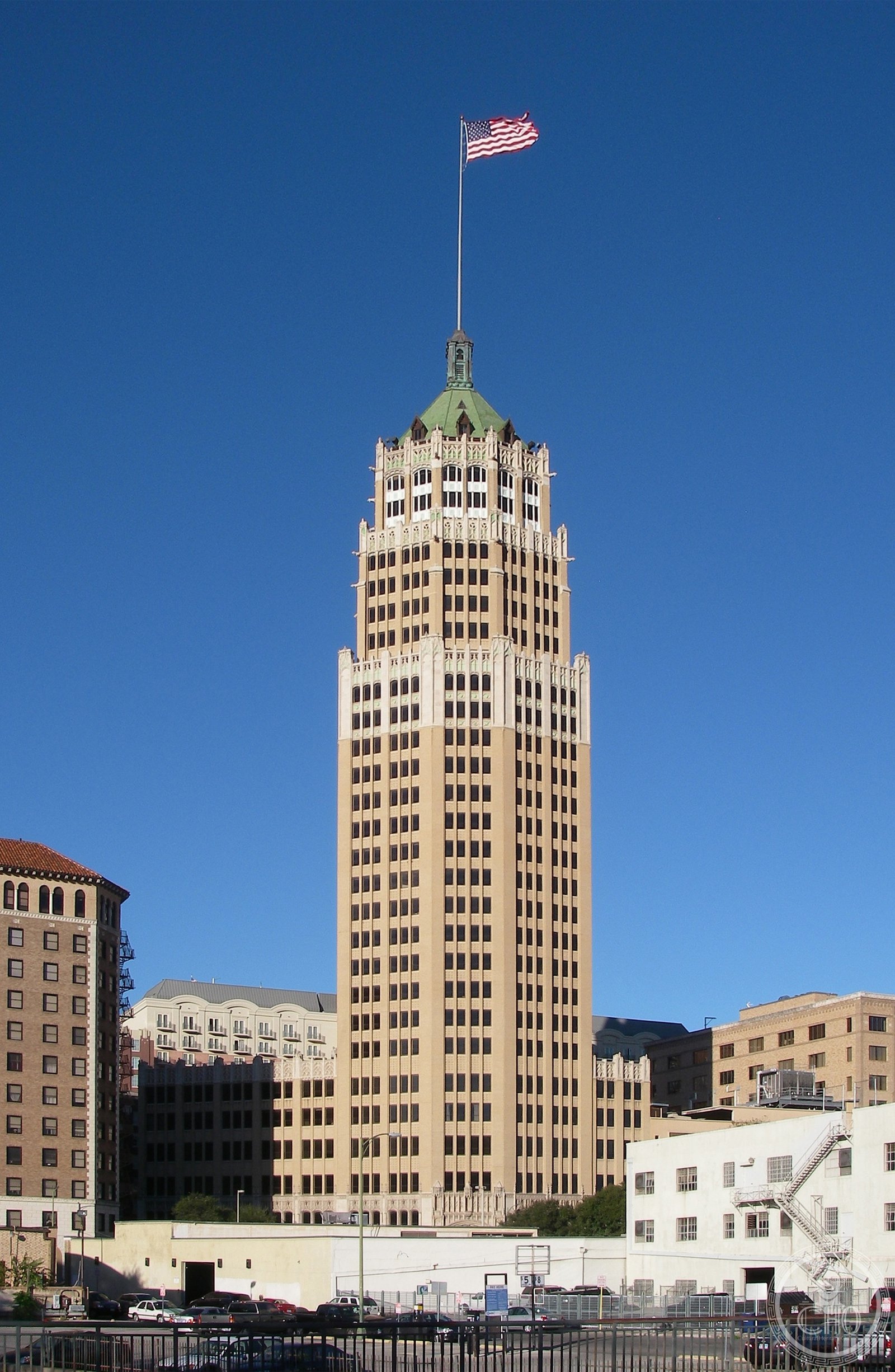
Built in 1929 as the Smith-Young Tower, San Antonio’s most distinctively crowned skyscraper rises thirty-one floors in a Gothic Revival silhouette — eight octagonal storeys tapering to an ornate top that stands out against the Texas sky from almost every approach to downtown.
At a glance
The Tower Life Building was the tallest building in San Antonio for many years after its 1929 completion and remains the most architecturally ambitious skyscraper in the city’s downtown. Designed by the San Antonio firm Ayres & Ayres for businessmen Thomas W. Smith and Charles A. Young, the building rises thirty-one floors through a shaft of limestone and brick before transitioning into an eight-floor octagonal crown, its Gothic tracery and corner turrets giving the structure a silhouette closer to European cathedral towers than to the commercial high-rise tradition of contemporary Chicago or New York. Listed on the National Register of Historic Places, the building continues as an office address in the heart of downtown San Antonio.
Key facts
- Address: 310 S. St. Mary’s Street, San Antonio, TX 78205
- Architects: Ayres & Ayres (Atlee B. Ayres and Robert M. Ayres), San Antonio
- Completed: 1929
- Original name: Smith-Young Tower
- Height: 31 stories, approximately 316 feet (96 m)
- Style: Gothic Revival with Art Deco detailing
- Designation: National Register of Historic Places
History
Atlee B. Ayres was the leading architect in San Antonio during the first decades of the twentieth century, responsible for a wide range of civic, commercial, and residential buildings across Texas. His firm — later expanded to include his son Robert — moved fluidly between Spanish Colonial Revival, Mission Revival, and Gothic idioms depending on the client and programme. The Smith-Young Tower commission gave Ayres the opportunity to work at the largest scale of his career, producing a building that competed with the commercial towers of major American cities while retaining a distinctly Texan sense of ornament.
The building’s name changed as it passed between corporate tenants across the decades, eventually becoming the Tower Life Building under the Tower Life Insurance Company — the name it has retained ever since.
The transition from the lower square shaft to the upper octagonal crown gives the building its characteristic silhouette: the corner turrets and Gothic tracery of the upper floors are finished in a lighter palette than the base, so that the crown appears almost to float above the main shaft in certain light conditions. The building is a landmark on the San Antonio skyline and a reference point in the city’s architectural identity.
What you see
At street level the building presents a traditional office-tower base — a rusticated limestone ground floor, a recessed entrance with bronze ornament, and a series of setbacks rising to the transition point where the square plan becomes octagonal. The lower floors use brick and limestone in a straightforward vertical rhythm; the decorative ambition is reserved for the crown. The eight octagonal floors carry carved Gothic tracery at the corners, arched windows with limestone surrounds, and finial-topped corner turrets that break the profile against the sky. The overall effect is of a building wearing its ornament at the top, concentrating visual energy on the part that reads from a distance.
The building sits at the edge of the San Antonio River Walk district: the river itself passes approximately one block to the east, and the Paseo del Río — the famous network of river-level walkways — is accessible within a few minutes on foot. The skyscraper is visible from the River Walk looking west, its Gothic crown framed by the subtropical vegetation and café terraces that characterise the waterway at street level.
Practical information
- Access: The building is an active office address; the lobby is accessible during business hours
- Exterior viewing: The tower is best viewed from Commerce Street or from the River Walk looking west — both provide clear sightlines to the octagonal crown
- Nearby attractions: The San Antonio River Walk is one block east and the Tower of the Americas is visible from the building’s base
Getting there
The Tower Life Building stands at the intersection of S. St. Mary’s Street and Commerce Street in downtown San Antonio, one block west of the San Antonio River. San Antonio International Airport is approximately eight miles (thirteen kilometres) to the north, with VIA Metropolitan Transit bus service connecting to the downtown terminal on Houston Street. The building is within walking distance of the Alamo, HemisFair Park, and the River Walk’s main tourist circuit. VIA bus routes serve Commerce Street along the building’s south facade.
Nearby
- San Antonio River Walk (Paseo del Río) — the famous river-level promenade, one block east
- The Alamo — San Antonio’s most visited landmark, approximately four blocks north-east
- HemisFair Park and Tower of the Americas — the 1968 World’s Fair site with its 750-foot observation tower, approximately three blocks south-east
- San Fernando Cathedral — one of San Antonio’s oldest and most historic churches, approximately two blocks north-west on Main Plaza
Sources
- National Register of Historic Places nomination, Tower Life Building (Smith-Young Tower)
- Willard B. Robinson, Gone from Texas: Our Lost Architectural Heritage (1981) — Texas commercial architecture context
- San Antonio Conservation Society — building records and architectural survey
- Historic American Buildings Survey (HABS) — photographic record and documentation
- Texas Historical Commission — property listing and architectural description
Find it on the map
See this place and what’s around it →📷 Become a Cultural Heritage Online photographer
Share your photos of places: they stay published under your name as the author. The more they're seen, the more you get noticed — and soon a contest will reward the most appreciated photos.
Log in or sign up free to add a photoIs this page about you?
This page is read by travellers and heritage enthusiasts who find it on Google. Tell us how you are connected to this place and we will take it from there.