
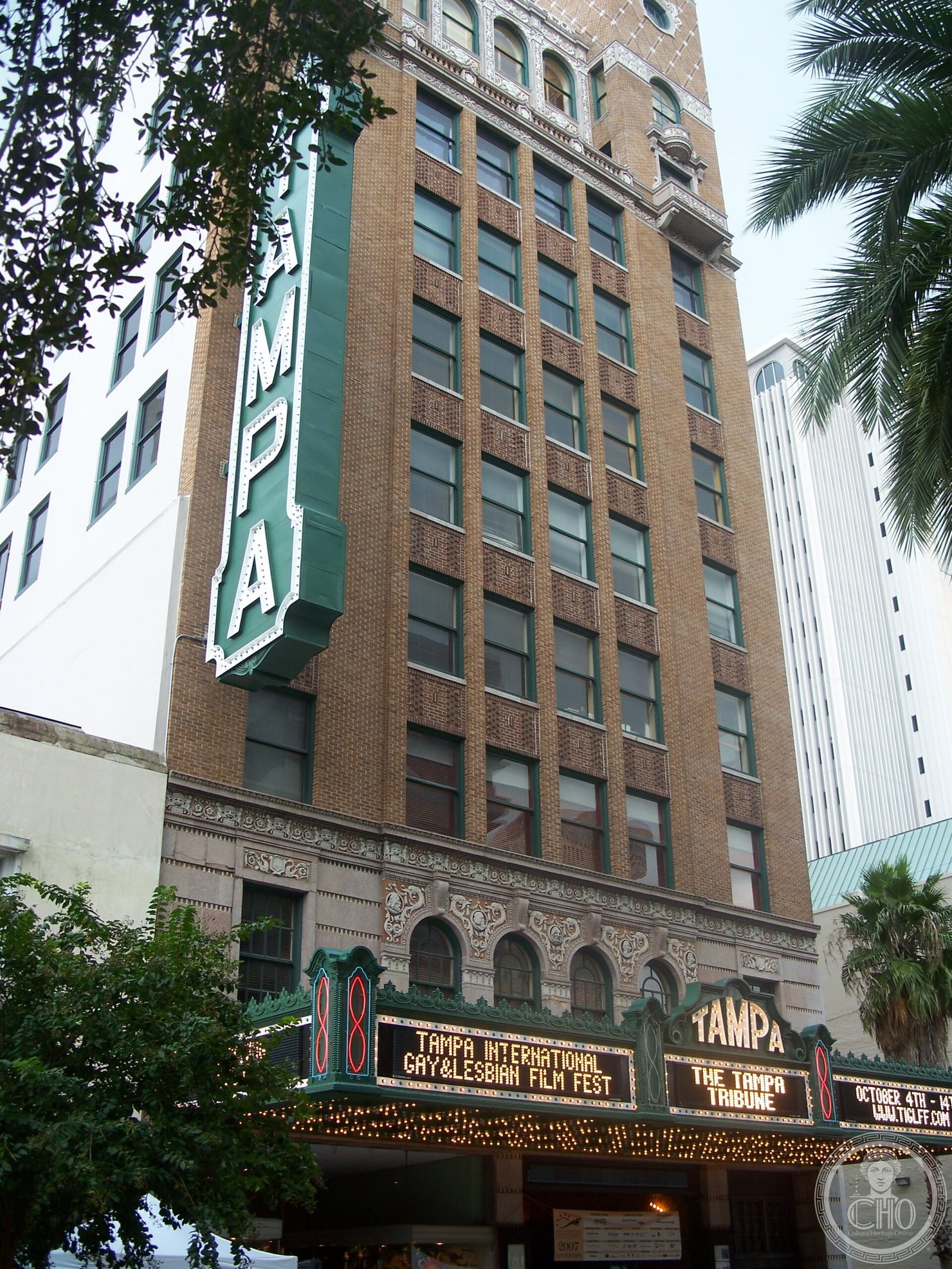
John Eberson’s 1926 atmospheric masterpiece conjures a Mediterranean night sky above a Florida audience — projected stars overhead, Moorish arcades flanking the stalls, and a Mighty Wurlitzer organ whose pipes are still pumped for every silent-film screening.
At a glance
Tampa Theatre opened in October 1926 as one of the most ambitious atmospheric movie palaces in the American South. Designed by John Eberson — the Vienna-born architect who pioneered the atmospheric style — the building creates the illusion of an open-air Mediterranean courtyard: audiences sit beneath a ceiling painted as a night sky, surrounded by stucco columns, terracotta niches, and ornamental balustrades drawn from Spanish and Italian prototypes. One of the most intact atmospheric theatres surviving in the United States, it has operated continuously through the multiplex era, sustained by community preservation and a rich programming calendar.
Key facts
- Address: 711 N. Franklin Street, Tampa, FL 33602
- Architect: John Eberson (1875–1954)
- Opened: October 1926
- Style: Atmospheric movie palace — Mediterranean / Moorish Revival interior
- Capacity: Approximately 1,400 seats
- Designation: National Register of Historic Places (1978)
- Current use: Cinema, live performances, private events, guided tours
History
The theatre was built for the Paramount–Publix circuit during the golden age of the American movie palace, when cinema operators competed not just on films but on architecture. Eberson had completed atmospheric projects in Houston, Chicago, and New York; his Tampa commission gave him a larger canvas and a more varied decorative programme than most of his earlier work. The Spanish Colonial Revival exterior — terracotta ornament, arched windows, and a central tower above Franklin Street — offers a restrained preface to the extravagance within.
As suburban multiplexes drew audiences from downtown cinemas during the 1950s and 1960s, the theatre’s commercial viability declined. By the 1970s, demolition was a genuine prospect. A sustained community campaign secured its listing on the National Register of Historic Places in 1978, and Tampa Theatre Inc., a nonprofit organisation, assumed management and undertook a long-running programme of physical restoration. The Mighty Wurlitzer pipe organ — a signature feature of the silent era — was restored and returned to regular use.
Today the theatre operates as a neighbourhood cinema and cultural venue, programming classic films, foreign releases, live music, organ recitals, and film festivals alongside touring acts drawn to its singular acoustic and visual environment.
What you see
The auditorium ceiling is painted a deep blue-black and fitted with a projector that casts a moving sky — clouds drifting across a field of stars — across the full dome during screenings. The side walls carry a sequence of arches, columns, towers, and sculpted niches that simulate a Mediterranean garden at night; plaster saints and classical figures stand in the recesses. Ornamental grillework screens the organ chambers on either side of the proscenium, and the arch itself is decorated with carved foliage and figures in the Spanish Colonial manner.
The Wurlitzer organ speaks from chambers behind those grilles, filling the auditorium with a warm, slightly trembling tone suited to both silent film accompaniment and solo concert performance. The overall effect is of total environment: the architecture does not frame the film so much as absorb the audience into a world that precedes it and persists after the credits roll.
Practical information
- Hours: Varies by programming — check the theatre’s schedule for film and event listings
- Admission: Film and event tickets available at the box office and online
- Tours: Public guided tours run at scheduled times; include backstage areas and organ demonstration
- Accessibility: Main auditorium is wheelchair accessible; contact the theatre directly for event-specific arrangements
Getting there
Tampa Theatre stands on N. Franklin Street in downtown Tampa, approximately four blocks north of the Hillsborough River waterfront. Tampa International Airport lies approximately seven miles (eleven kilometres) to the west, with HART bus service connecting to the downtown transit centre. The theatre is within walking distance of the Channelside Bay Plaza and the Convention Center district. Street and garage parking are available on adjacent blocks throughout the downtown grid.
Nearby
- Tampa Riverwalk — a waterfront promenade along the Hillsborough River, approximately four blocks south
- Glazer Children’s Museum — on the waterfront, five minutes on foot
- Curtis Hixon Waterfront Park — public park adjacent to the Riverwalk, regular outdoor event host
- Ybor City Historic District — Tampa’s late-nineteenth-century cigar-manufacturing neighbourhood, approximately one mile east
Sources
- National Register of Historic Places nomination, Tampa Theatre (1978)
- Tampa Theatre Inc. — institutional history and programming archive
- Ben M. Hall, The Best Remaining Seats: The Golden Age of the Movie Palace (1961)
- David Naylor, American Picture Palaces: The Architecture of Fantasy (1981)
- Florida Division of Historical Resources — property survey records
Find it on the map
See this place and what’s around it →📷 Become a Cultural Heritage Online photographer
Share your photos of places: they stay published under your name as the author. The more they're seen, the more you get noticed — and soon a contest will reward the most appreciated photos.
Log in or sign up free to add a photoIs this page about you?
This page is read by travellers and heritage enthusiasts who find it on Google. Tell us how you are connected to this place and we will take it from there.