
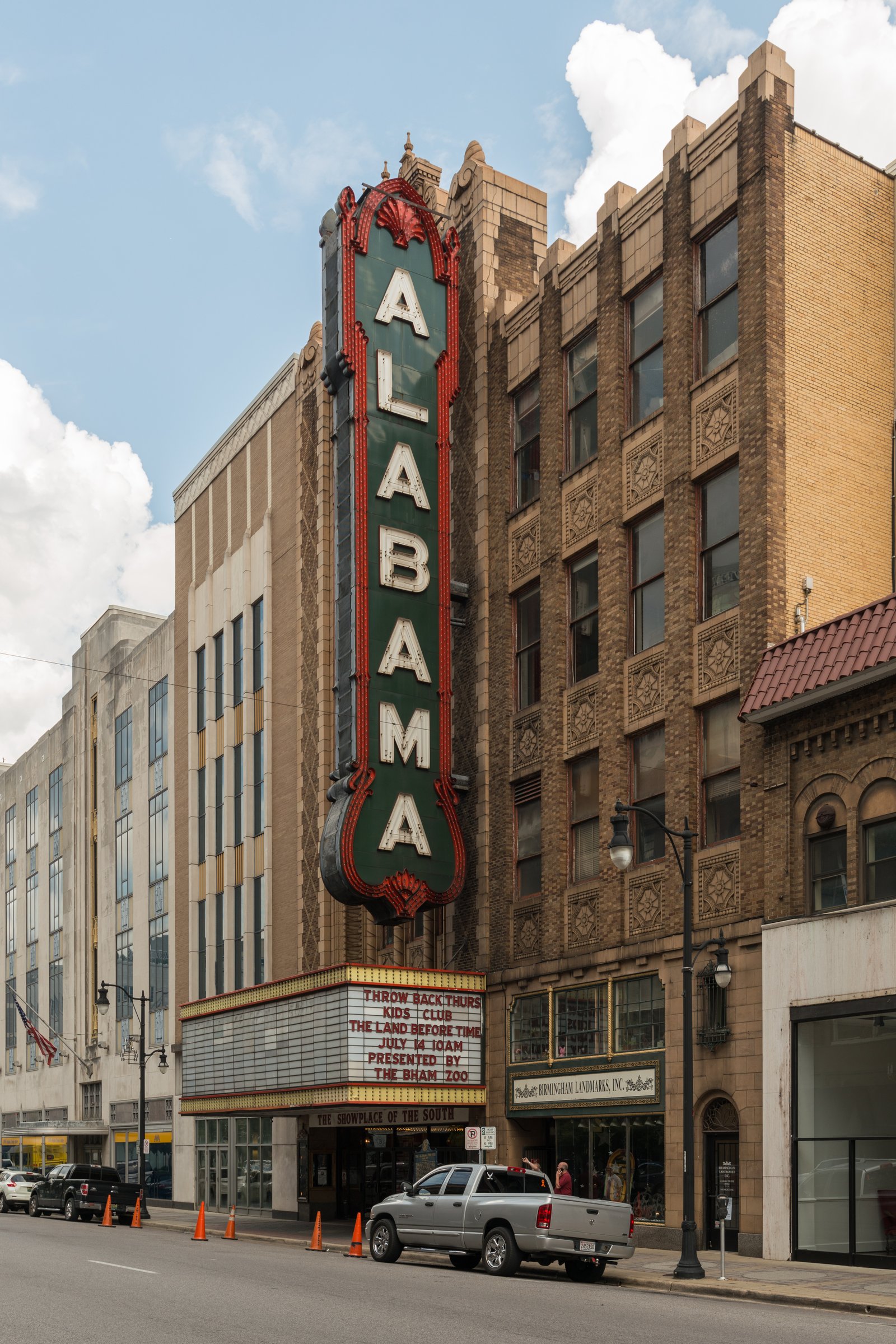
Alabama Theatre
Birmingham’s grand movie palace has survived the decline of the picture house era largely intact, with one of the finest Wurlitzer pipe organs still in regular use in the American South.
At a glance
Opened in 1927 on Third Avenue North in downtown Birmingham, the Alabama Theatre is one of the most intact surviving movie palaces in the South. Built by the Paramount/Publix theatre chain during the peak of the picture palace era, it offered Birmingham audiences an interior of Spanish Gothic and Moorish grandeur: gilded plasterwork, ornate box tiers, a starlit ceiling that glittered with coloured lights, and the centrepiece of the house — a three-manual Wurlitzer pipe organ that still accompanies silent film screenings today. The Alabama is listed on the National Register of Historic Places and operates as a working performance venue, presenting classic films, concerts, and Broadway touring shows.
Key facts
- Location: 1817 Third Avenue North, Birmingham, Alabama
- Opened: 1927
- Style: Spanish Gothic Revival and Moorish Revival interior; Art Deco-era exterior
- Organ: three-manual Wurlitzer pipe organ, still in regular use
- Capacity: approximately 2,500 seats
- Operator: Birmingham Landmarks, Inc. (preservation non-profit)
- Status: National Register of Historic Places
History
The Paramount/Publix chain was at the height of its power in 1927, with studios racing to build flagship cinemas in major American cities as showplaces for their films. Birmingham, as Alabama’s largest commercial city, was considered significant enough to receive a building of the first rank. The Alabama Theatre opened on December 26, 1927, with an ornate interior of a quality that rivalled comparable theatres in much larger cities — the gilded plasterwork, the star-scattered ceiling, and the Wurlitzer organ all in place from opening day. The organ served dual purposes: accompanying silent films in the early years, and providing musical entertainment between showings in the talking-picture era.
The Alabama shared the fate of most American movie palaces after the mid-century: declining attendance as suburban multiplexes expanded, changing ownership, and serious deterioration by the 1970s. A preservation organisation, Birmingham Landmarks, Inc., acquired the building in 1987 and undertook an extensive restoration that returned the interior to something close to its original condition. The Wurlitzer organ — a particular focus of the restoration — was serviced and returned to working order, and the Alabama now presents regular silent film screenings with live organ accompaniment, as well as concerts, theatre productions, and film festivals.
What you see
The Alabama’s Third Avenue North facade is a restrained composition of light stone with Gothic-arched window openings and a marquee that announces the current programme in the tradition of the American movie palace streetscape. The exterior understates what waits inside. The lobby introduces the building’s ornamental language — gilded arches, patterned tile floors, and a quality of light that signals the transition from the ordinary street to an interior designed for pleasure. The auditorium deepens this effect considerably.
The main house presents tiers of box seats framed in gilded Moorish arches, a ceiling vault decorated with plasterwork in the Spanish Gothic manner, and the star-scattered sky effect that was a standard feature of movie palace design in the 1920s — hundreds of small electric lamps embedded in the ceiling vault, dimmable to simulate starlight. The Wurlitzer organ console rises from the orchestra pit on a hydraulic lift, in the manner common to theatres of the era where the organist needed to be visible to the audience for musical accompaniment of silent films. Its restoration is one of the most complete in the South.
Practical information
- Hours: open for ticketed events; box office open on performance days
- Silent film screenings: regular screenings with live Wurlitzer organ accompaniment — check the schedule
- Tours: architectural tours periodically offered; contact Birmingham Landmarks
- Time needed: arrive 30 minutes before performances to appreciate the lobby and facade
Getting there
The Alabama Theatre is at 1817 Third Avenue North in downtown Birmingham, within walking distance of the Birmingham Jefferson Convention Complex and the BJCC. The Red Mountain Expressway (US-31) runs nearby. WEGO Birmingham public transit serves the downtown corridor. From Birmingham-Shuttlesworth International Airport, the drive into downtown takes approximately fifteen minutes.
Nearby
- Birmingham Museum of Art — major regional art museum, a few blocks away
- Paramount Building (1925) — adjacent Art Deco commercial building
- Birmingham Civil Rights Institute — important civil rights heritage site, a short distance south
Sources
- National Register of Historic Places nomination file, Alabama Theatre, Birmingham, Alabama
- Birmingham Landmarks, Inc., restoration documentation and building history
- Alabama Theatre official history and Wurlitzer organ records
Find it on the map
See this place and what’s around it →📷 Diventa un fotografo di Cultural Heritage Online
Condividi le tue foto dei luoghi: restano pubblicate con la tua firma come autore. Più vengono viste, più ti fai conoscere — e presto un concorso premierà le foto più apprezzate.
Accedi o registrati gratis per aggiungere una fotoDo you manage this place?
This page is read by travellers and heritage enthusiasts who find it on Google. Keep it accurate — and make it work for you. Free for non-profit heritage institutions.