
.jpg)
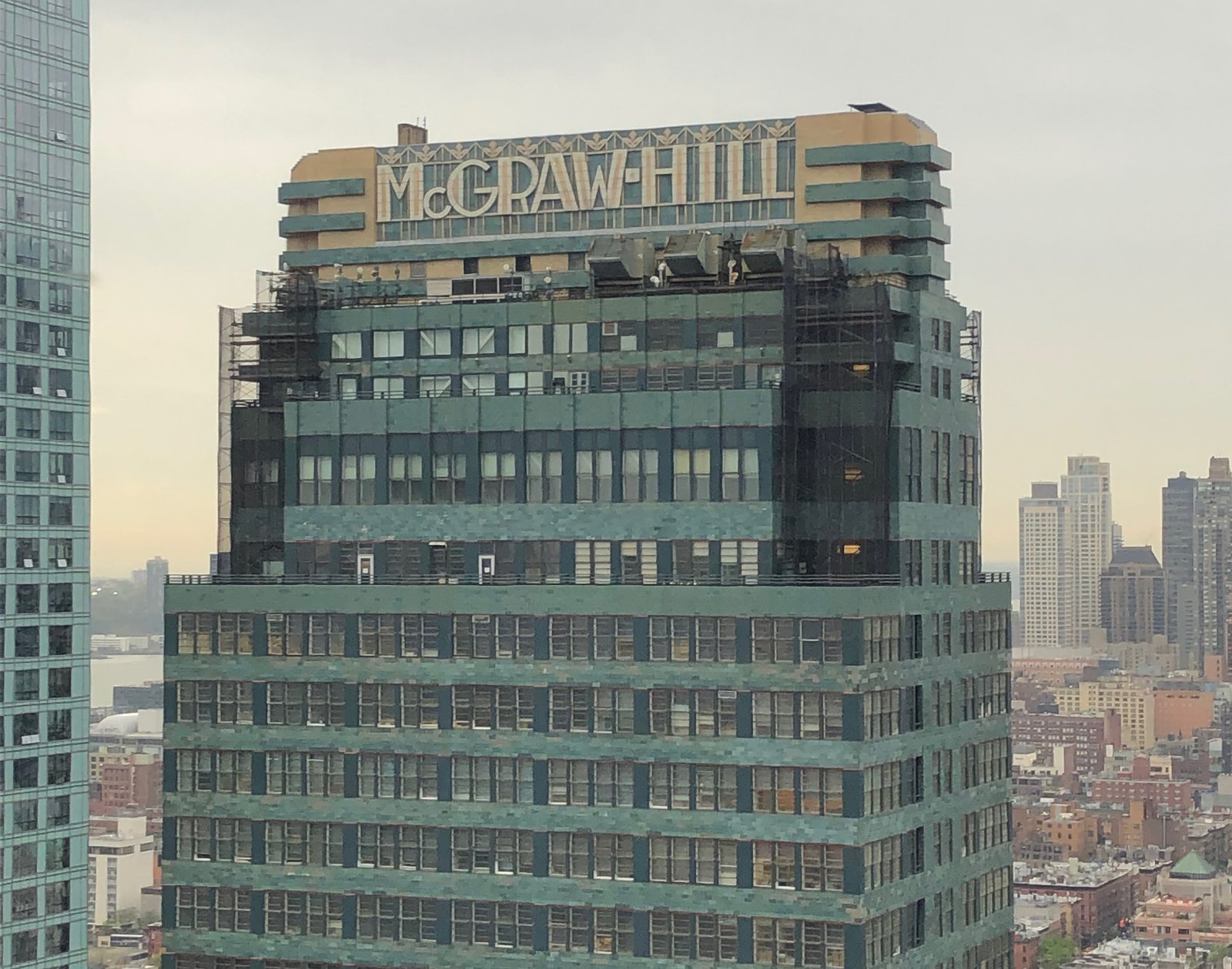
Raymond Hood wrapped this 35-storey tower in horizontal bands of blue-green glazed terra cotta — a colour and a logic that belonged to no previous building in New York and that announced, in 1931, that everything about the skyscraper could still be reinvented.
At a glance
The McGraw-Hill Building stands at 330 West 42nd Street in Midtown Manhattan, its distinctive turquoise-blue horizontal banding immediately legible from across the block. Completed in 1931 for the McGraw-Hill publishing company, it was the work of Raymond Hood (1881–1934) — who, in the same period, was designing the towers of Rockefeller Center. The McGraw-Hill Building is the more personal of the two commissions: smaller, more experimental, and visually unlike anything that surrounded it. The horizontal emphasis challenged the vertical orthodoxy of New York skyscraper architecture in a way that no one had attempted before.
Key facts
- Completed: 1931
- Architect: Raymond Hood (1881–1934), Hood & Fouilhoux
- Height: 35 stories
- Exterior: Horizontal bands of blue-green glazed terra cotta
- Client: McGraw-Hill Book Company
- Address: 330 West 42nd Street, New York, NY 10036
- National Register of Historic Places: listed
History
Raymond Hood had arrived at his signature approach through the Tribune Tower competition of 1922 — he submitted a Gothic design that won — and the American Radiator Building of 1924, where he used black brick and gold ornament to give the building a visual weight it would otherwise have lacked in the midtown streetscape. By the time he received the McGraw-Hill commission, he had been thinking for years about how to make a skyscraper that looked nothing like the ones that already existed.
The result at 330 West 42nd Street was a building that emphasised horizontal bands rather than vertical piers — a reversal of almost every contemporary New York tower. Hood applied blue-green glazed terra cotta to the spandrels and darker blue to the windows, creating a striped pattern that reads as a single coherent surface from a distance rather than as a stack of individual floors. The technique owed something to the industrial aesthetic of the period and something to Hood’s own restlessness with received form.
McGraw-Hill eventually vacated the building and it was converted to other commercial uses. It was listed on the National Register of Historic Places as part of the broader recognition of the Art Deco period in American commercial architecture.
What you see
The facade is the argument. The horizontal banding wraps the building on all sides — blue-green spandrels alternate with windows of a deeper blue, and the setback upper floors repeat the pattern at a smaller scale. There is virtually no vertical ornament of the kind that drives the Chrysler Building or the Empire State Building upward; instead, the building seems to lie on its side, compressed rather than stretched. Hood used a green-tinted window treatment to soften the boundary between the glazing and the terra cotta, which is why the building reads from the street as a single blue-green mass rather than as separate materials.
The entrance lobby at street level is modest compared to the theatrical lobbies of some contemporaries — Hood put his energy into the exterior. The lobby retains original Art Deco metalwork and stone, and the proportions of the entrance hall give a sense of the period even if the public rooms lack the scale of the Chrysler or One Wall Street banking halls.
Practical information
- Access: Lobby open during business hours; upper floors are commercial office space
- Allow: 15–20 minutes to view exterior and lobby
- Best view: From the sidewalk on 42nd Street looking south-west at mid-morning light, when the terra cotta reads at its most vivid
Getting there
The McGraw-Hill Building is at 330 West 42nd Street in Hell’s Kitchen / Theatre District. The nearest subway stations are Port Authority Bus Terminal (A/C/E lines) and 42nd Street–Times Square (1/2/3/7/N/Q/R/W lines), each a short walk east along 42nd Street. From Grand Central Terminal, walk west along 42nd Street approximately 10 minutes.
Nearby
- Chrysler Building (1930) — William Van Alen’s stainless steel masterwork, 12 blocks east along 42nd Street
- Daily News Building (1930) — another Raymond Hood design, 6 blocks east at 220 East 42nd Street
- Rockefeller Center (1930–1940) — Hood’s largest commission, 6 blocks north-east via Sixth Avenue
Sources
- National Park Service, NRHP nomination, McGraw-Hill Building (1989)
- Robert A.M. Stern, Gregory Gilmartin, Thomas Mellins, New York 1930 — comprehensive account of Hood’s career
- Cervin Robinson and Rosemarie Haag Bletter, Skyscraper Style: Art Deco New York
- Museum of the City of New York, architectural archives
Find it on the map
See this place and what’s around it →📷 Become a Cultural Heritage Online photographer
Share your photos of places: they stay published under your name as the author. The more they're seen, the more you get noticed — and soon a contest will reward the most appreciated photos.
Log in or sign up free to add a photoIs this page about you?
This page is read by travellers and heritage enthusiasts who find it on Google. Tell us how you are connected to this place and we will take it from there.