
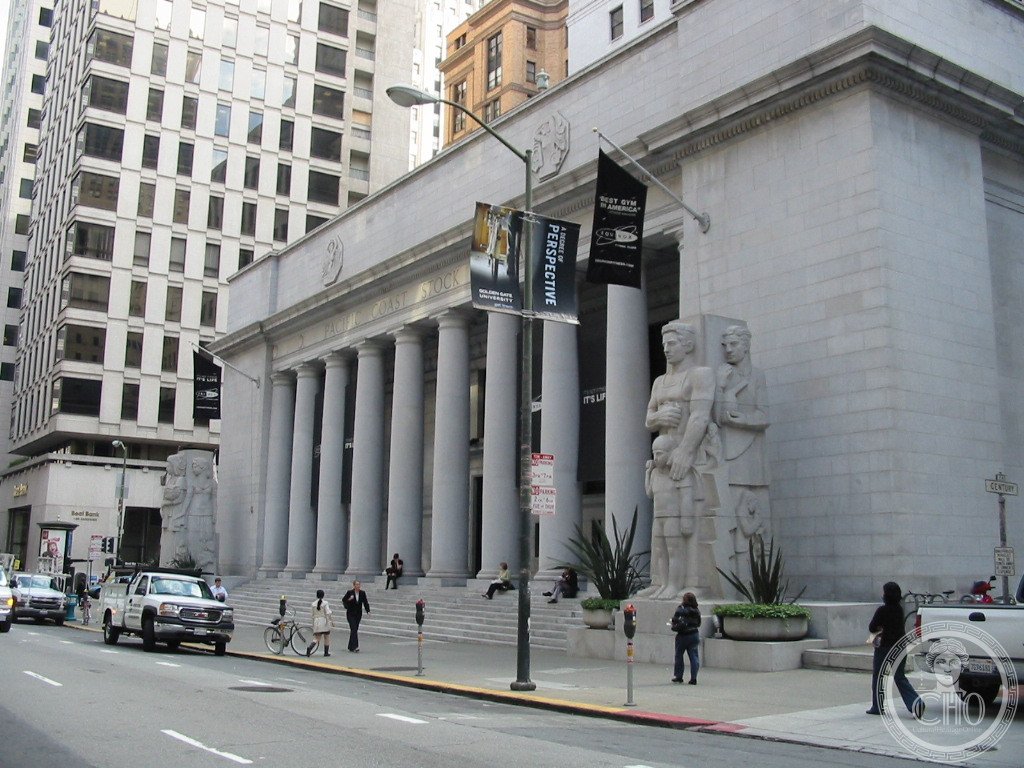

The trading floor building of the Pacific Coast Stock Exchange at 301 Pine Street was transformed by Timothy Pflueger in 1930 from a classical colonnaded structure into one of the most remarkable Art Deco facades in the American west — its entrance flanked by two monumental granite figures carved by Ralph Stackpole, representing the productive forces of California, presiding over what was then the third-largest stock exchange in the United States.
At a glance
The Pacific Coast Stock Exchange complex in San Francisco’s Financial District comprises two buildings: the trading floor at 301 Pine Street and the Exchange Tower at 155 Sansome Street, connected by a shared lobby. Both buildings were remodelled in 1929–1930 by Timothy Pflueger of Miller & Pflueger, who transformed earlier classical structures into coherent Art Deco landmarks. The 301 Pine building is distinguished by Ralph Stackpole’s two colossal granite sculptures at the entrance — “Earth’s Fruitfulness” (a female figure representing agriculture) and “Man and His Inventions” (a male figure representing industry) — while the 155 Sansome Tower contains Diego Rivera’s 1931 fresco “Allegory of California” in its Stock Exchange Lunch Club interior (now the City Club of San Francisco). Both buildings are designated National Historic Landmarks.
Key facts
- Remodelled: 1929–1930 (original building 1915)
- Architect (remodel): Timothy Pflueger, Miller & Pflueger
- Style: Art Deco
- Address: 301 Pine St, San Francisco, CA 94104
- NHL: National Historic Landmark (both Pine and Sansome buildings)
- Sculptures: Ralph Stackpole (1885–1973), granite, 1930; two colossal figures flanking entrance
- Current use: City Club of San Francisco occupies 155 Sansome (includes the Rivera fresco); 301 Pine trading floor converted to offices
History
San Francisco’s stock exchange had operated from a series of buildings in the Financial District since the Gold Rush era. By the 1920s, the Pacific Coast Stock Exchange had become the third-largest exchange in the United States by trading volume — a position that reflected San Francisco’s role as the financial capital of the Pacific Coast and the growth of California’s agricultural and industrial economy. The exchange’s board commissioned Timothy Pflueger to modernise the complex at the end of the decade, asking for an architectural statement that would match the exchange’s status and its ambitions.
Pflueger’s solution for 301 Pine Street was to clad the existing classical trading floor building in an Art Deco skin, retaining the classical columns as a structural armature while adding a new facade of polished granite with geometric friezes and, crucially, commissioning Ralph Stackpole to create the two colossal entrance sculptures that would become the building’s most famous feature. Stackpole, a San Francisco sculptor who had trained in Paris and was a close associate of Diego Rivera, carved both figures directly in place — working on the building facade as if it were a studio — and completed them in 1930. Rivera’s “Allegory of California” fresco in the Stock Exchange Lunch Club at 155 Sansome was completed in 1931, painted during Rivera’s first extended stay in San Francisco. The two works — Stackpole’s granite sculptures and Rivera’s fresco — make the exchange complex the most important site for the intersection of Mexican muralism, California modernism, and Art Deco architecture in the United States.
The Pacific Coast Stock Exchange continued to operate until 1957, when it merged with the Los Angeles Stock Exchange to form the Pacific Exchange. The complex was subsequently converted: the trading floor at 301 Pine became offices, while the Lunch Club space at 155 Sansome became the City Club of San Francisco, which has carefully maintained the Rivera fresco. The buildings received National Historic Landmark designation in recognition of their architectural and cultural significance.
What you see
The Pine Street facade of 301 is the site of Pflueger’s most decisive intervention and Stackpole’s most ambitious sculpture. The two granite figures — each approximately 8 feet tall and integrated into the architectural composition of the facade — stand at the sides of the entrance recess, their simplified, powerful forms a direct response to the geometric vocabulary of Art Deco while their subject matter (agricultural abundance on one side, industrial invention on the other) continues the tradition of civic allegory in monumental sculpture. The figures are carved in polished black granite against a facade of lighter stone, creating a strong visual contrast that anchors the entrance composition.
The entrance recess itself is framed by polished granite pilasters with geometric incised ornament — Pflueger’s characteristic abstract pattern language — and surmounted by a frieze with stylised figures in low relief. Above the entrance zone, the upper facade resolves into a simpler grid of windows with spandrel ornament in a more restrained Art Deco register. The building’s relationship to the Sansome Street tower (155 Sansome) is best appreciated from the intersection of Pine and Sansome, where the massing of the two buildings — the low trading floor and the taller tower — creates a stepped composition that reads as a single architectural entity.
Practical information
- Exterior sculpture: Freely visible from Pine Street at all times; no entry required
- Rivera fresco (155 Sansome): Accessible via the City Club of San Francisco; contact the City Club for visitor access arrangements
- Best time: Morning light on the Pine Street facade; sculptures best seen at mid-morning
- Time needed: 15–20 minutes exterior; allow 45–60 minutes if visiting the Rivera fresco interior
- GPS: 37.7924° N, 122.4027° W
- Nearest transit: BART Montgomery St station (4 minutes walk); Muni buses on Pine Street
Getting there
The Pacific Coast Stock Exchange is at 301 Pine Street in the Financial District, between Montgomery and Sansome streets. BART Montgomery St station (Market and Montgomery) is 4 minutes south on foot; the Embarcadero station is 5 minutes north-east. San Francisco International Airport (SFO) is approximately 14 miles (23 km) south; BART from SFO to Montgomery St takes approximately 35 minutes.
Nearby
- Merchants Exchange Building (1904, Willis Polk) — beaux-arts commercial building with Julia Morgan–designed interior; 465 California St, 2 minutes north
- Wells Fargo History Museum — Gold Rush artefacts and California financial history in a historic Banking Hall; 420 Montgomery, 3 minutes north
- Transamerica Pyramid (1972) — William Pereira’s iconic tower; 600 Montgomery, 4 minutes north-west
Sources
- National Historic Landmark nomination, Pacific Coast Stock Exchange — nps.gov
- San Francisco Planning Department, Landmark records — sf.gov
- Marnham, Patrick. Dreaming with His Eyes Open: A Life of Diego Rivera. Alfred A. Knopf, 1998. Pages 214–220.
- Wikidata, Pacific Exchange San Francisco — wikidata.org
- California Office of Historic Preservation, Timothy Pflueger works — ohp.parks.ca.gov
Find it on the map
See this place and what’s around it →📷 Become a Cultural Heritage Online photographer
Share your photos of places: they stay published under your name as the author. The more they're seen, the more you get noticed — and soon a contest will reward the most appreciated photos.
Log in or sign up free to add a photoIs this page about you?
This page is read by travellers and heritage enthusiasts who find it on Google. Tell us how you are connected to this place and we will take it from there.