

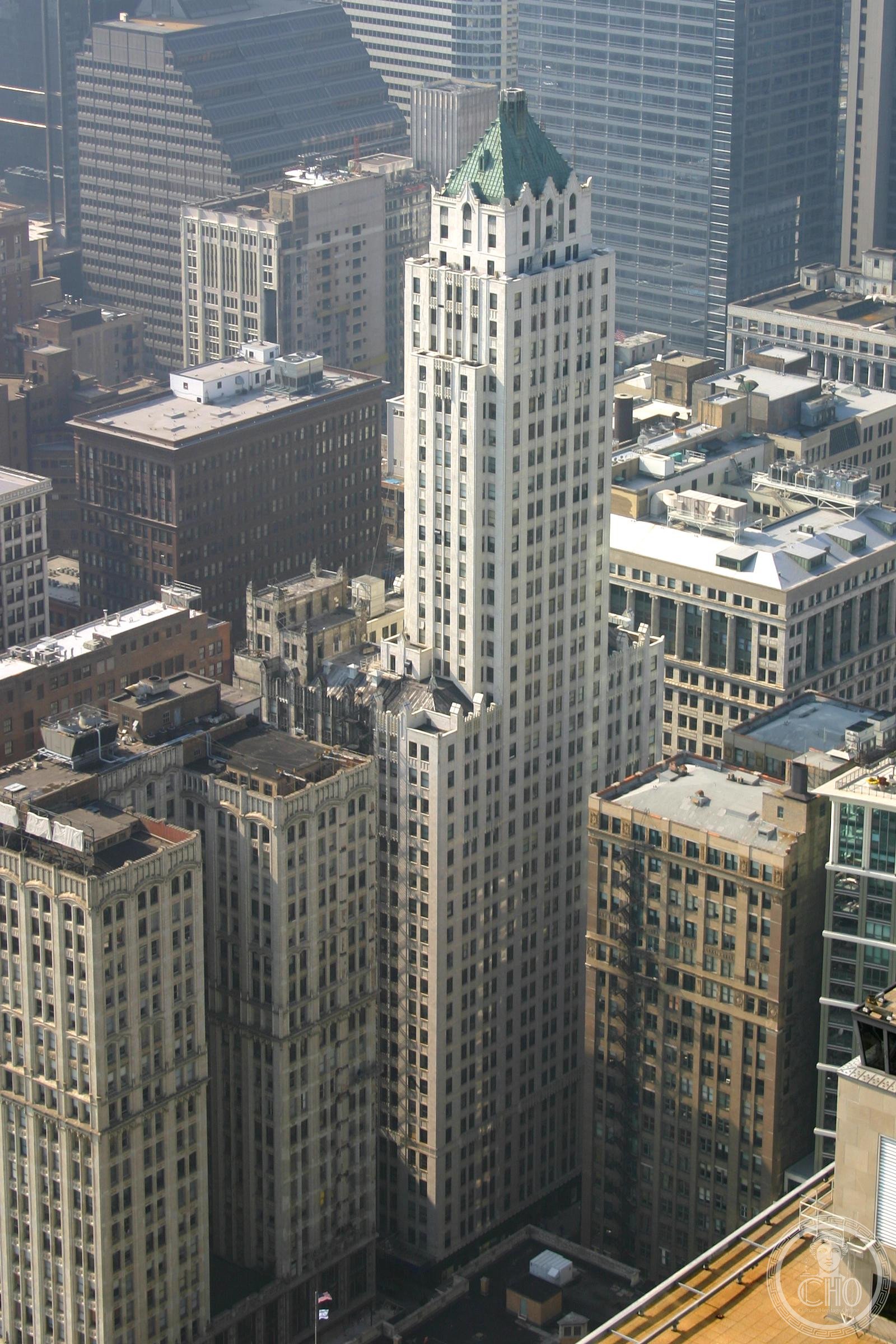

Completed in 1927 at the corner of Washington Street and Wabash Avenue in the Loop, the Pittsfield Building is one of the finest examples of the Gothic-inflected Art Deco skyscraper that Chicago architects developed in the years immediately following the 1922 Chicago Tribune Tower competition — a 38-story tower of carved Bedford limestone whose ornamental crown and rich lobby interior make it one of the most rewarding of the city’s interwar commercial buildings.
At a glance
Standing 492 feet at 55 E Washington Street in the central Loop, the Pittsfield Building was completed in 1927 as one of the first major Chicago skyscrapers to employ the setback design made mandatory by the 1923 Chicago zoning ordinance. The building’s Gothic ornamental vocabulary — pointed arches, carved pinnacles, and tracery panels in Indiana limestone — places it in the tradition of the great hybrid towers that followed the Tribune Tower competition, combining the structural logic of the steel-frame skyscraper with the symbolic prestige of medieval ecclesiastical architecture. The Pittsfield Building’s lobby, with its vaulted ceiling, carved stone, and original bronze fixtures, is one of the best-preserved commercial Gothic interiors in the United States and is publicly accessible during business hours.
Key facts
- Completed: 1927
- Architects: Graham, Anderson, Probst & White
- Style: Gothic / Art Deco
- Address: 55 E Washington St, Chicago, IL 60602
- Height: 38 stories, 492 ft (150 m)
- Notable: One of the first Chicago buildings to use the 1923 zoning setback design; Gothic ornamental programme in Bedford limestone
- Lobby: Vaulted Gothic interior with original bronze fixtures; publicly accessible
- Nearby: Millennium Park, Chicago Cultural Center, Art Institute of Chicago
History
The 1922 Chicago Tribune Tower competition was one of the defining events of American architectural culture in the 20th century. The competition brief asked entrants to design “the most beautiful and distinctive office building in the world,” and the 263 entries it received — from architects in 23 countries — ranged across every style and tendency of the age. The winning entry by Hood & Howells was a Gothic tower with a buttressed crown; Eliel Saarinen’s second-place Modernist tower was more admired by many younger architects. But the competition’s most lasting effect was to establish the Gothic vocabulary as a prestigious choice for tall commercial buildings.
The Pittsfield Building, begun in 1926 and completed in 1927, was among the first Chicago towers to take the competition’s Gothic lesson seriously at a purely commercial scale. The building’s client, the Pittsfield Company, commissioned a tower that would be a prestige address in the central Loop while also responding to the new setback zoning that Chicago had enacted in 1923. The setback design — requiring buildings to step back from the property line as they rose above a certain height — was intended to allow light and air to reach the street; it also produced the distinctive stepped profiles of 1920s and 1930s Chicago towers that are so different from the sheer-walled slabs of the postwar era.
The Pittsfield Building’s Gothic ornamental programme — the carved limestone pinnacles, the pointed arches at the upper windows, the tracery panels and gargoyle-like grotesques at the setback zones — is deployed with particular skill at the transition points between the building’s massing steps, where the setbacks create natural occasions for concentrated ornament. The lobby, entered from both Washington Street and Wabash Avenue, has a vaulted ceiling with Gothic ribs and carved keystones, original bronze elevator surrounds, and an extensive programme of carved limestone in the wall panels. It has been preserved with great care and remains one of the most rewarding commercial interiors accessible to the public in the Loop.
What you see
The Pittsfield Building’s Washington Street facade presents 38 stories of buff Bedford limestone, with the Gothic vocabulary concentrated at three zones: the entrance level, the setback transitions at the upper floors, and the crown. The entrance portals are framed by carved stone surrounds with pointed arches and foliate ornament; the spandrel panels between the windows carry shallow-relief geometric and plant-form ornament in a hybrid Gothic/Art Deco idiom. At the main setback zone — approximately at the 25th floor — a programme of pinnacles, grotesques, and tracery panels marks the transition between the lower shaft and the upper tower; these elements are most visible from the adjacent street intersections and from the elevated Wabash Avenue structure (the “L”), where they appear at roughly eye level.
The lobby interior is the building’s greatest asset. Entering from Washington Street, the visitor passes through bronze doors into a hall whose vaulted ceiling — in plaster with Gothic ribbing and painted infill panels — rises above limestone walls with carved ornamental panels. The original bronze elevator surrounds and the original terrazzo floor with its geometric inlay pattern survive intact. The scale of the lobby — high-ceilinged, relatively narrow, extending the full depth of the building — creates a procession from street to elevator that is architecturally more ambitious than most commercial lobbies of the period. Looking up from the lobby floor to the vault above, the building’s ambition is clear: this is a Gothic cathedral transposed to a commercial programme.
Practical information
- Lobby access: Open during business hours weekdays; free, no ticket required
- Best time: Morning light on the Washington Street facade; lobby any time
- Time needed: 30 minutes lobby + exterior
- GPS: 41.8830° N, 87.6257° W
- Nearest transit: CTA Red/Blue Lines Washington station (2 minutes west); CTA Brown/Purple/Green/Pink/Orange Lines Randolph/Wabash station (2 minutes north)
Getting there
The Pittsfield Building stands at 55 E Washington Street in the Loop, immediately east of State Street and one block from Michigan Avenue. CTA Red and Blue Lines serve Washington station (2 minutes west on foot); the Chicago Cultural Center and Millennium Park are 2 minutes east. O’Hare Airport is approximately 17 miles (27 km) north-west; the Blue Line to Clark/Lake takes approximately 45 minutes.
Nearby
- Chicago Cultural Center (1897) — former Chicago Public Library with magnificent Tiffany glass domes; Michigan and Washington, 2 minutes east; free
- Millennium Park — Cloud Gate, Crown Fountain, Jay Pritzker Pavilion; 2 minutes east on Washington
- Art Institute of Chicago — world-class collection including Seurat, Picasso, Hopper; Michigan Avenue and Adams Street, 5 minutes south
Sources
- Commission on Chicago Landmarks, Pittsfield Building records — chicago.gov
- Chicago Architecture Foundation, Pittsfield Building entry — architecture.org
- Siry, Joseph M. The Chicago Auditorium Building. Context for Loop commercial architecture.
- Willis, Carol. Form Follows Finance: Skyscrapers and Skylines in New York and Chicago. Princeton Architectural Press, 1995.
- Wikidata, Pittsfield Building Q2056267 — wikidata.org
Find it on the map
See this place and what’s around it →📷 Become a Cultural Heritage Online photographer
Share your photos of places: they stay published under your name as the author. The more they're seen, the more you get noticed — and soon a contest will reward the most appreciated photos.
Log in or sign up free to add a photoIs this page about you?
This page is read by travellers and heritage enthusiasts who find it on Google. Tell us how you are connected to this place and we will take it from there.