

Wine and limestone: a medieval town built underground
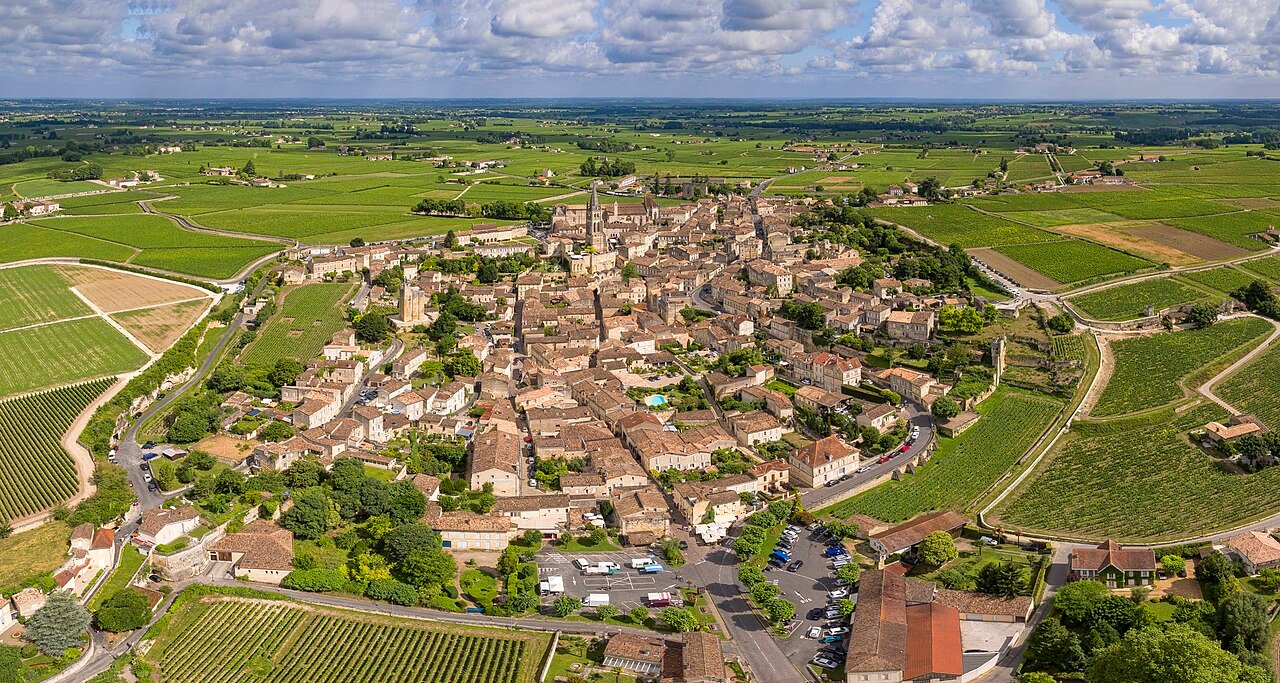
Saint-Émilion occupies a hillside of Jurassic limestone in the Gironde, 40 km east of Bordeaux — and it is as much underground as above it. The entire medieval town rests on a network of catacombs, wine cellars, quarries, and a monolithic church (the Église Monolithe) carved entirely from the living rock between the 9th and 12th centuries. The 11th-century bell tower rises above ground; the church below it — 38 metres long, 20 metres wide, 11 metres tall — was created by removing 15,000 cubic metres of stone from the cliff. It is the largest underground church in Europe and one of the most astonishing spaces in France.
UNESCO inscription: a viticultural landscape in continuous use
Inscribed in 1999, the Jurisdiction of Saint-Émilion was recognised as an outstanding example of a wine-producing region that has maintained cultural continuity from the early medieval period to the present day. The UNESCO inscription covers not just the town but the entire historic jurisdiction — the boundaries of the wine-producing area first defined in the 13th century, which correspond closely to the modern AOC Saint-Émilion appellation. This is the only UNESCO World Heritage property specifically designated for a wine jurisdiction.
The Gallo-Roman and monastic origins of a wine culture
The Latin poet Ausonius, who held estates near here in the 4th century CE and wrote a celebrated poem about the Moselle valley, is sometimes credited with bringing systematic viticulture to the region — the wine Château Ausone, ranked among the finest in Saint-Émilion, perpetuates his name. Monks of the Benedictine and Franciscan orders refined viticultural and winemaking techniques through the medieval period; the Collegial Church of Saint-Émilion (12th century) and the adjacent cloister remain in the town centre.
The Église Monolithe: a cathedral hewn from rock
The most extraordinary monument in Saint-Émilion is the Église Monolithe — a church entirely carved from the limestone cliff between the 9th and 12th centuries. Its three naves, its carved columns, its pointed arches, and its bell tower (which rises above street level) were all created by subtraction: the church is not built but excavated. The interior space, lit by narrow openings in the rock face, has an otherworldly atmosphere that no surface-built church can replicate. Guided tours descend through the catacombs to the ossuary and the hermit’s cell where Saint Émilion himself is said to have lived in the 8th century.
The limestone terroir: what the rock gives the wine
Saint-Émilion’s wine character is inseparable from its geology. The plateau and slopes are composed of calcaire à astéries — a limestone rich in star-shaped echinoderm fossils — that drains rapidly, warms quickly, and forces vine roots deep in search of water and minerals. The resulting wines, dominated by Merlot (with Cabernet Franc as the principal secondary variety), are known for their softness, their aromatic complexity, and their capacity to age. The Saint-Émilion Grand Cru classification, revised periodically by the Bordeaux wine authorities, ranks the properties of the jurisdiction in a hierarchy dating to 1955.
The medieval town: ramparts, wine merchants, and pilgrims
The town itself preserves its medieval street plan within walls first raised in the 13th century. The Place du Marché — the central square carved partly from the cliff — is surrounded by wine merchant cellars, cafes, and the entrance to the Église Monolithe. The Tour du Roy (King’s Tower, 13th century) is the highest point in the town and offers panoramic views over the vineyards. The Chemin de Saint-Jacques — the pilgrimage route to Santiago de Compostela — passes through Saint-Émilion, connecting its religious and commercial heritage.
The jurisdiction today: 800 châteaux in 5,400 hectares
The Jurisdiction of Saint-Émilion produces wine across 5,400 hectares divided among approximately 800 châteaux — most of them family-owned estates of modest size. The range of quality and style is exceptional: from the great classified growths (Château Pétrus, though technically in neighbouring Pomerol, sets the regional price benchmark) to small artisan producers making wine in cave cellars their grandparents quarried. Total annual production exceeds 30 million bottles, making it one of the largest quality wine appellations in France.
Visiting Saint-Émilion
The town is 35 km from Bordeaux by train (25 minutes) or car. The old town is entirely pedestrian and walkable in half a day; guided tours of the Église Monolithe depart from the Office de Tourisme several times daily. Château visits require advance booking — most estates offer tastings and cellar tours year-round. The harvest (September–October) brings the town to its most animated; July–August is peak tourist season but hot. Wine and Patrimoine tours combining the UNESCO site with Bordeaux city and the Médoc are operated by several local agencies.
Find it on the map
See this place and what’s around it →
📷 Become a Cultural Heritage Online photographer
Share your photos of places: they stay published under your name as the author. The more they're seen, the more you get noticed — and soon a contest will reward the most appreciated photos.
Log in or sign up free to add a photo