
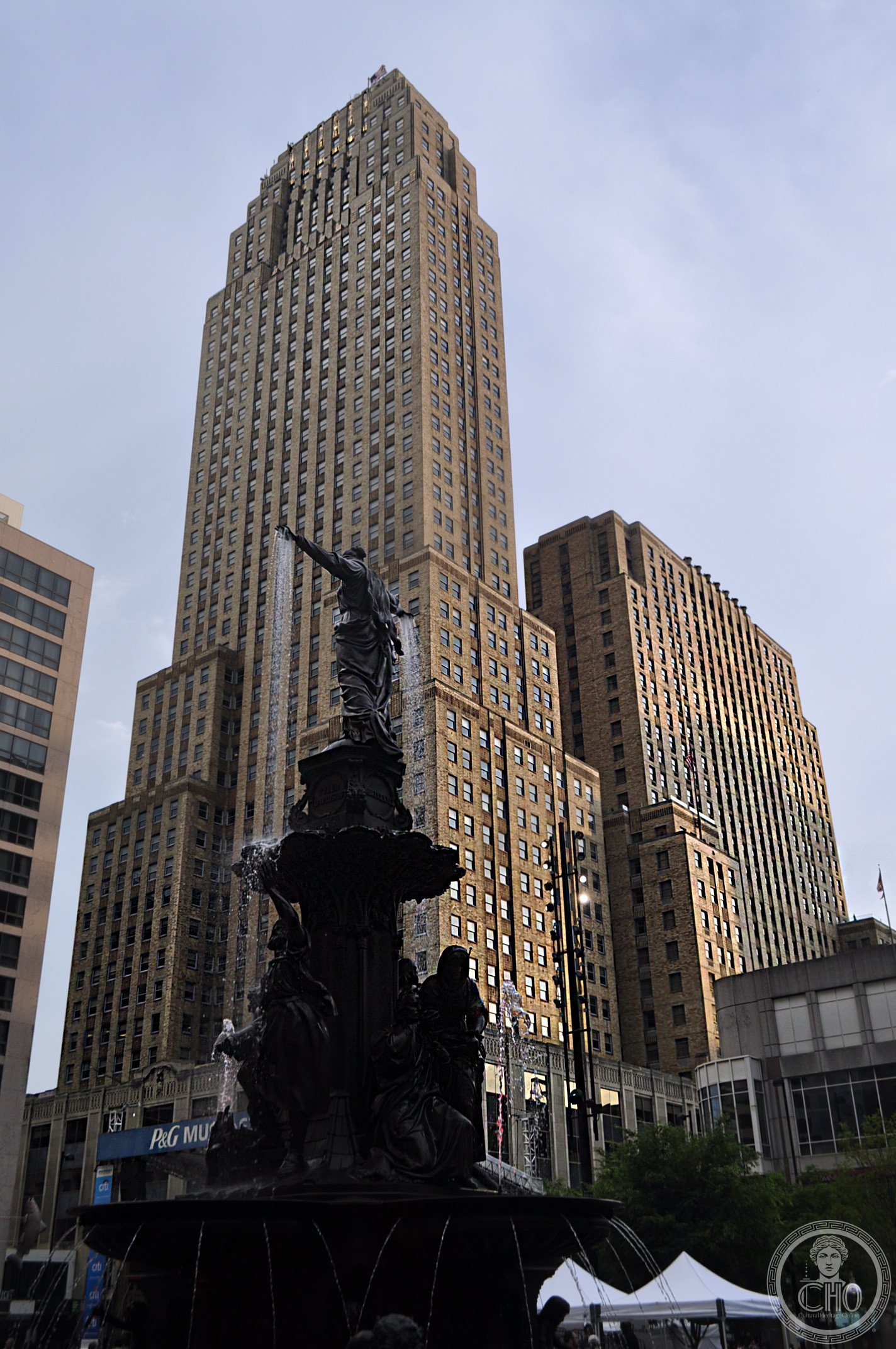

Completed in 1930 at 441 Vine Street, at the corner of Sixth and Vine in the heart of downtown Cincinnati, the Carew Tower is the most prominent element of the Cincinnati skyline — a 49-story Art Deco mixed-use complex whose observation deck offers one of the most commanding urban panoramas in the American midwest, overlooking the Ohio River and the Kentucky hills beyond.
At a glance
Standing 574 feet above downtown Cincinnati at 441 Vine Street, the Carew Tower was designed by Chicago architect Walter W. Ahlschlager in association with New York firm Delano & Aldrich and completed in 1930. It was the tallest building in Cincinnati for decades and remains one of the dominant elements of the city skyline. The building’s original programme combined office space, retail, a hotel (the Hilton Cincinnati Netherland Plaza, whose lobby is a separate Art Deco masterpiece), and a publicly accessible observation deck. The tower is listed on the National Register of Historic Places. Its rooftop observation deck at the 49th floor provides unobstructed views of the Ohio River valley, downtown Cincinnati, and the hills of northern Kentucky.
Key facts
- Completed: 1930
- Architects: Walter W. Ahlschlager (Chicago); Delano & Aldrich (New York)
- Style: Art Deco
- Address: 441 Vine St, Cincinnati, OH 45202
- Height: 49 stories, 574 ft (175 m)
- NRHP: Listed (part of Carew Tower/Netherland Plaza complex)
- Observation deck: 49th floor; ticketed, open daily
- Signature feature: Vertical Art Deco shaft above Fountain Square; Ohio River panorama from observation deck; Hilton Cincinnati Netherland Plaza lobby (separate NRHP landmark) at base
History
The Carew Tower was developed by the Emery Company as a mixed-use commercial complex to anchor the commercial core of Cincinnati at Fifth and Vine Streets. The commission went to Walter W. Ahlschlager, a Chicago architect known for his theatre and hotel work, working in association with the New York firm of Delano & Aldrich. The project combined in a single development an office tower, a hotel (the Netherland Plaza), retail arcades, and a public observation platform — a model borrowed from contemporary New York complexes and applied at Cincinnati scale.
Construction was completed in 1930, on the eve of the Depression, and the tower opened to become the dominant element of the Cincinnati skyline. The Hilton Cincinnati Netherland Plaza, occupying the lower floors of the complex, has a French Art Deco interior of exceptional richness — the Grand Ballroom ceiling, the Hall of Mirrors, and the lobby rotunda are among the finest Art Deco hospitality interiors in the country and are separately listed on the National Register of Historic Places as a National Historic Landmark.
The Carew Tower’s commercial fortunes fluctuated through the mid-twentieth century and into the postwar period as Cincinnati’s downtown lost tenants to suburban development. The complex was eventually restored and the hotel returned to full operation. The observation deck has remained a consistent public amenity, providing Cincinnati residents and visitors with access to one of the best urban panoramas in the midwest: the Ohio River’s great bend, the suspension bridges, and the dramatic terrain of the Kentucky hills visible on the far bank.
What you see
The Carew Tower’s Vine Street facade presents a characteristic late Art Deco composition: the lower floors in a limestone base that merges with the surrounding street wall; the shaft, from approximately the fifth floor upward, in a vertical programme of setback piers and spandrel panels that accelerates the eye upward; the crown, at the 45th to 49th floors, in a stepped pyramid termination with a flagpole mast. The building’s relationship to Fountain Square, directly to the south, gives it a forecourt that no other Cincinnati skyscraper possesses — from the square, the tower appears as the backdrop to Tyler Davidson Fountain (1871) and the urban stage of the square itself.
The observation deck at the 49th floor is an outdoor terrace at 574 feet — a height sufficient to read the complete geography of the Cincinnati basin. The Ohio River’s great northward bend is visible in both directions; the Roebling Suspension Bridge (1866) and the Clay Wade Bailey Bridge cross at the foot of downtown; the hills of Covington and Newport rise on the Kentucky side. On clear days the panorama extends 20–30 miles in all directions. In the evening, the lights of Fountain Square are visible directly below, and the Carew Tower’s crown lights are visible from across the river.
Practical information
- Observation deck: 49th floor; open daily, ticketed (fee varies; check cincinnatiobservatory.org)
- Hilton Netherland Plaza lobby: Free public access; worth visiting separately for Art Deco interior
- Best time: Late afternoon and evening for Ohio River lighting
- Time needed: 45–60 minutes (observation deck + Netherland lobby)
- GPS: 39.1007° N, 84.5132° W
Getting there
The Carew Tower stands at 441 Vine Street at Fountain Square in downtown Cincinnati. Cincinnati/Northern Kentucky International Airport is approximately 12 miles (19 km) south-west; taxi or rideshare to downtown takes 20–25 minutes. Amtrak does not serve Cincinnati.
Nearby
- Cincinnati Art Museum — major collection in Eden Park, 15 minutes east; free general admission
- John A. Roebling Suspension Bridge (1866) — the prototype for the Brooklyn Bridge, 5 minutes south on Vine Street; pedestrian crossing to Covington, KY
- Cincinnati Union Terminal (1933) — Art Deco train station now housing the Cincinnati Museum Center, 10 minutes north-west by streetcar or taxi
Sources
- National Register of Historic Places, Carew Tower/Netherland Plaza nomination — nps.gov
- Cincinnati Preservation Association, Carew Tower records — cincinnatipreservation.org
- Hilton Cincinnati Netherland Plaza, building history — hilton.com
- Emery, Mary M. The Emery Family and Cincinnati Architecture. Various sources.
- Wikidata, Carew Tower Q152129 — wikidata.org
Find it on the map
See this place and what’s around it →📷 Become a Cultural Heritage Online photographer
Share your photos of places: they stay published under your name as the author. The more they're seen, the more you get noticed — and soon a contest will reward the most appreciated photos.
Log in or sign up free to add a photoIs this page about you?
This page is read by travellers and heritage enthusiasts who find it on Google. Tell us how you are connected to this place and we will take it from there.