

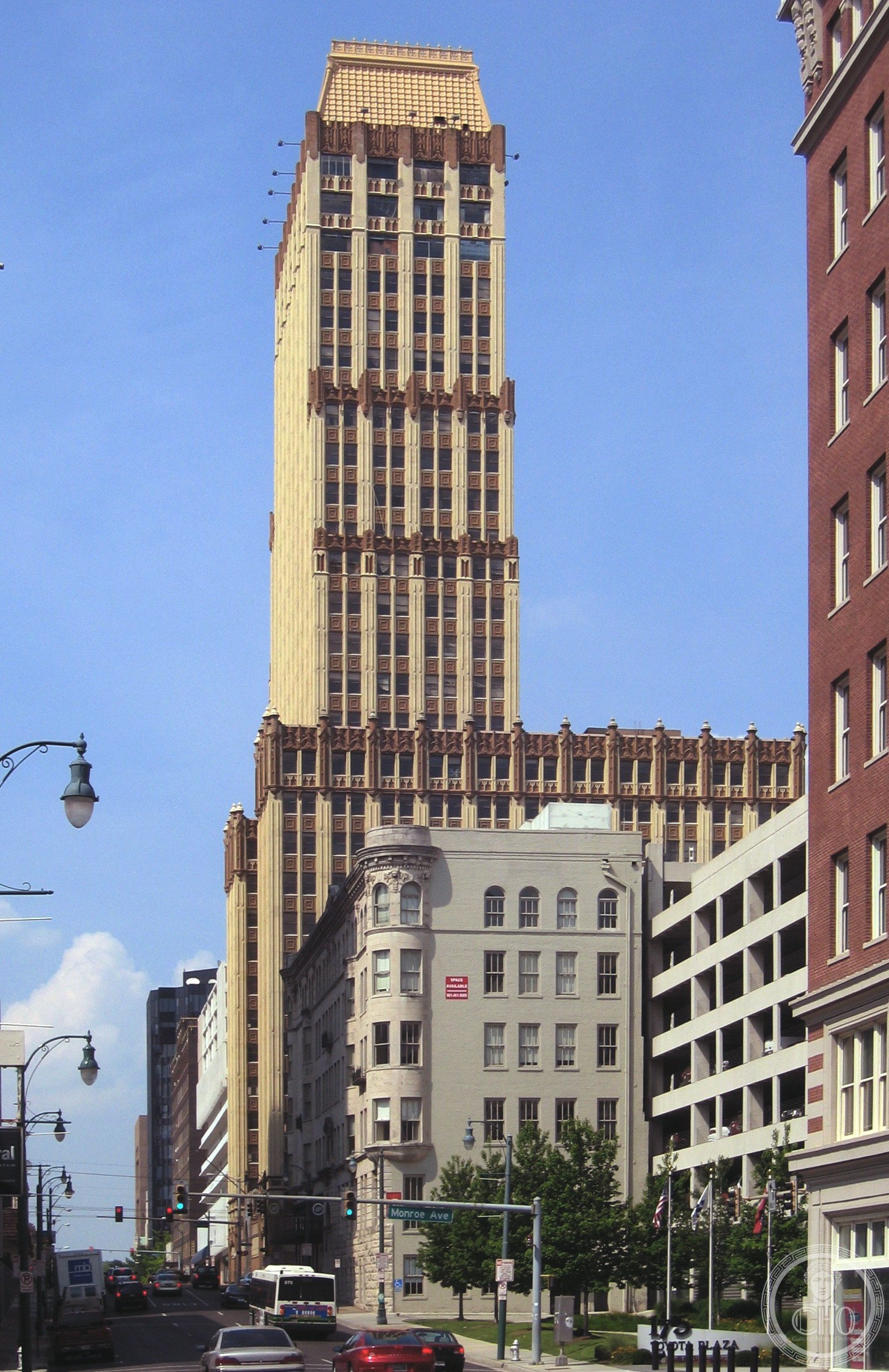

Completed in 1929 at the corner of Madison Avenue and what is now BB King Boulevard, the Sterick Building was the tallest structure in Memphis and the entire mid-South region for more than three decades — its 29-story Gothic-inflected Art Deco tower a landmark of downtown Memphis that has stood vacant since the 1980s, awaiting restoration.
At a glance
Designed by Fort Worth architect Wyatt C. Hedrick and completed in 1929, the Sterick Building was the dominant element of the Memphis skyline from its opening until the 1960s, when taller postwar towers began to appear. The 29-story tower combines Art Deco vertical massing with Gothic ornamental detailing at the crown — a hybrid vocabulary common in American commercial skyscrapers of the late 1920s, which drew on the prestige of Gothic cathedral architecture for its upper-floor ornament while employing the setback and geometric Deco language at the base and shaft. The building is listed on the National Register of Historic Places and is among the most significant underused architectural assets in the American south.
Key facts
- Completed: 1929
- Architect: Wyatt C. Hedrick
- Style: Art Deco with Gothic crown ornament
- Address: 8 S 2nd Street (BB King Blvd & Madison Ave), Memphis, TN 38103
- Height: 29 stories, 365 ft (111 m)
- NRHP: Listed 1979
- Current status: Vacant (since early 1980s); ongoing preservation/redevelopment proposals
- Signature feature: Gothic pinnacles and gargoyles at the crown; terracotta cladding; dominant downtown Memphis silhouette
History
The Sterick Building was developed by a group of Memphis businessmen who engaged Fort Worth architect Wyatt C. Hedrick to design a skyscraper that would be the tallest in the mid-South. Construction began in 1928 and the building was completed in 1929, standing 365 feet and 29 stories above street level. For nearly three decades it was the tallest structure in Memphis and in the entire mid-South region, a visible symbol of the city’s commercial confidence in the years before the Depression.
The building’s Gothic ornamental crown — the gargoyles, pointed finials, and carved stone panels at the upper floors — was a deliberate architectural statement. In the late 1920s, American commercial architects frequently invoked Gothic sources for their crown ornament, positioning their clients’ buildings within a visual tradition of permanent institutional authority. For Memphis, a city whose commercial culture had long been dominated by cotton and timber, the Sterick Building’s Gothic silhouette was both a civic assertion and a competitive gesture toward the more established commercial centres of the northeast.
After decades of continuous office use, the building was vacated in the early 1980s as tenants relocated to newer downtown towers. It has remained empty ever since — a condition that has made it one of the most prominent vacant historic skyscrapers in the United States. Listed on the National Register of Historic Places in 1979, the building has been the subject of numerous redevelopment proposals over the decades, all of which have to date failed to proceed. Its future remains one of the central questions in Memphis’s ongoing conversation about downtown heritage and urban regeneration.
What you see
The Sterick Building’s silhouette on the Memphis skyline is defined by its Gothic crown: the pointed finials, gargoyles, and carved stone ornament at the 28th and 29th floors read, even from a distance, as an ecclesiastical quotation set atop a commercial shaft. The stone and terracotta cladding — in a warm buff tone that has weathered over the decades — covers the facade from street level to crown, with carved Gothic panels at the spandrel zones and vertical piers organising the window bays into a continuous upward rhythm.
At street level, the Madison Avenue elevation presents a stone base with carved entrance surrounds and the original lobby entrance — now closed. The corner treatment at BB King Boulevard and Madison has a distinctive rounded profile that curves the facade at the intersection, giving the building a more dynamic relationship to the street than a simple orthogonal plan would allow. From the elevated vantage of Beale Street, looking north, the Sterick Building’s Gothic crown is visible above the surrounding roofline; from the Mississippi River bridges, it appears on the right side of the downtown silhouette, its pointed pinnacles distinguishing it from the rectangular profiles of the postwar towers.
Practical information
- Access: Exterior only; building vacant and closed to the public. Viewable from street
- Best view: Corner of BB King Blvd and Madison Ave looking up; or from Beale Street looking north for the skyline silhouette
- Time needed: 15 minutes exterior
- GPS: 35.1447° N, 90.0500° W
Getting there
The Sterick Building stands at the corner of BB King Boulevard and Madison Avenue in downtown Memphis, 3 minutes’ walk from Beale Street and 6 minutes from the National Civil Rights Museum. Memphis International Airport is approximately 10 miles (16 km) south-east; the Main Street Trolley streetcar line provides downtown connectivity.
Nearby
- Beale Street — Memphis’s historic blues music district, 3 minutes south
- National Civil Rights Museum — housed in the former Lorraine Motel, site of the 1968 assassination of Martin Luther King Jr., 5 minutes walk south
- Orpheum Theatre (1928) — restored Art Deco vaudeville and movie palace on Main Street at Beale, 3 minutes south-west
Sources
- National Register of Historic Places, Sterick Building nomination (1979) — nps.gov
- Memphis Landmarks Commission, building records — memphistn.gov
- Memphis Heritage, Sterick Building advocacy documentation — memphisheritage.org
- Robinson, Kenneth W. The Sterick Building: Memphis Architecture and Preservation. Various proceedings, Memphis Historic Preservation Commission
- Wikidata, Sterick Building Q1810578 — wikidata.org
Find it on the map
See this place and what’s around it →📷 Become a Cultural Heritage Online photographer
Share your photos of places: they stay published under your name as the author. The more they're seen, the more you get noticed — and soon a contest will reward the most appreciated photos.
Log in or sign up free to add a photoIs this page about you?
This page is read by travellers and heritage enthusiasts who find it on Google. Tell us how you are connected to this place and we will take it from there.