
The eastern pillar of heaven: China’s most sacred mountain
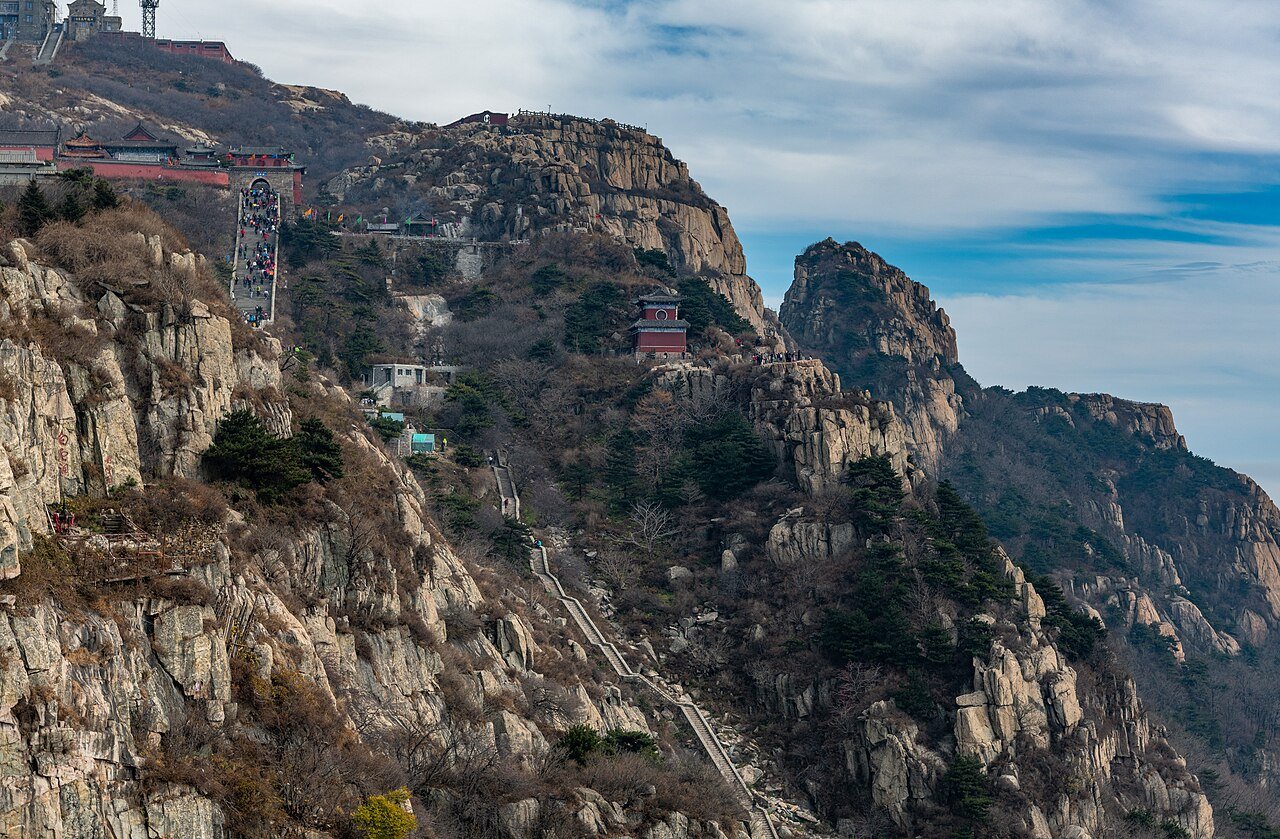
For three thousand years, the mountain known as Tai Shan — Eastern Sacred Peak, Taishan, Mount Tai — has been the most venerated of China’s Five Sacred Mountains, the geological embodiment of the East, the direction of sunrise, of spring, and of life. Seventy-two emperors climbed its 7,200 stone steps to perform the Feng and Shan sacrifices, the supreme imperial ritual of offering to Heaven and Earth. Confucius climbed it and declared: “The world is small.” Mao Zedong climbed it and saw in the sunrise a metaphor for a new China.
UNESCO inscription: the first mixed site in China
Inscribed in 1987, Mount Tai was the first property in China to be listed on the World Heritage List and the first Chinese site to receive “mixed” status — recognised for both its natural beauty and its extraordinary cultural significance. The UNESCO citation describes it as “the embodiment of ancient Chinese civilisations and beliefs and a symbol of ancient art and literature.”
The ascent: 7,200 steps through Chinese history
The traditional ascent from Dai Miao temple in Tai’an city follows a pilgrimage route developed over two millennia. The path — mostly stone steps cut into the mountain — passes through the Archway to Immortality, the Gate of Middle Heaven, and the South Gate to Heaven (Nantian Men), which marks the beginning of the summit zone. Along the route, more than 1,800 inscribed stone tablets and cliff carvings record imperial edicts, philosophical meditations, and devotional graffiti spanning from the Han dynasty to the 20th century.
The summit: temples, sunrises, and an ocean of cloud
The summit (1,545 metres) is crowned by the Temple of the Azure Clouds (Bixia Ci), dedicated to the Goddess of the Azure Clouds who protects women and children — the most important goddess in popular Chinese religious practice. On clear mornings, pilgrims gather at the Sunrise-Viewing Peak before dawn to watch the sun emerge from the Yellow Sea, a spectacle that has been described in Chinese literature for two thousand years.
Confucius and the mountain: philosophy on high
Confucius (551–479 BCE) was born in Qufu, 80 kilometres south of Mount Tai, and is reported to have climbed it repeatedly. His observation — “I climbed the eastern hill and Lu seemed small; I climbed Mount Tai and the world seemed small” — is inscribed on a stele near the summit and has been quoted for 2,500 years as a philosophical aphorism about perspective and ambition. The mountain was central to Confucian cosmology as the place closest to Heaven.
The Feng and Shan sacrifices: imperial religion on the mountain
The imperial Feng sacrifice (offering to Heaven on the summit) and Shan sacrifice (offering to Earth at the foot) were the most solemn rituals in Chinese state religion, performed only by emperors who had brought peace and prosperity to the realm. The first emperor Qin Shi Huang performed them after unifying China in 221 BCE; the last was performed by Emperor Xuanzong of Tang in 726 CE. The 7,200-step ascent, in full imperial procession, was itself a cosmic act.
Natural wonders: ancient pines and granite cathedrals
The mountain’s natural environment — ancient pines growing from granite cliffs, mist-filled valleys, and a distinctive ecology shaped by altitude — is as celebrated as its cultural monuments. The “Five Pines” of the Han dynasty, given official rank by the First Emperor, are now aged over 2,000 years. The mountain’s geology, part of the Precambrian shield of the Shandong craton, is among the oldest exposed bedrock in China.
Visiting Mount Tai today
Mount Tai is reached from Tai’an city, 3 hours by high-speed rail south of Beijing. The traditional ascent on foot takes 4–6 hours; a cable car serves the final section. Accommodation is available at the summit for those wishing to watch the sunrise. The mountain is most spectacular in autumn (October–November) and in spring, when pilgrims and tourists share the stone steps with vendors of incense and red prayer ribbons.
Find it on the map
See this place and what’s around it →📷 Diventa un fotografo di Cultural Heritage Online
Condividi le tue foto dei luoghi: restano pubblicate con la tua firma come autore. Più vengono viste, più ti fai conoscere — e presto un concorso premierà le foto più apprezzate.
Accedi o registrati gratis per aggiungere una foto