
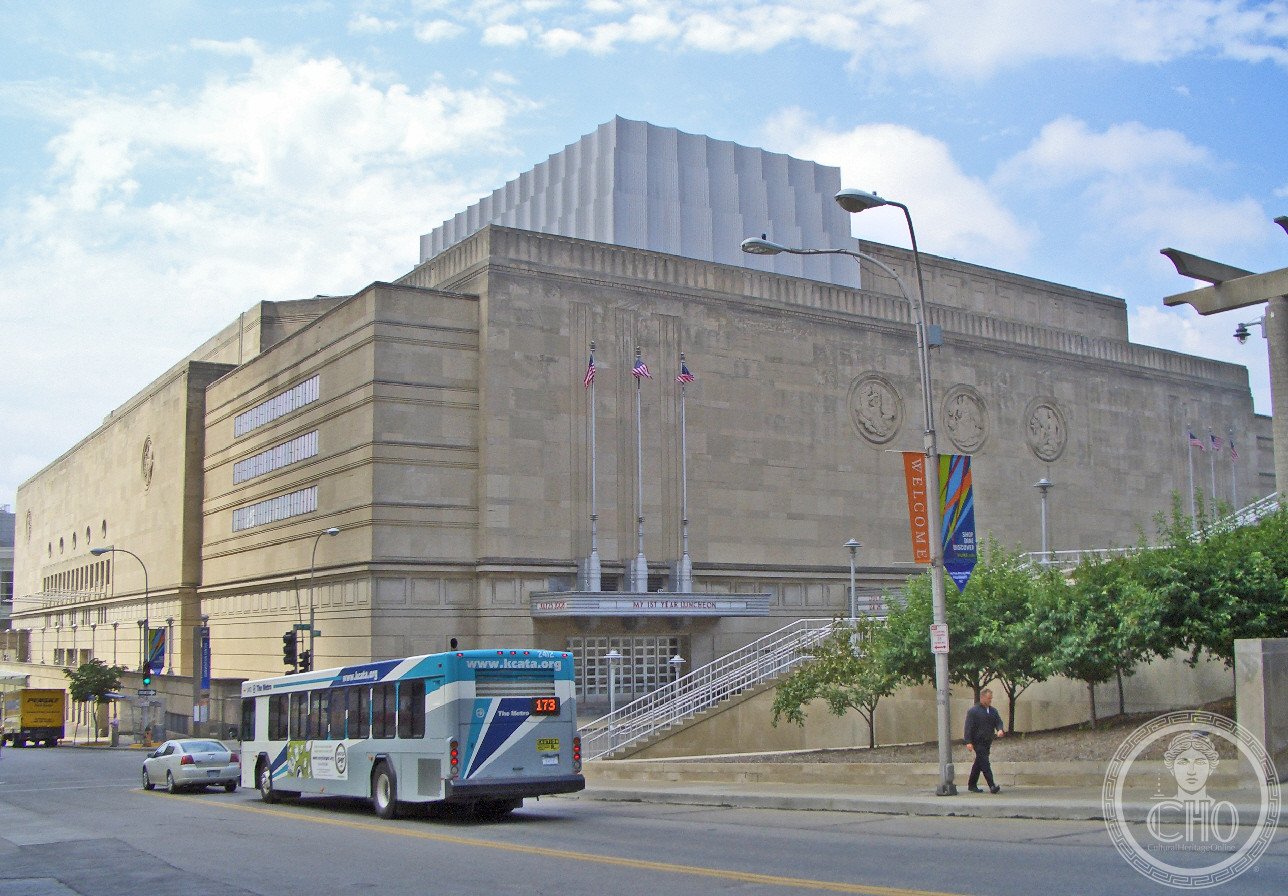

Kansas City Municipal Auditorium
Opened in 1935 with New Deal funding, Kansas City’s Municipal Auditorium is one of the largest and most architecturally ambitious PWA Moderne complexes in the American midwest — a block-wide civic statement of stone, terracotta, and Art Deco ornament that has hosted everything from Democratic National Conventions to NBA basketball.
At a glance
Standing at 301 W 13th Street in downtown Kansas City, Missouri, the Municipal Auditorium was completed in 1935 with support from the Public Works Administration as part of the New Deal’s investment in large-scale civic infrastructure. The complex contains two principal venues: the Music Hall, with approximately 2,400 seats, and the Arena, with capacity for up to 10,000. The facade’s stripped limestone surfaces, geometric ornamental panels, and Art Deco detailing represent the PWA Moderne style at its most confident — public architecture designed to outlast the Depression and assert the permanence of civic institutions. The building is listed on the National Register of Historic Places.
Key facts
- Completed: 1935
- Architects: Gentry, Voskamp & Neville (lead); Hoit, Price & Barnes (associated)
- Style: PWA Moderne / Art Deco
- Address: 301 W 13th Street, Kansas City, MO 64105
- Venues: Music Hall (2,400 seats) + Arena (up to 10,000)
- NRHP: Listed 2007
- Signature feature: Block-wide limestone facade with paired vertical Art Deco towers and geometric ornamental panels
History
Kansas City’s ambition for a large multipurpose civic auditorium predated the Depression, but it was the New Deal’s Public Works Administration funding that made construction financially viable. The PWA programme, launched under Harold Ickes in 1933, directed federal money into large civic building projects that provided employment while producing durable public infrastructure. Kansas City’s application was one of the major municipal projects funded in the programme’s first years, and the resulting building was designed to serve as both a political and cultural venue of the first order.
Completed in 1935, the Municipal Auditorium immediately became one of the most important civic venues between Chicago and the Pacific coast. It hosted major political conventions, sporting events, and performances throughout the mid-twentieth century, including the Big Eight Basketball Tournament and prominent Democratic and Republican party gatherings. The Kansas City Kings NBA franchise used the Arena as a home venue in the early 1970s and again during the 1979–80 season, when Kemper Arena (their primary home since 1974) was closed for repairs after a partial roof collapse. The Kings relocated to Sacramento in 1985.
Listed on the National Register of Historic Places in 2007, the Municipal Auditorium remains in active use. Renovation work has maintained the building’s operational capacity while preserving its PWA Moderne character — the Music Hall and Arena continue to operate under their original names as the centrepiece of the Kansas City Convention Center complex, making it one of the best-maintained large civic Art Deco complexes in the country.
What you see
The Municipal Auditorium occupies a full block along 13th Street, its limestone facade presenting the characteristic PWA Moderne balance of monumental scale and controlled ornament. The principal elevation is organised symmetrically around a central entrance bay, with vertical tower forms at the corners and the flanking surfaces dressed with geometric panels, stylised relief figures, and the lettered inscription that identifies the building as a civic institution. The ornamental vocabulary is distinctly Art Deco — abstracted foliate forms, angular geometric motifs, vertical emphasis — but deployed at a civic scale and sobriety that distinguishes PWA Moderne from the commercial Deco of nearby office towers.
At street level the entrance bays present bronze-framed doors, carved limestone surrounds, and panel reliefs that are among the finest surviving examples of PWA Moderne architectural sculpture in the region. The interior lobbies retain original terrazzo floors and Art Deco plaster ceilings. The Music Hall’s auditorium, behind the main facade, is one of the most complete surviving large-scale Deco theatrical interiors in the midwest — its proscenium arch, side wall relief panels, and ceiling ornament intact from the 1935 opening.
Practical information
- Access: Open for performances; lobby accessible on event days. Tours available by arrangement
- Best time: Exterior any time; interior best experienced during a Music Hall performance
- Time needed: 30 minutes exterior; full performance visit 2–3 hours
- GPS: 39.0984° N, 94.5864° W
- Nearest transit: Main Street MAX; KC Streetcar on Main Street
Getting there
The Municipal Auditorium stands at 301 W 13th Street in downtown Kansas City, a 5-minute walk from the Power & Light Building and 15 minutes from Union Station. Kansas City International Airport connects to downtown by taxi or shuttle in approximately 30–40 minutes. The KC Streetcar’s Main Street line stops near the auditorium and links north to the River Market and south to Union Station.
Nearby
- Kansas City City Hall (1937) — 29-story Art Deco civic tower at 414 E 12th Street, two blocks north-east
- Power & Light Building (1931) — Hoit, Price & Barnes’ Art Deco skyscraper at 14th and Baltimore, two blocks south
- Union Station (1914) — Beaux-Arts rail terminal at 30 W Pershing Road, 10 minutes’ walk south-west
Sources
- National Register of Historic Places, Kansas City Municipal Auditorium nomination (2007) — nps.gov
- Kansas City Public Library, Missouri Valley Special Collections — kclibrary.org
- Public Works Administration, Kansas City project records — National Archives, College Park
- Shortridge, James R. Kansas City and How It Grew, 1822–2011. University Press of Kansas, 2012
- Wikidata, Kansas City Municipal Auditorium Q14704450 — wikidata.org
Find it on the map
See this place and what’s around it →📷 Diventa un fotografo di Cultural Heritage Online
Condividi le tue foto dei luoghi: restano pubblicate con la tua firma come autore. Più vengono viste, più ti fai conoscere — e presto un concorso premierà le foto più apprezzate.
Accedi o registrati gratis per aggiungere una foto